


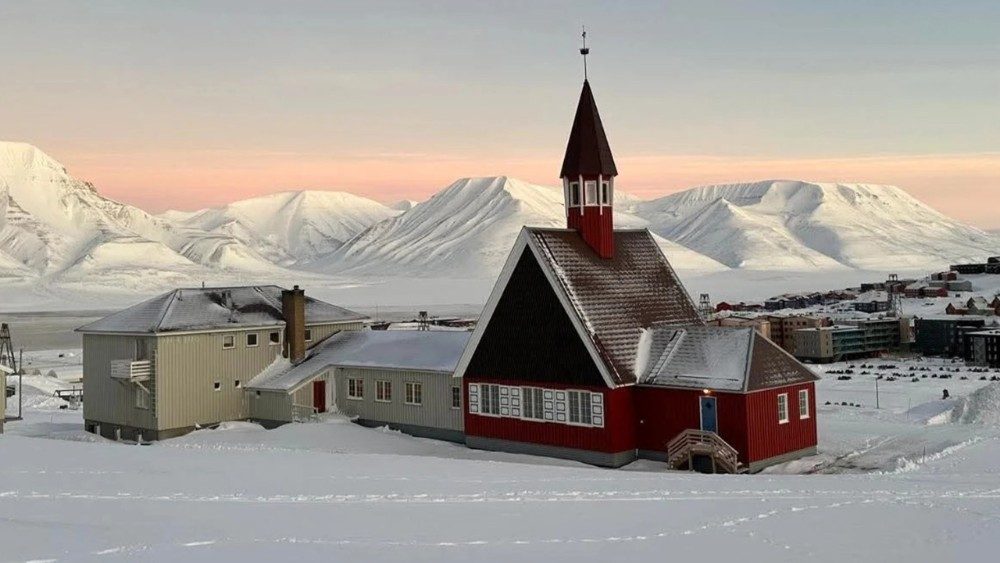
Bishop Erik Varden, Bishop of Trondheim and Apostolic Administrator of Tromsø, presided over a solemn Mass this Sunday, August 30, in Longyearbyen, in the Norwegian archipelago of Svalbard, to commemorate one hundred years since the first Catholic Mass celebrated in these remote Arctic islands.
The celebration took place in the Svalbard church, belonging to the Lutheran Church of Norway, since the archipelago does not have its own Catholic church. Varden was accompanied by Father Andrzej Kosciukiewicz, parish priest of Our Lady of Tromsø; Father Rafal Ockojski, local delegate of the Territorial Prelature of Tromsø; representatives of Caritas and members of the Catholic community of Tromsø. Representatives of the Church of Norway also participated.
The first Mass, in 1926
The first Catholic Mass in Svalbard was celebrated in Longyearbyen on August 4, 1926 by Bishop Johannes Olav Smit, who had traveled to the archipelago to locate the Catholics living in those lands and provide them with pastoral care.
Smit undertook the journey encouraged by Cardinal Willem van Rossum, in Rome. He found no resident Catholics in Longyearbyen or Ny-Ålesund, but upon arriving in Barentsburg he encountered Dutch Catholic workers employed by the mining company Nederlandsche Spitsbergen Compagnie. The workers had written to the Pope requesting spiritual assistance.
On August 8, four days after that first celebration, Smit presided over a pontifical Mass in Barentsburg and administered the sacrament of Confirmation.
Although a permanent Catholic mission was never established in Svalbard, regular celebrations of Mass in Longyearbyen were able to resume in 1986. Priests from Tromsø have also traveled to the Polish scientific station in Hornsund to celebrate the Eucharist and attend to the Catholics present there.
The archipelago’s connection to the structure of the Catholic Church in Norway is even earlier: in 1913, Saint Pius X decreed that Svalbard be integrated ecclesiastically into Norwegian Catholic territory.
Varden: “What we need is a healthy sense of reality”
During the centenary homily, Varden took the extreme Arctic landscape as a starting point to reflect on human vulnerability, loneliness, and humanity’s relationship with reality.
The bishop compared the vastness of Svalbard with the desert sought by the first Christian monks. According to him, those men withdrew into solitude not because they despised others, but to shed illusions and stand before God.
“Encountering oneself means coming face to face with one’s own vulnerability,” he stated.
Varden noted that modern society has often tried to eliminate that vulnerability by trusting in technological progress and in humanity’s ability to control circumstances, while a growing sense of uncertainty persists.
“What we need is not more virtual fantasy; what we need is a healthy sense of reality,” he affirmed.
The bishop pointed out that the archipelago itself, with its changing environment and melting ice, can teach that realism: “If we turn off the iPhone, Svalbard teaches us many essential things.”
The immensity of the Arctic landscape, he added, also reminds man of his smallness before creation and before God.
“If we have eyes to see, we realize how small we are, both in time and in space. If we have ears to hear, this awareness echoes with eternity.”
“We are responsible for one another”
Drawing on the Sunday readings, Varden recalled the words of Saint Paul: “Do not conform to this world, but be transformed by the renewal of your mind.”
He also dwelt on Jesus’ rebuke to Peter after the apostle rejected the announcement of the Passion.
According to Varden, the world’s mentality conveys to man that he is ultimately left to himself and that the strongest will prevail. “God’s thought, on the other hand, and the path He invites us to walk, make us responsible for one another,” he noted.
The bishop therefore called for approaching those who have been isolated by fear, suffering, or loneliness, bringing “the message of reconciliation, healing, and the possibility of friendship.”
Varden concluded the celebration by also looking to the future of the Christian presence in the archipelago.
“In gratitude for the grace God has poured out on Svalbard over one hundred years, we will faithfully assume responsibility for that grace,” he stated.
And he finally resorted to an image linked to the Arctic landscape: “We are called to knock on the door of every frozen cabin, whether it is found in the wild expanses or wherever we ourselves live.”