


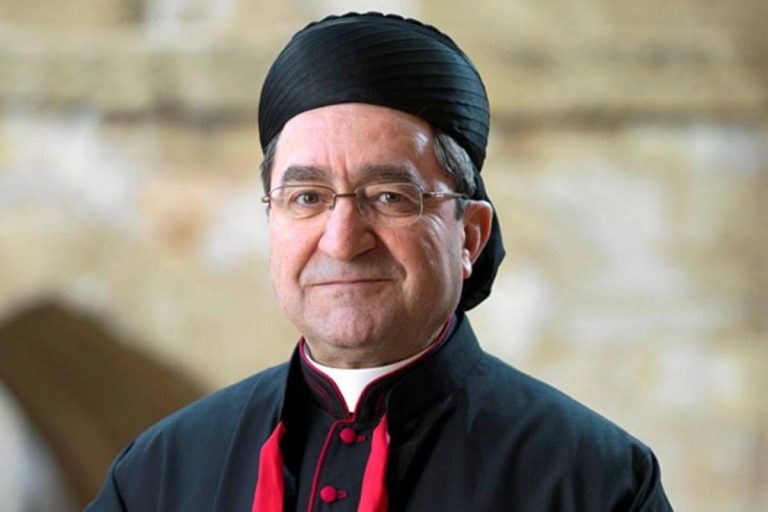
The Maronite bishop of Batroun, Mons. Mounir Khairallah, has warned that Lebanon has become the stage where various powers settle their confrontations and has defended the country’s multi-religious identity against a reading of its situation reduced to the conflict between Israel and Hezbollah.
“For years Lebanon has been paying for other people’s wars: Israel is waging its war in Lebanon, the United States is waging its war in Lebanon, Iran is waging its war in Lebanon. The settling of scores from all over the Middle East takes place in Lebanon,” the eparch stated in an interview given to La Nuova Bussola Quotidiana during the Meeting of Rimini, held in Emilia-Romagna (Italy).
Khairallah took part in the event, which this year dedicated to the land of the cedars the exhibition Lebanon. The beauty, the wounds, the hope. The prelate insisted on presenting the country not only through its wars and divisions, but through a singular coexistence among religious communities that he considers an essential part of its identity and mission.
Lebanon as a “message-country”
The bishop recalled Saint John Paul II’s definition of Lebanon as a “message-country,” an expression the Pontiff used to highlight the value of coexistence among its different religious communities.
“Saint John Paul II already spoke in 1989 of Lebanon as a message-country, recalling the importance of what it represents, that is, coexistence, the ‘conviviality’ of eighteen different confessions,” Khairallah explained.
In his view, it is also a “mission-country” that can show the rest of the world that “living together is possible.”
The prelate recalled that John Paul II formulated this vision when Lebanon was still going through the 1975-1990 war. Khairallah questioned, however, the very characterization of that conflict as a purely civil or confessional war and maintained that foreign forces and interests played a decisive role.
A harsh accusation against Israel
Khairallah was especially critical of Israel and maintained that the Israeli state and the Lebanese model respond to opposing conceptions.
According to the bishop, while Lebanon is structured around an “open, multi-confessional, multicultural and multi-religious” system, Israel would have opted for a model based on a Jewish national identity that, in his view, hinders such coexistence.
The eparch went so far as to claim that “the so-called civil war was carried out by Israel to destroy” the Lebanese model and stated that “the war against this model” has still not ended.
This is the interpretation expressed by Khairallah regarding a conflict in which numerous Lebanese and foreign actors intervened for fifteen years and which included, among other episodes, the Israeli military interventions of 1978 and 1982 and the Syrian presence on Lebanese territory.
The bishop linked his criticism to the approval in 2018 of the Israeli Basic Law on the Nation-State, which defines Israel as the “nation-state of the Jewish people” and reserves the right to national self-determination in the State to the Jewish people.
“The State of Israel does not want peace”
Khairallah went further in analyzing Israeli policy and stated that “the State of Israel does not want peace.”
In his view, fear plays a central role in Israeli society and is used politically by its leaders. The bishop contrasted the current Israeli leadership with the figure of Prime Minister Yitzhak Rabin, assassinated in 1995 by the Jewish extremist Yigal Amir after having promoted the Oslo Accords with the Palestinians.
“Rabin was the only Israeli leader who sincerely desired peace,” Khairallah stated.
In another interview given during the Meeting to the Italian magazine Tempi, the prelate expressly distinguished between the Jewish people and Zionism, just as he rejected identifying Muslims with extremists.
“Free yourselves from hatred, free yourselves from resentment, free yourselves from the desire for revenge. In the name of God, let us build peace together,” he then urged Jews and Muslims.
Israel, the United States and Iran
The bishop placed Lebanon’s current situation within a much broader regional confrontation.
“Israel is waging its war in Lebanon, the United States is waging its war in Lebanon, Iran is waging its war in Lebanon,” he stated.
The country is currently going through a delicate political and military situation marked by negotiations for the Israeli withdrawal from Lebanese territory and by the demand to disarm Hezbollah, a Shiite organization backed by Iran that for decades has maintained a military structure parallel to the Lebanese Armed Forces.
The Lebanese government maintains that weapons must remain exclusively under state control, while Hezbollah resists disarmament and conditions any progress on the Israeli withdrawal. The dispute has once again awakened within the country the fear of new internal confrontations.
Khairallah, however, rejected the idea that the present and future of the country can be explained exclusively through the confrontation between Israel and Hezbollah.
“Hezbollah is only an episode in its history”
“Portraying Lebanon according to the logic of the current conflicts between Israel and Hezbollah is reductionist,” he asserted.
The bishop recalled the historical depth of the country in contrast to the relatively recent appearance of the Shiite militia: “Lebanon is five thousand years old; Hezbollah, a militia born in 1982, is only an episode in its history: just as it was born, tomorrow it will disappear. Lebanon, on the other hand, will not disappear.”
Khairallah therefore called for not presenting the country solely through the wars and violence that have marked its recent history.
“Voice must also be given to the beauty, the richness, the greatness of the country,” he stated. “The Lebanese people are a beautiful, hospitable, generous people, driven by the desire to live with dignity to continue fighting.”