


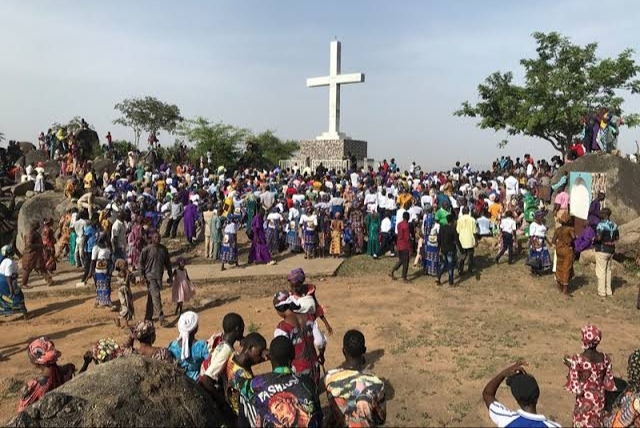
Nigerian priest Atta Barkindo, executive director of the Kukah Centre, has denounced that the persecution of Christians in Nigeria is not limited to killings and attacks carried out by jihadist groups, but also includes «structural discrimination» that particularly affects the faithful in the north of the country.
Barkindo, who has just joined the team of experts tasked with drafting Nigeria’s new National Peace Framework, maintains that there are areas where Christians face obstacles to building churches, accessing public employment, or exercising certain rights on equal terms with Muslims.
«For me, the second level—the subtle and structural discrimination—is where the real persecution of Christians lies,» he stated in an interview with Catholic World Report.
Two levels of persecution
The priest distinguishes between two forms of persecution.
The first is physical violence carried out by terrorist organizations that defend extremist interpretations of Sunni Islam and attack both Christians and Muslims who reject their ideology.
The second, according to Barkindo, is less visible but deeply rooted in certain social and administrative structures in northern Nigeria.
«There are places where building a church is not allowed,» he states. The priest specifically cites the states of Katsina and Sokoto, in the north of the country, and claims there are restrictions on the use of land acquired to build Christian temples.
Barkindo also denounces that Christians suffer discrimination in access to public administration, that forced conversions occur, and that in certain places a Christian cannot access certain traditional leadership positions.
«There is no equality of citizenship; your rights are determined entirely by your religion,» he maintains.
The priest also states that even in some federally funded universities, Christians face difficulties in obtaining land for the construction of churches.
«This is where the real discrimination lies»
Barkindo links this situation to Nigeria’s historical structure and the system implemented during British colonial rule.
Before independence in 1960, he recalls, the north was organized around Islamic institutions such as the Sokoto Caliphate and the Kanem-Bornu Empire. The British colonial authorities governed that area through an indirect system that preserved some Islamic political, educational, and legal structures.
After independence, some of those elements remained within the new state.
Barkindo believes this historical legacy contributed to generating inequality that still affects relations between Christians and Muslims.
Among the examples he mentions is also marriage. According to him, in certain northern states a Muslim man can marry a Christian woman, while a Christian who wants to marry a Muslim woman faces the requirement of converting to Islam.
«These things are happening as we speak,» he assures.
Criticism of the use of public funds for Islamic activities
The priest also criticizes that some state governments directly fund Muslim religious activities despite Nigeria’s constitutionally secular character.
Barkindo cites as an example the funding of collective Muslim weddings by the Kano state government and the use of large amounts of public money to finance pilgrimages to Mecca.
In his view, those resources should be allocated to public services such as hospitals, roads, and schools.
«They are being used to promote religious activities in a country that, according to its Constitution, should be secular,» he laments.
The new National Peace Framework
Barkindo’s statements come after his incorporation into the Expert Review Team tasked with drafting the National Peace Framework promoted by Nigeria’s Office of the National Security Adviser.
The priest directs the Kukah Centre, an institute founded by Bishop Matthew Hassan Kukah, Bishop of Sokoto, dedicated to research and projects on peace, democracy, and interreligious dialogue.
The expert team was constituted at the beginning of August with the objective of reviewing existing peace initiatives and developing a common framework capable of addressing both traditional threats and new factors of instability.
Barkindo believes that for years the Nigerian government has concentrated its resources on military responses while peace-building initiatives have remained mainly in the hands of civil organizations and local communities.
«The government has realized that it doesn’t even have a peace policy,» he stated.
The new framework aims to coordinate conflict prevention, reconciliation, and coexistence initiatives and establish mechanisms to oversee public institutions responsible for these policies.
«We die as Christians and Muslims, not as Nigerians»
Barkindo believes that religious and ethnic fragmentation constitutes an even greater threat than some forms of armed violence.
«In Nigeria, we do not see ourselves primarily as citizens of this country. We see ourselves through a tribal, political, or religious lens,» he points out.
The priest summarizes this fracture with an expression that, he says, circulates commonly in the country: «We die in Nigeria as Christians and Muslims, not as Nigerians.»
In his view, building a common national identity is essential to confront violence, especially ahead of the presidential elections scheduled for 2027.
Barkindo warns that Nigerian politics remains deeply divided along ethnic, religious, and regional lines and believes that no exclusively military strategy can solve the problem.
Education against extremism
The priest also identifies the lack of schooling as one of the main factors fueling extremist recruitment in the north.
Barkindo particularly points to the situation of the almajiris, minors who receive traditional Islamic education and who in many cases remain outside the formal education system and survive by begging.
«For decades, the generation that rejected education has now become cannon fodder for terrorism,» he warns.
His proposal for the National Peace Framework includes making modern education mandatory throughout the country, for both boys and girls, without presenting it as incompatible with religious training.
Barkindo also speaks from his own experience. Born in Adamawa state, he explains that his parents were Muslims and converted to Catholicism so he could attend school.
«If I hadn’t gone to school, up to the University of London, I probably could have become a terrorist myself. Who knows?» he states.
For the priest, Nigeria will not be able to overcome insecurity through military operations alone. The solution lies in simultaneously addressing religious discrimination, institutional corruption, lack of education, and a national identity still subordinated, in too many cases, to religion and tribal affiliation.