


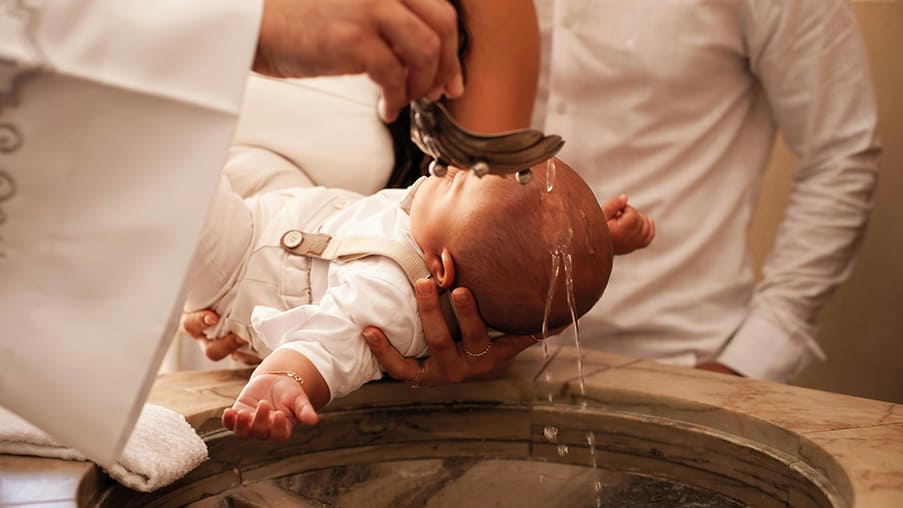
Ireland has recorded a 30% drop in the number of Catholic baptisms over the last decade. The decline is significantly greater than that of births and reflects, in addition to the demographic crisis, the progressive loss of Catholic identification in a country where seven out of ten inhabitants still declare themselves members of the Church.
This is reflected in the new report Baptism trends in Ireland, published on August 18 by the Iona Institute. Its authors calculate that around 60% of the reduction in baptisms between 2015 and 2025 can be explained by the decline in birth rates. The remaining 40% points mainly to another phenomenon: fewer parents identify as Catholic and, therefore, fewer children receive baptism.
Fewer births do not explain the entire decline
The difference between both trends is significant. While baptisms decreased by approximately 30% in a decade, births in the Republic of Ireland fell by 17.9%.
“In a way, the figures are not surprising given the rapid decline in the number of births and increasing secularization,” explains Tom Finegan, president of the Iona Institute. “Given that births have fallen by almost a fifth in the last ten years and more people are ticking the ‘no religion’ box in the census, we could not expect anything other than a large drop in baptism figures.”
The change can also be observed in the official data from the 2022 census. In 2016, just over 79% of the population of the Republic of Ireland identified as Catholic. Six years later, the percentage had dropped to 69%.
Conversely, the number of people declaring no religion reached 736,210 in 2022, 63% more than six years earlier.
The trend is even more pronounced among children. 65.4% of children aged 0 to 4 were registered as Catholic in 2022, while 15.6% had no religion and another 10.5% belonged to denominations other than Catholic.
Dublin loses almost 6,300 baptisms in a decade
The Archdiocese of Dublin offers one of the clearest examples. In 2015, 15,759 baptisms were celebrated; in 2025 there were 9,465. In a decade, 6,294 baptisms have been lost, almost 40%.
The birth rate in the capital has also decreased, but in a much smaller proportion: 21.9% during the same period.
The report links this difference to the greater degree of secularization in Dublin. According to data from Ireland’s Central Statistics Office, around 59% of the capital’s population declared themselves Catholic in 2022, compared to 69% for the Republic as a whole.
The Diocese of Meath recorded an even slightly higher percentage decline, of 40.8%: from 4,675 baptisms in 2015 to 2,768 in 2025.
Elphin, in western Ireland, is the exception. It is the only diocese analyzed where the number of baptisms increased during the decade, although by just 0.9%.
Families who identify as Catholic continue to baptize the majority of their children
However, the report introduces an important nuance. The overall decline in baptisms does not appear to be primarily due to parents who continue to consider themselves Catholic having stopped taking their children to receive the sacrament.
In the 2022 census, 65.4% of children aged 0 to 4 were registered as Catholic. The Iona Institute compares this figure with the proportion of women of childbearing age who identified as Catholic and finds very similar percentages.
Based on these data, the authors consider that the “vast majority” of parents who still identify as Catholic continue to baptize their children.
This data allows us to distinguish between two different phenomena. On the one hand, the number of potential baptisms is reduced because fewer children are born. On the other, the number of families who identify as Catholic is decreasing. Within the latter, however, baptism continues to be widely practiced.
The report considers that this continuity allows us to qualify the extent of distancing from the Church among part of Irish society. “No one who is very anti-Catholic would baptize their child,” its authors point out.
Finegan warns, however, that it “remains to be seen” whether this continuity of baptism among those who maintain a Catholic connection will continue to be a significant reality in Ireland.