


The story usually charges dearly for discernment. To know whether one was with Athanasius or with Arius one had to stake one’s soul on a vowel: homoousios, homoiousios, an iota of difference, and in that iota lay the divinity of Christ. To take sides in the Eastern schism one had to have a formed opinion on the procession of the Holy Spirit, which is not table-talk. The De auxiliis quarrel demanded mastery of efficacious grace; Jansenius, having read Augustine entire. To be Catholic in times of crisis was almost always a difficult examination. For us, by contrast, they have made it easy. Insultingly easy.
Because it is worth saying once and for all what this war is about, since it is not about what the others were. No proposition is disputed, nor a formula, nor the exegesis of a council. What is disputed is the rite with which the Church has prayed since there is written memory of her prayer: the canon that Gregory the Great already recited, the missal with which the saints now on the altars were buried and the sinners we hope to find in their shadow. That, which stood at the center of Catholic life until the day before yesterday, so to speak, is today the only thing that requires permission, dispensation, vigilance and suspicion. And what is unheard-of is not the restriction, but its logic: no one is asked to affirm anything; one is asked to renounce. If possible in public, and with a record.
The Tokugawa officials devised in seventeenth-century Japan a method of perfect efficacy for detecting Christians: the fumi-e, a bronze plate with the image of Christ that the suspect had to step on. No speech was demanded, nor a reasoned retraction, nor a theological dispute: the gesture was demanded. Whoever stepped on it went free. The liturgical war has reached that degree of technical refinement. No one is now required to deny the Filioque or to subscribe to theses on grace: one is required to step on one’s mother’s missal on the day of one’s daughter’s burial. It is quite satanic, isn’t it.
And the mechanism works with a precision that betrays its nature. Almost everything fits in the contemporary Church: masses with screens and animators fit, homilies that are rallies fit, churches lent for whatever comes along fit; none of that has ever triggered an alarm in a dicastery. Only one thing sets the device off with clockwork punctuality: the 1962 missal. And the device does not stop at anything, because it has reached weddings and it has reached funerals, which are the two moments when the Church, for twenty centuries, granted almost everything to almost anyone. There are Catholics who have said farewell to their dead without the prayers with which their dead prayed: without the Requiem aeternam repeated like a heartbeat, without the Dies irae, which is the only funerary text of the West that neither flatters the dead nor lies to the living, without the In paradisum with which the Church handed kings and laborers to the angels without asking anyone about their liturgical sensibility. Twenty-five centuries the West has known that here lies the frontier of the sacred: the first tragedy of our political literature does not deal with taxes or borders, it deals with a burial. Antigone does not discuss theology; she buries her brother against the decree, invoking those unwritten laws that are not of today or yesterday, but of always. Creon, at least, alleged the security of the city. Here a motu proprio is alleged.
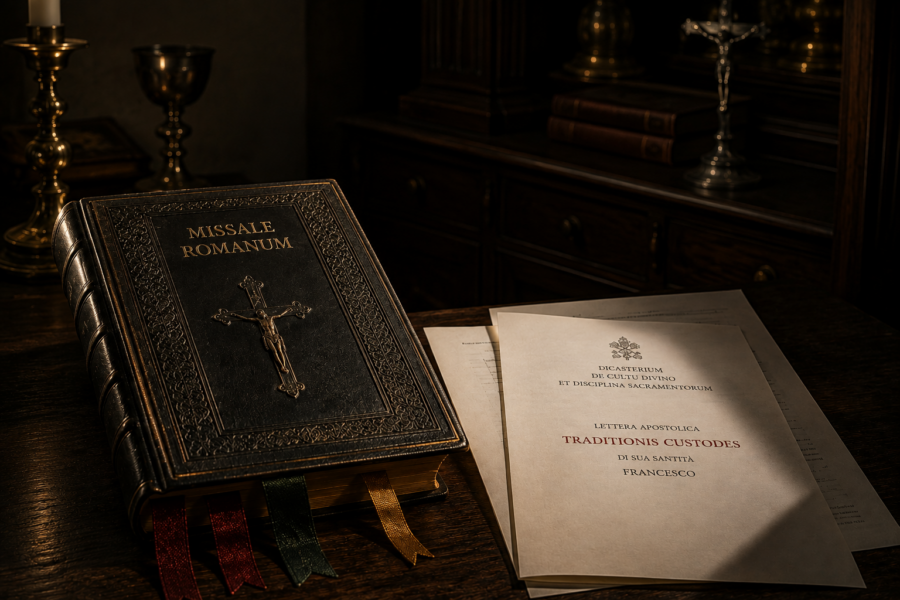
Traditionis custodes, the law is called, which is a name with the vocation of an alibi: the custodians of tradition, consecrated to guarding it from the faithful. The prefect of the branch has just assured that nothing is going to change, that there will be no turning back. His frankness is appreciated: the oracles of Thebes also spoke plainly.
And here one must measure one’s words, because there is one that burns. It was written, however, by Paul VI, precisely the pope of the new missal, when he acknowledged in 1972 that through some fissure the smoke of Satan had entered the temple of God. One limits oneself to philology: diábolos means in Greek “the one who divides,” and also “the one who accuses.” An ecclesial device whose verifiable fruit consists in dividing the faithful from the prayers of their dead and in treating as suspect the one who prays as the saints prayed has had its name since before Christianity. By their fruits you will know them, said Someone with more authority than all the dicasteries together.
I said at the beginning that they have made it easy for us, and that is the only gratitude possible. Arius demanded metaphysics; the East, trinitarian theology; Jansenius, erudition. This only demands eyes. When, to discern the spirit of a law, it suffices to look at what it does with a coffin, history has renounced subtlety. It was never so cheap to know which side to be on.
Meanwhile, the liturgy that admits no reform continues to be celebrated where the dicasteries do not reach. In paradisum deducant te angeli. It is the only rite they can no longer forbid our dead.