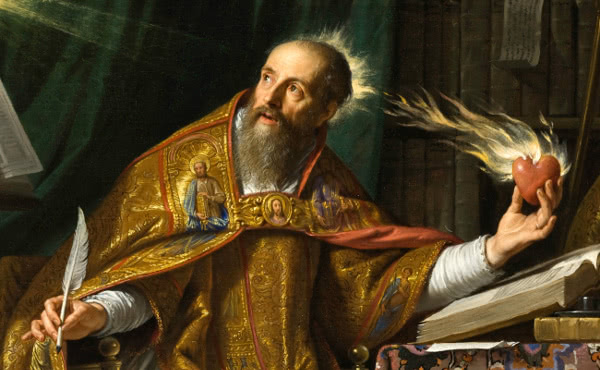
About to turn nineteen, he was the top student in his class at the rhetoric school in Carthage. Ambitious, brilliant, a bit pedantic—he himself admits it: “he took pleasure in vanity and pedantry.” His plan was clear: to sell his words well, reap laurels, make money. Then, as part of the academic program, a book by a certain Cicero fell into his hands, the Hortensius. It was not great literature, nor did it pretend to be; it was an exhortation to philosophy. But that reading, he writes, “changed my emotional world, my plans, and my desires.” Suddenly, the expectations of his frivolity lost credibility, and he began to desire wisdom “with incredible ardor.” A book, at the beginning of a course, twisted his entire life.
That student’s name was Augustine, and he would become one of the men who have weighed most heavily in the history of the West. So much so that Roger-Pol Droit could title an editorial in Le Monde with just two words: “Name: Augustine; nickname: the West.” He was born in 354 in Roman North Africa and died on August 28, 430—hence his feast day—while the Vandals were besieging Hippo, the city of which he was bishop. He witnessed the collapse of an empire that believed itself eternal, and amid the ruins, he kept writing.
But before becoming a saint, he was a restless man. He sought happiness in pleasure and did not find it: “With his friends he had thrown himself into the arms of Mediterranean hedonism, but he was not happy.” He also sought it in ambition, in sects and philosophies, in loves he confesses without adornment. Nothing was enough for him. All that story fits into the line that opens the Confessions and sums up his entire life: “You have made us for yourself, O Lord, and our heart is restless until it rests in you.”
Rest came in a garden in Milan, and again through a book. Augustine hears a child’s voice repeating “Tolle lege”—take and read. He opens the letter of Saint Paul at random, and something breaks inside him. Years later he would write what may be the most beautiful confession of love in literature: “Late have I loved you, beauty so ancient and so new, late have I loved you!” It is not the voice of someone renouncing life, but of someone who has finally found it.
What makes him enduring is that Augustine does not give lessons: he searches himself out loud, and his question has not aged. “And what is it that I love when I love you?” he writes, and questions the sea, the sky, the stars. An extraordinarily intelligent man on his knees before his own desire. That is why he was read, and continued to be read, by Petrarch and Saint Teresa, Pascal and Montaigne, Kierkegaard and Simone Weil.
The end of summer has something of a threshold. The days grow shorter, the schedule returns, the academic year begins, the working year, and also the inner one. It is the time of good resolutions that rarely survive September. And few better companions for that transition than a man who tried everything before finding himself, and who had the honesty to tell it.
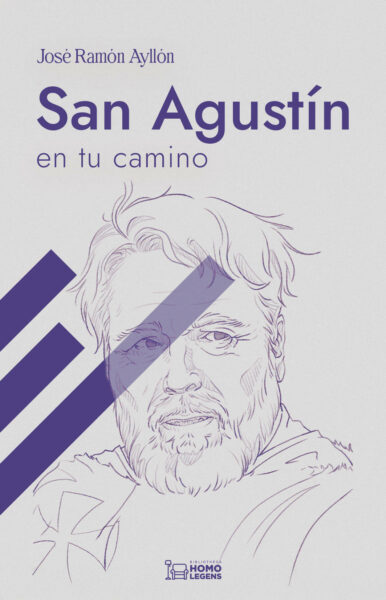
Bibliotheca Homo Legens approaches that figure with Saint Augustine on Your Path, with a selection of texts and an introduction by José Ramón Ayllón. The second title in the collection that opened with Seneca on Your Path, it arranges the Confessions like a life—from childhood to the garden in Milan—and lets Augustine speak in the first person, without scholarly apparatus, in brief fragments that invite one to pause. The kind of reading that helps cross the threshold with depth rather than haste. And, who knows, perhaps a book will twist our course as one twisted his.