


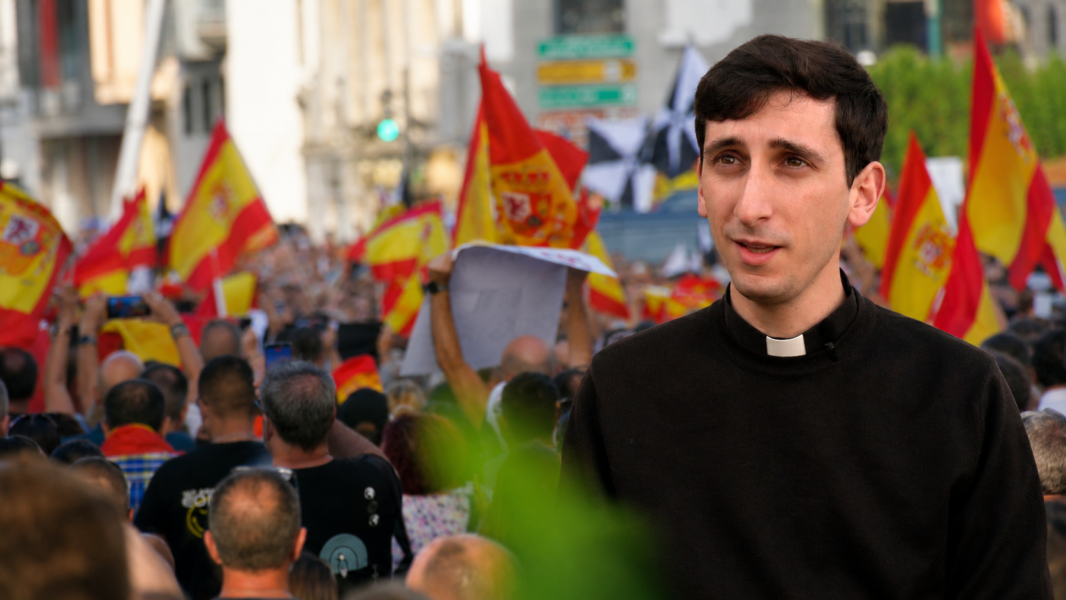
Priest Jesús Francisco Molina, parochial vicar of the Sanctuary of Santa María de África in Ceuta, has recalled that the Church “is not an NGO” and has defended that, given limited resources, charity also requires a hierarchy in its distribution. “One attends first to one’s neighbor, who is the nearest, the one beside you, the Ceutan, before the one who is not,” he stated when asked about assistance to the migrants remaining in Ceuta.
The remarks come after several days of tension in the autonomous city over the presence of thousands of migrants who entered from Morocco at the end of July. This Thursday, hundreds of residents blocked a Red Cross truck for more than two hours to prevent it from delivering food to the migrants camped on Trampolín beach, arguing that maintaining assistance encourages them to stay in the city. Police eventually intervened to allow the distribution, and hours later new incidents occurred when groups of protesters went to several settlements.
“First of all, it must be said that the Church is not an NGO,” the priest replied, before clarifying that caring for the needy is one of its main tasks, but does not constitute its primary mission.
“The Church’s main function is not to attend to the needy; it is certainly one of the principal ones, but the Church exists to attend to its people in the supernatural needs it must administer: the sacraments, preaching, the sustenance of the people of God,” he explained.
“It does not have sufficient resources to help those who have entered”
Molina made clear that this priority does not mean abandoning those who need assistance. “Of course, if it is within our power to help the needy, we will do so,” he affirmed, before pointing out the limits of available resources in the current situation.
“In the situation we are in, naturally the resources we have are not sufficient—not only the Church, but Ceuta itself; and the Church, as part of Ceuta, does not have sufficient resources to help those who have entered.”
The priest also recalled that the city’s welfare needs predate the migration crisis: “We also had poor people here before to attend to, and our resources were already limited for that.”
“It is charity that demands this hierarchy”
Addressing how to distribute the available aid, Molina explicitly appealed to the order of charity and rejected the idea that attention to the newly arrived should come at the expense of withdrawing resources from people in need in Ceuta.
“If, in addition, we have to take away from our own poor, from our own needy people, the resources we already possess, we find ourselves in a much more complicated situation,” he explained.
The priest concluded his reasoning with the statement that summarizes his position: “It is charity that demands this hierarchy. One attends first to one’s neighbor, who is the nearest, the one beside you, the Ceutan, before the one who is not.”
The local Church institutions have participated from the outset of the crisis in assisting the migrants. Parishes, Caritas and other ecclesial entities have collaborated in meeting the needs arising after the entries from Morocco.
From Physics and Piano to the priesthood
Jesús Francisco Molina was born in San Fernando (Andalusia) in 1998 and was ordained a priest of the diocese of Cádiz and Ceuta on 30 September 2023, at the age of 25, becoming at that time the youngest presbyter in the diocese.
Before entering the seminary he had planned to study Physics at the University of Seville. A gifted student, he began studying Piano at the age of four. His interest in the organ of Cádiz Cathedral eventually brought him into contact with seminarians and with Father Andrés Muñoz, who became his confessor.
In an interview given to Diario de Cádiz on the occasion of his ordination, Molina identified the decisive moment of his vocation as 25 February 2016, when he was still a teenager and already in the process of discernment. During a Mass, he recounted, “I perceived very clearly that saying yes to the priesthood was in reality the absolute act of freedom I could make in my life.”
He eventually entered the Diocesan Seminary and during his eight years of formation continued to play the organ of the Cathedral. “It seems strange to make such a great commitment at such a young age,” he acknowledged before his ordination, but added: “Now is when one has so much to offer, has a whole life ahead to give. One must be generous, in this case with the love of God.”