


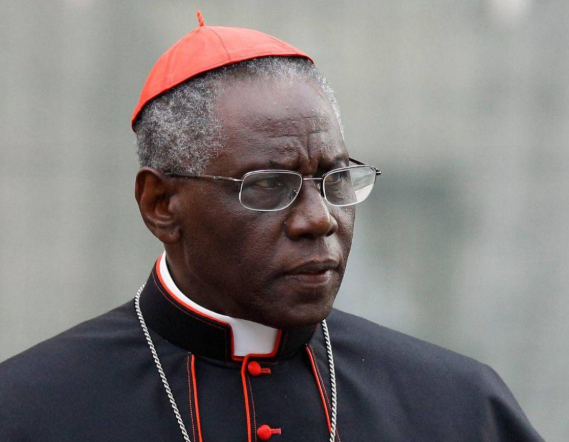
Cardinal Robert Sarah attributes to certain ecclesial circles marked by the “generation of ’68” the aversion to Latin and Gregorian chant. “When the generation of ’68 passes, these unfounded unilateralisms that mortify the cultural stature of Latin Catholicism will also pass,” states the prefect emeritus of the Congregation for Divine Worship in an interview published this Thursday, August 27, by Il Giornale.
The conversation, held on the occasion of the publication of Il Cantico dell’Agnello. Musica sacra e liturgia celeste, his new book written together with Peter Carter, also addresses the Traditional Mass and the restrictions imposed by Traditionis custodes. Sarah considers Francis’s decision “neither wise nor respectful,” claims the fruits of Benedict XVI’s liturgical opening, and gathers the testimony of priests for whom knowing the traditional liturgy has helped them “to celebrate better.”
The “generation of ’68” and the rejection of Latin and Gregorian chant
Il Giornale asks the cardinal whether there is an aversion to Latin and Gregorian chant in some sectors of the Church. The response places the problem in certain cultural circles and, especially, in a generational issue.
“It seems to me an aversion of some self-referential cultural circles, more psychological than truly founded, and I think it is solely a generational problem: when the generation of ’68 passes, these unfounded unilateralisms that mortify the cultural stature of Latin Catholicism will also pass.”
The question occupies a central place in Il Cantico dell’Agnello, dedicated to sacred music and the liturgy. In the work, published by Cantagalli, Sarah and Carter trace the Church’s musical tradition and reflect on the place that sacred music holds within Catholic worship.
The reference to 1968 reappears later in the interview, this time when speaking of the faithful attached to the Traditional Mass. Faced with a reading of the liturgical question conditioned by debates from more than half a century ago, he calls for attention to the present reality.
“If the hierarchy is truly capable of reading the signs of the present times—and not those of ’68, arriving once again late—then spaces for fraternal and serene dialogue can be opened.”
The Traditional Mass that helps “to celebrate better”
Another focus of the interview is the opening promoted by Benedict XVI with Summorum Pontificum in 2007. Sarah identifies among its fruits a positive influence on the celebration of the reformed Missal.
“Among the effects of the liberalization of the extraordinary form was the positive influence, I would even say the correction, of possible abuses in the celebration of the ordinary form.”
The clarification is immediate: liturgical abuses are “very grave acts,” but they cannot be identified with the ordinary form itself.
The experience of numerous priests constitutes for Sarah another of the fruits of that opening: “Many priests testify that the discovery of the extraordinary form has helped them to celebrate better”.
In his reading of Summorum Pontificum, Benedict XVI’s decision also had a long-term horizon. The Pope sought “to guarantee its maximum diffusion so as to allow the people of God, over the decades, to be able to choose which form best corresponded to the strengthening of the faith.”
That process ended abruptly with the restrictions introduced by Francis in 2021. “All this was cut short by Traditionis custodes while the emeritus Pontiff was still alive.”
Traditionis custodes “was not a wise or respectful decision”
Asked for his assessment of Traditionis custodes, the response is direct: “It did not seem to me a wise or respectful decision”.
Sarah also dwells on Benedict XVI, who was still alive when Francis, through the motu proprio, restricted a large part of the faculties to celebrate according to the 1962 Missal that his predecessor had recognized.
“Benedict, a man as meek as a lamb, allowed himself to be humiliated and, thus, in silence and prayer, offered his suffering to God in order to identify more closely with Christ’s pain for his Church and to purify her.”
Regarding the possibility of repealing the current restrictions, he proposes a principle that he considers applicable to a liturgical tradition handed down for centuries: “Access to ritual forms recognized and existing for centuries can never be artificially limited by decrees”.
And he directly links the question to the transmission of the faith: “If a rite did not serve the faith, it would die by itself; if, on the contrary, it safeguards and promotes the faith, we must not limit it, because we would be limiting the preservation and diffusion of the faith itself.”
Sarah had already called in July for greater freedom for the celebration of the Traditional Mass and had expressed his hope that the restrictions introduced during Francis’s pontificate would gradually disappear.
Read also: Robert Sarah: “What Leo XIV has asked of France must be valid for all bishops”
“We cannot wage war” on the faithful who attend the Traditional Mass
The interview concludes by focusing on the many faithful who must travel kilometers to attend a celebration of the Traditional Mass. Sarah begins his response by acknowledging the sacrifice this entails: “I can only admire this great expression of love for God.”
The phenomenon, far from disappearing, is, in his view, experiencing “growing diffusion.” Hence his call to open “spaces for fraternal and serene dialogue” instead of maintaining liturgical confrontation.
The conclusion is one of the most forceful statements of the entire interview:
“We cannot, as a Church, wage war on those who devoutly participate in the Mass simply because they prefer one form or another: it is a myopic and completely ideological attitude, therefore neither pastoral nor Christian. It is harmful, destructive to the Church.”