


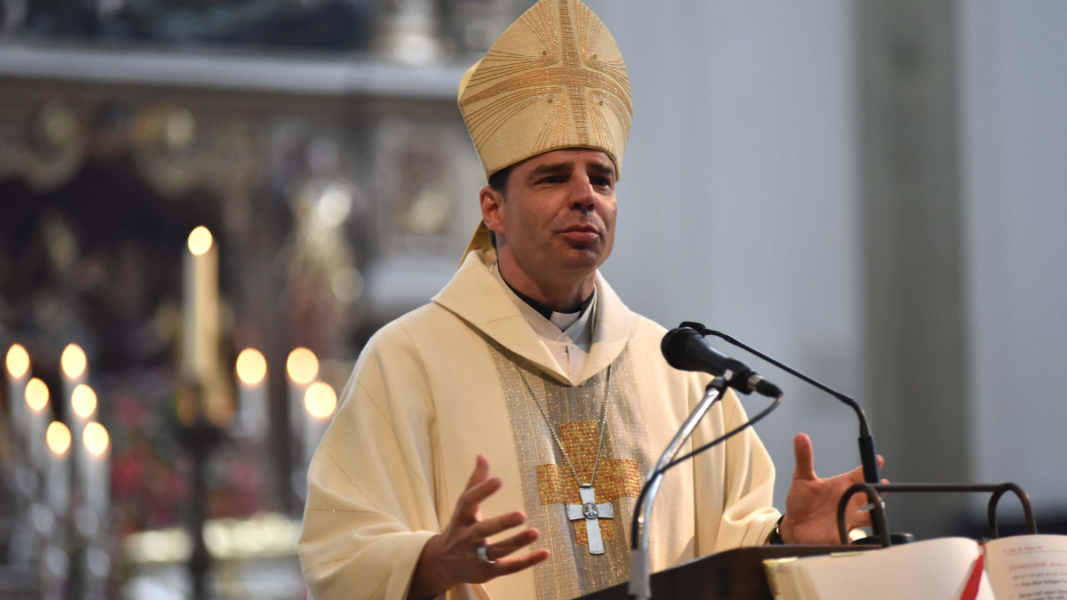
The defense of Christian anthropology made by Bishop Stefan Oster of Passau during his homily for the Solemnity of the Assumption has provoked a harsh reaction from the Catholic LSBT+ Committee of Germany, an alliance of groups that promote LGBT claims within the Church. The collective maintains that the prelate has «disqualified himself as a theologian and as a pastor» because of his statements on human dignity, sex, gender, and the Christopher Street Days, as the LGBT pride celebrations are commonly known in Germany.
The reaction came nine days after the homily delivered by Oster at the Marian shrine of Altötting in Bavaria (Germany). Under the title What is the vision? On human dignity and the Christian image of man, the bishop reflected on the progressive distancing of German society from its Christian roots and its consequences for issues such as abortion, assisted suicide, surrogacy, marriage, family, and gender ideology.
Oster: human dignity comes from God
The bishop took as his starting point the first article of the German Basic Law, approved in 1949: «Human dignity is inviolable.» He also recalled that its preamble places the German people «conscious of their responsibility before God and before men.»
For Oster, behind this formulation lies a certain conception of the human being. Christian anthropology allows us to affirm that dignity does not depend on a concession from the State, on individual autonomy, or on the exercise of certain capacities, but on the fact that man has been created in the image of God.
«The condition of being in the image of God as the source of our dignity cannot be taken away by anyone,» he stated.
The prelate gave as examples the embryo in the mother’s womb and a person in a coma near death. The absence of the current exercise of capacities such as reason or freedom does not diminish, he maintained, their personal condition or their dignity.
«Is the embryo in the mother’s womb already a human being, a human person, and therefore the bearer of inviolable human dignity? We, as Christians, say: yes, of course,» Oster pointed out.
«If faith disappears, the Christian conception of man disappears»
The bishop later warned of the consequences he observes in an increasingly secularized society.
«If faith disappears, the Christian conception of man disappears,» he stated. According to Oster, when the reference to God is eliminated, the principle that dignity must be protected can be formally maintained, but a permanent discussion remains open about what that dignity means and who is fully entitled to it.
The prelate gave as an example several debates that, he maintained, those who drafted the German Basic Law could hardly have imagined.
He mentioned the claim to consider abortion as a right, with France as an example for having incorporated into its Constitution the guaranteed freedom to resort to voluntary termination of pregnancy.
He also recalled the 2020 ruling of the German Federal Constitutional Court on self-determined death and described the possibility of turning assisted suicide into a business model as a «breach of a dam» and an inversion of the meaning of human dignity.
Oster also referred to surrogacy and alluded, without naming him, to CDU politician Jens Spahn, who resorted to this practice abroad together with his husband despite having spoken out against its legalization in Germany.
The biblical vision versus conceptions of sex and gender
The passage that particularly provoked the reaction of the collective was the one dedicated to the Christopher Street Days.
Oster pointed out that the «ways of life, sexual preferences, and assumed identities» shown in these celebrations make visible the extent to which society has been transformed.
The bishop acknowledged that this is a manifestation of the freedom that democracy expressly allows. But he raised the question of what judgment should be made from the perspective of faith:
«Does this correspond to the dignity that God has given us or does it contradict it?»
He then evoked the well-known formulation attributed to Dostoevsky: «If God does not exist, is everything permitted?»
Oster stated that the disappearance of God from the cultural horizon has enormously expanded what is considered possible «in the entire context related to sex and gender.»
His conclusion was unequivocal: «Most of it precisely does not correspond to the biblical conception of man».
«Beloved children of God with inalienable dignity»
Oster’s moral critique was accompanied by an equally explicit affirmation about the dignity of the people he was referring to.
«All those who participate there, without exception, are beloved children of God with inalienable dignity,» the bishop stated.
Oster added that they must be respected in their freedom, «without thereby having to approve what is shown or defended there».
The distinction formulated by the prelate was, therefore, between the dignity of each person—which he presented as universal, received from God, and impossible to lose—and the moral judgment that a behavior or a certain conception of sexuality deserves.
The LGBT «Catholic» collective: Oster has «disqualified himself»
The Catholic LSBT+ Committee responded with a statement titled Scharf daneben—an expression that can be translated as «completely off the mark»—in which it rejects the bishop’s approach.
The collective admits that it shares with Oster the conviction that the Christian tradition provides important elements for understanding the dignity of every human being. It considers, however, that the prelate ruins that approach by linking it with what it describes as «derogatory» statements about LGBT people, the Christopher Street Days, and social diversity.
The organization maintains that «human dignity does not depend on sexual orientation or gender identity, nor on family forms or religious convictions.»
It also accuses Oster of conveying through his questions the impression that LGBT visibility represents «moral arbitrariness» and distancing from God.
The statement concludes with a direct disqualification of the bishop: «Oster has disqualified himself as a theologian and also as a pastor».
They claim «coming out» as an experience of faith
The collective maintains that Oster links homosexual, bisexual, trans, intersex, or non-binary identities with the absence of God or distancing from the Christian conception of man.
Its members claim, against the bishop, a compatibility between those identities and their own conception of faith.
«As queer Christians, we believe and pray, we celebrate worship and understand our life in harmony with our relationship with God,» they affirm. They add that their gender identity or sexual orientation constitutes «an important part» of their lives and go so far as to maintain that in coming out they experience «the liberating power of our faith».
The group also accuses the bishop of being unaware of so-called queer theology and pastoral care specifically oriented toward LGBT people, and resorts to the well-known question pronounced by Francis in 2013: «Who am I to judge?»
Oster links Christian anthropology with the future of democracy
Oster’s homily had a broader scope than the LGBT issue. Its central thesis linked the conception of human dignity present in the German Basic Law with the Christian roots of the country.
The bishop also recalled that Article 6 of the Constitution establishes that «marriage and the family are under the special protection of the state order» and maintained that its drafters had in mind the monogamous union and «the usual unity of father, mother, and their son or sons.» Many of them, he added, were formed in Christianity and shared the Catholic conception of marriage as a sacrament.
Oster also extended his defense of human dignity to refugees, people of other cultures, ethnicities, and religions, people with disabilities, the elderly, women, children, and those living on the margins of society. The Christian, he pointed out, is called to always respect every human being and «above all, never to violence.»
Finally, he warned that abandoning the anthropological foundation on which, in his view, German democracy was built may end up weakening the political system itself.
«I am convinced that our Basic Law and, with it, our liberal democracy had essentially as their background the biblical image of man,» he stated.
And he added: «I fear that it is precisely the progressive distancing from it in our society that endangers our democracy».
Faced with a society that he considers in need of a common vision, Oster ended his Assumption homily by proposing the Catholic response: to remain united to Christ and to the Church, whose primordial image he identified in the Virgin Mary, and to «keep heaven open» to offer that hope to others.