


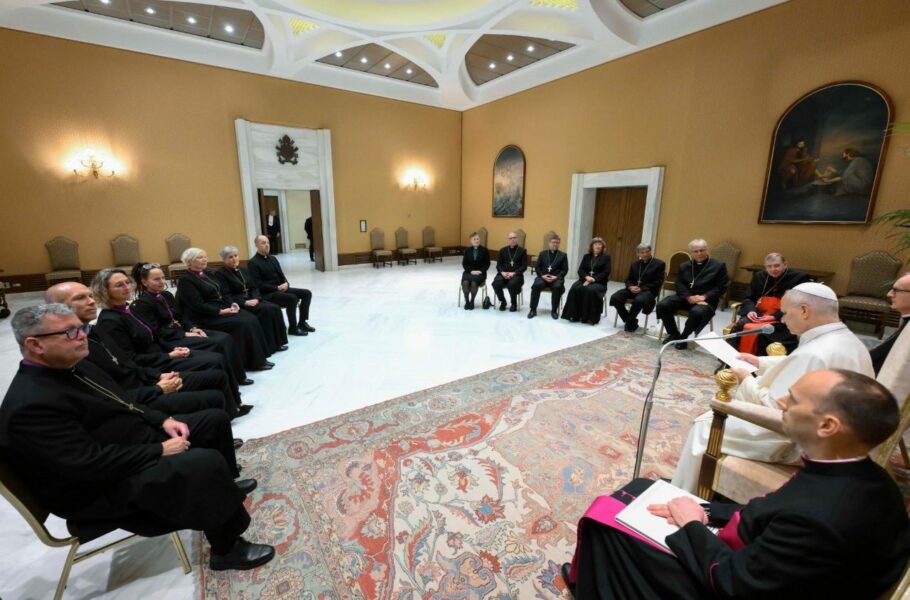
Pope Leo XIV received the bishops of the Church of Norway, the country’s Lutheran confession, at the Vatican on Wednesday, August 26, in a meeting initiated by the apostolic nuncio to the Nordic countries, Archbishop Julio Murat. In his brief address, the Pope appealed to the “common baptism” and the “shared mission” of Catholics and Lutherans and expressed his desire that they grow together in the service of peace and justice.
The meeting forms part of the ecumenical agenda promoted by Leo XIV, who, barely a year ago during the Ecumenical Week in Stockholm, stated that the Catholic Church had “fully embraced the ecumenical path” since the Second Vatican Council. The audience takes place, however, between communities separated by substantial doctrinal and moral differences. The Church of Norway has ordained women since 1961 and, since 2017, has celebrated marriages between persons of the same sex.
A journey centered on ecumenism
The Church of Norway explained before the audience that the meeting with Leo XIV had arisen at the initiative of the pontifical representative for the Nordic countries, Archbishop Julio Murat.
The Lutheran bishops are making their first study trip abroad in several years during the last week of August. After visiting the Community of Sant’Egidio in Rome, they will travel to the ecumenical community of Taizé in France. Young adults and ecumenism are the two main topics of the trip.
During their stay at the Vatican, they are also scheduled to meet with Cardinal Kurt Koch, prefect of the Dicastery for the Promotion of Christian Unity.
Before the audience, Olav Fykse Tveit, president of the Episcopal Conference of the Church of Norway, described the invitation as “a great honor” and highlighted the existing cooperation with the Catholic Church in various fields, including peace work.
“Seeking concrete paths of reconciliation and fraternity”
Leo XIV began his address by recalling the first Christians and martyrs of Rome, whose witness of faith, he noted, continues to be a source of inspiration to give one’s life “for the glory of God and for the good of our brothers and sisters.”
The Pope then referred to the international and social climate, which he described as “particularly turbulent,” marked by growing animosity among peoples, international conflicts, and the acrimony that frequently characterizes political and social discourse.
“Given our fallen human condition, it is all too easy to adopt an attitude of hostility toward those with whom we disagree,” he observed.
In light of this situation, the Pontiff called for a joint effort to “seek concrete paths of reconciliation and fraternity” and affirmed that Jesus Christ shows another way by revealing that “goodness and charity have the power to disarm.”
Leo XIV also thanked the Lutheran representatives for their desire to “seek ways of building communion” and maintained that even small gestures can inspire and guide along the path of reconciliation.
Leo XIV appeals to the “common baptism”
The Pope then quoted Christ’s prayer for the unity of his disciples recorded in the Gospel of John: “May they become completely one, so that the world may know that you have sent me and have loved them even as you have loved me” (Jn 17:23).
“Founded on our common baptism and our shared mission in the world, I pray that we may always grow together in our service to the promotion of peace and justice,” Leo XIV stated.
The Pontiff did not address during his brief intervention the doctrinal differences that keep Catholics and Lutherans apart. In other ecumenical encounters of his pontificate, he has expressly pointed to the need for doctrinal unity. When receiving Catholicos Aram I of the Armenian Apostolic Church—See of Cilicia last May, Leo XIV affirmed that “there can be no restoration of communion between our Churches without unity in the faith.”
Women pastors and same-sex marriages
The Church of Norway maintains positions incompatible with Catholic doctrine on issues that go beyond the historical controversies arising from the Protestant Reformation.
The Lutheran confession itself recalls that Ingrid Bjerkås was its first woman ordained as a pastor on March 19, 1961. The decision at the time met strong opposition from a large number of Norwegian bishops and ecclesial circles.
The differences also extend to the understanding of marriage. In 2016, the Kirkemøtet, the highest representative body of the Church of Norway, decided to prepare a liturgy that would allow unions between persons of the same sex. The new rite was approved in January 2017 by 83 of the 112 representatives present and began to be used on February 1 of that year.
The bishops of the Church of Norway took another step in 2022. In a joint statement marking the 50th anniversary of the repeal of the law that had penalized male homosexual relations in the country, they maintained that the growth of “acceptance and equality” of homosexuals in Norwegian society and in their Church constituted “a great and positive change.”
St. Olaf and the upcoming millennium
Leo XIV then proposed to the delegation to look to the witness of the first martyrs and of saints such as St. Olaf and St. Sunniva, whose lives, he affirmed, “helped to unite peoples” and left a lasting testimony “of the transforming power of charity.”
The reference to St. Olaf coincides with preparations for the upcoming millennium. Before traveling to Rome, Fykse Tveit announced that he would take the opportunity of the audience to convey to Leo XIV that he would be welcome at the upcoming celebrations.
The Pope concluded the meeting by asking God to help Catholics and Lutherans to live “ever more truly as brothers and sisters” and to give “common witness to our Savior, our Lord Jesus Christ.”
The encounter continues an ecumenical line that Leo XIV has developed since the beginning of his pontificate. In August 2025, in a message to the Ecumenical Week of Stockholm, he stated that “what unites us is much greater than what divides us” and recalled the rapprochement between Catholics and Lutherans developed in recent decades.
Below is the full message delivered by Leo XIV to the bishops of the Church of Norway:
Dear friends:
I am pleased to welcome you this morning to Rome and here at the Vatican, and I hope you have time, or have already had time, to visit the various holy places associated with the first Christians and martyrs, whose witness of faith in our Lord continues to be an enduring source of inspiration, also encouraging us to give our lives for the glory of God and for the good of our brothers and sisters.
There is no doubt that we face difficult challenges in our time, as the world goes through a particularly turbulent period. There seems to be a growing animosity among peoples, evident not only in international conflicts and disputes, as you have mentioned, but also within each country, as shown by the acrimony that frequently characterizes political and social discourse.
Given our fallen human condition, it is all too easy to adopt an attitude of hostility toward those with whom we disagree. For this reason, a joint effort is required to seek concrete paths of reconciliation and fraternity. In this regard, Jesus shows us another way, revealing to us that goodness and charity have the power to disarm. Therefore, I am sincerely grateful for your presence here and for your shared desire to seek ways of building communion. Indeed, even small gestures can inspire and guide us along the path of reconciliation.
As we well know, our Lord prayed to the heavenly Father for the unity of his disciples: “May they become completely one, so that the world may know that you have sent me and have loved them even as you have loved me” (Jn 17:23). Founded on our common baptism and our shared mission in the world, I pray that we may always grow together in our service to the promotion of peace and justice.
As we continue on this path, we can look to the example of the first martyrs and of saints such as St. Olaf and St. Sunniva, whose lives, dedicated to God and neighbor, helped to unite peoples and gave an enduring witness to the transforming power of charity.
Therefore, dear friends, dear brothers and sisters, I thank you once again for coming this morning and for your closeness. Let us ask God’s blessing so that, in his infinite goodness and wisdom, he may help us to live ever more truly as brothers and sisters and thus give common witness to our Savior, our Lord Jesus Christ.
Thank you very much.