


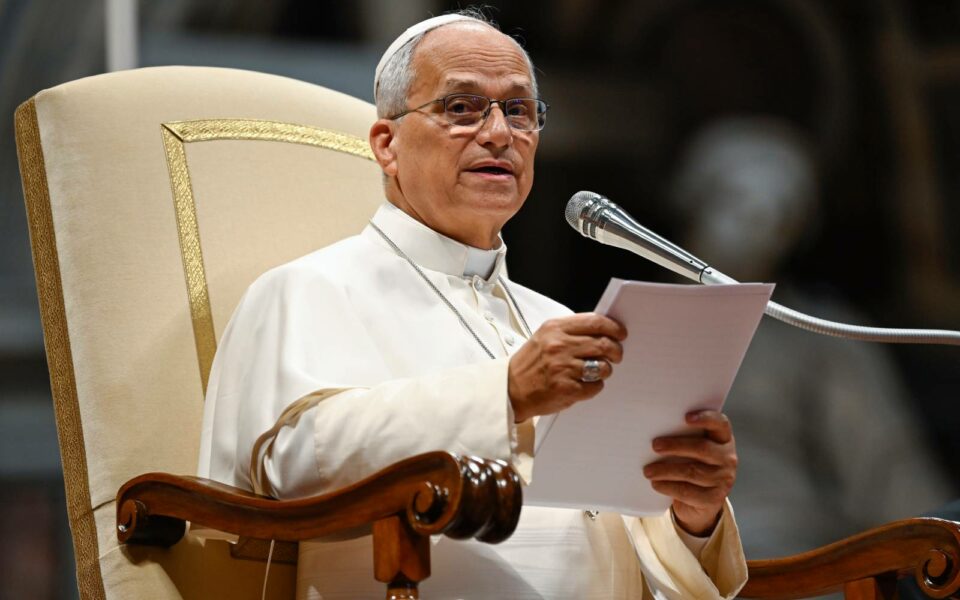
Pope Leo XIV dedicated this Wednesday’s general audience on 26 August to the motivations behind the liturgical reform promoted by the Second Vatican Council, in the final catechesis of his journey through the constitution Sacrosanctum Concilium. Before the pilgrims gathered in St. Peter’s Basilica, the Pope stated that this reform stands “in the furrow of the Church’s living tradition” and maintained that its correct understanding also allows us to “reject the abuses” that arose in some sectors during the post-conciliar period and that, he warned, “unfortunately still occur today.”
The Pontiff recalled that it is especially the responsibility of bishops and priests to “safeguard and promote” a liturgy celebrated according to the norms and marked by “noble simplicity.” In his subsequent greetings, Pope Leo XIV also joined the renewal in Częstochowa, Poland, of the Jasna Góra Vows, drafted seventy years ago by Cardinal Stefan Wyszyński during his imprisonment, and asked that their programme of moral renewal—founded on the protection of human life, the care of marriage and the family, and the education of children and young people—continue to inspire society.
Complete Catechesis of Pope Leo XIV
The Documents of the Second Vatican Council. II. Constitution Sacrosanctum Concilium. 8. The Motivations for the Liturgical Reform
Dear brothers and sisters:
In this final catechesis on the Constitution Sacrosanctum Concilium, I wish today to dwell on the reasons why the Council Fathers wished to promote a reform of the liturgy. Illuminating in this regard is the third Letter from the Council that Cardinal Giovanni Battista Montini, then Archbishop of Milan, sent on 28 October 1962 to the faithful of his Church. The liturgy, he wrote, “is a sincere expression of both the divine and the human. It is language. It is a vehicle of divine teaching on the one hand, and a voice of dialogue with God on the other. It is clear that it cannot renounce its didactic function and must not fail to offer faith and piety the possibility of expressing themselves with spontaneous intelligibility.”
Moved by these convictions, the future Pope Saint Paul VI affirmed that the faithful “can no longer and must no longer remain mute and passive. Their physical presence cannot be reconciled with their spiritual absence.”
These statements clearly resonate with those that would appear in no. 48 of the conciliar Constitution: “The Church, therefore, spares no effort in ensuring that, when the faithful attend this mystery of faith, they should not be there as strangers or silent spectators. On the contrary, having a good grasp of it through the rites and prayers, they should take part in the sacred action, actively, fully aware, and devoutly. They should be instructed by God’s word, and be nourished at the table of the Lord’s Body. They should give thanks to God. Offering the immaculate victim, not only through the hands of the priest but also together with him, they should learn to offer themselves. Through Christ, the Mediator, they should be drawn day by day into ever more perfect union with God and with each other, so that finally God may be all in all.”
In these words one perceives a renewed awareness of the value of the liturgy. Through the ritual actions of the Church, while the memorial of the work of salvation is being celebrated, the possibility is offered of living a true relationship with God, entering into contact with the saving event. Since the gestures and words of the sacred liturgy are decisive for this experience, the participation of the faithful cannot be passive.
The conciliar reform, by placing at the centre what constitutes the heart of ecclesial experience, wished to make the liturgy shine forth as “the primary source of that divine exchange in which the life of God is communicated to us.” From this conviction arose the need to make the richness of the biblical texts and prayers more accessible to all the faithful, and to render the celebratory order more linear than that provided in the liturgical books then in force.
The liturgy, being a living reality, has always been subject to developments and changes throughout the centuries. The Magisterium has adapted its forms to the needs of different times. It is not surprising, therefore, that the Second Vatican Council, with the utmost respect for the heritage of tradition and precisely in order to make it more accessible, considered a revision of the liturgical books necessary.
The objective the Fathers had in mind is set out in no. 21 of the Constitution Sacrosanctum Concilium: “In order that the Christian people may derive more abundant grace from the sacred liturgy, holy Mother Church desires to undertake a general reform of the liturgy itself. For the liturgy is made up of immutable elements divinely instituted, and of elements subject to change. These latter not only may but ought to be changed with the passage of time if they have suffered from the intrusion of anything out of harmony with the inner nature of the liturgy or have become less suitable. In this restoration, the texts and the rites should be drawn up so that they express more clearly the holy things they signify, and that the Christian people, as far as possible, are able to understand them with ease and to take part in them fully, actively, and as befits a community.”
The distinction within the liturgy between divine, immutable elements and human elements that “can undergo various modifications, approved by the sacred Hierarchy assisted by the Holy Spirit, according to the needs of the times, of things and of souls” (Acta Apostolicae Sedis 39, 1947, 541-542) goes back to Pope Pius XII’s encyclical Mediator Dei.
Moreover, the desire for a “general reform” did not arise suddenly, but had already been manifested in the action of the Popes who succeeded one another from the beginning of the twentieth century, in harmony with the aspirations of the Liturgical Movement. The affirmation of the need for the faithful not to attend celebrations “as strangers or silent spectators” had already been taken up by Pope Pius XI’s apostolic constitution Divini Cultus.
Furthermore, one may recall the interventions of Pius XII concerning the ordering of the rites of Holy Week, which he restored to the hours corresponding to the paschal events, after they had for centuries been anticipated to the morning hours.
Nor should it be forgotten that Saint John XXIII considered necessary a simplification of the rubrics of the Breviary and the Missal, approving it with the motu proprio Rubricarum instructum of 25 July 1960, in which he referred to the forthcoming Ecumenical Council the proposal of the fundamental principles for a reform of the liturgy.
The liturgical reform promoted by the Second Vatican Council therefore stands in the furrow of the Church’s living tradition. Its correct understanding also allows us to reject the abuses that occurred in some sectors of the Church during the post-conciliar period and that, unfortunately, still occur at times today, by absolutising or misinterpreting some of the principles that underlay the reform itself.
In this regard, it is worth recalling how the conciliar Constitution states that “liturgical services are not private functions, but are celebrations of the Church, which is the ‘sacrament of unity,’ namely, the holy people united and ordered under their bishops. Therefore, liturgical services pertain to the whole body of the Church; they manifest it and have effects upon it” (Sacrosanctum Concilium, no. 26).
It is therefore the primary responsibility of pastors, of bishops, but also of every priest, to safeguard and promote a liturgy that, while respecting liturgical norms, shines with noble simplicity (cf. no. 34) and thus manifests the one, holy, catholic and apostolic Church.
Such a liturgy will also be a fundamental vehicle of evangelisation, the instrument of grace through which, as the Council teaches, we can learn to offer ourselves and, through the mediation of Christ, be perfected in unity with God and with one another (cf. no. 48).
Greetings to Spanish-speaking Pilgrims
I cordially greet the Spanish-speaking pilgrims. Today we celebrate the memory of Saint Teresa of Jesus Jornet e Ibars, a Spanish religious, patroness of the elderly. Through her intercession, let us ask the Lord to bless all the elderly, as well as those who care for and accompany them. May God bless you. Thank you very much.
Pope Leo XIV Recalls the Jasna Góra Vows
I cordially greet the Polish faithful. I spiritually join all those gathered in Częstochowa, where today, after seventy years, the “Jasna Góra Vows of the Polish Nation,” drafted by Cardinal Stefan Wyszyński during his imprisonment, are being renewed.
May the programme of moral renewal of society contained in them—through the protection of human life, the care of marriage and the family, and the education of children and young people—continue to inspire the commitment to justice and fraternity. My blessing to all!
Final Greeting
I extend a cordial welcome to the Italian-speaking pilgrims. In particular, I greet the diocesan directors of the Pontifical Mission Societies, the participants in the summer meeting for seminarians, the guests of the “Regina coelorum” residence in Santa Marinella, and the various parish groups.
I also greet the newly confirmed from the diocese of Chiavari, accompanied by their bishop. Dear young people, with Confirmation you have received the most beautiful gift, the Holy Spirit: it is not a treasure to be kept hidden, but a light you must make shine every day.
Finally, my thoughts turn to the young, the sick and the newly married. Tomorrow and the day after, the liturgy commemorates two great saints, Saint Monica and Saint Augustine, united on earth by family ties and in heaven by the same destiny of glory. May their example arouse in each of us a sincere and passionate search for the evangelical Truth, so as to bear witness to it joyfully in daily life.
My blessing to all!