


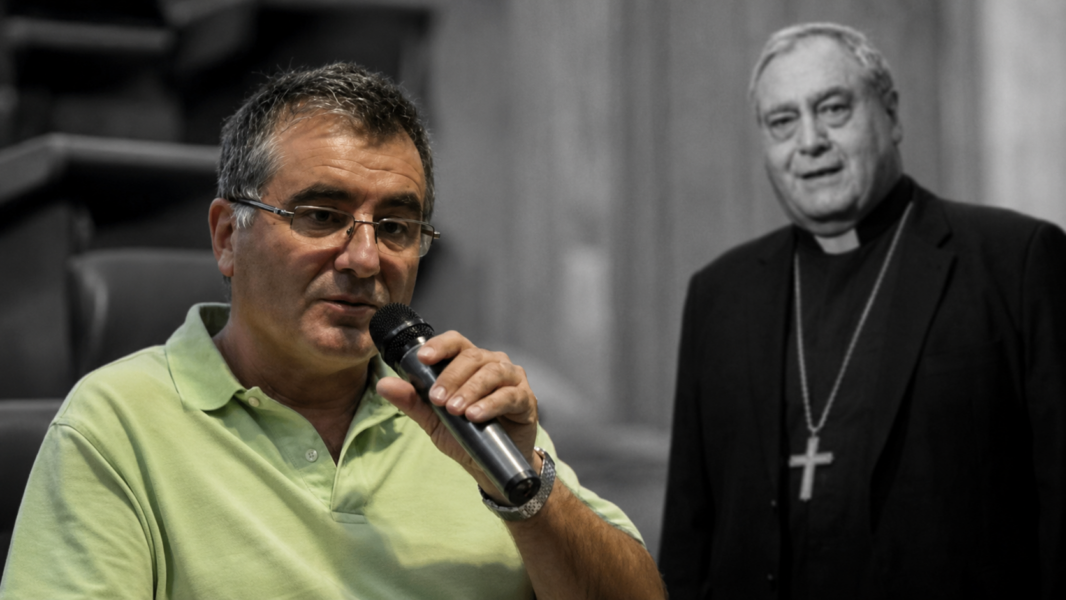
While the earth continues to tremble and the Cathedral remains closed, the diocesan advisor of the JOC publishes in the secular press a total amendment to the procession called by Gil Tamayo. In El Independiente de Granada. Picked up by Religión Digital. Without, predictably, anything happening.
One thought that August had already given Granada everything a month could possibly give: the earth rearing up in a seismic swarm since the 14th, a 5.2 magnitude earthquake with its epicenter in Alhendín in the early hours of the 15th, the Cathedral closed along with four other churches and its activity moved to the parish of El Sagrario, the city’s patroness moved because her basilica has been damaged. What was still missing, however, was the most unexpected aftershock of the swarm, one that has not been recorded by the National Geographic Institute because its epicenter is in the opinion section of El Independiente de Granada: a scandalized parish priest. Not because of the earthquake. Because of the rogation.
Let us recap for the reader who has just arrived. The Archbishop of Granada, Monsignor José María Gil Tamayo, has called for a rogation procession in September with the Most Holy Christ of San Agustín, which will depart from the Cathedral —where the image is located for the Kerygma exhibition— to the Basilica of Our Lady of the Angustias, with the date still to be confirmed. The choice is neither whimsical nor, God forbid, a pastoral novelty: the City Council declared this image the Sacred Protector of the City after the end of the 1779 epidemic, with an annual vow renewed every 14 September, and already in 1755 the Christ was taken out in rogation after a strong earthquake that affected Granada. In other words: the archbishop has done exactly what Granada has been doing since there is written memory of tremors. Praying.
Well then: this, which to any Granadan with two centuries of family memory seems obvious, has produced an attack of perplexity in Don Mario Sixto Picazo Robles, parish priest of Santa María Micaela and advisor to the Christian Workers’ Youth, which he considered urgent to share with the general public. This Sunday he published in El Independiente de Granada —and Religión Digital, always attentive to such things, reproduced it diligently— an article headed by the proverb “Pray to God and keep hammering,” in which, on account of the call issued by his own archbishop, he asks: “What Church am I in? What world do we live in?” And he continues asking: whether “this type of manifestation” makes sense, what image of God “this type of proposal feeds,” whether this is the response the world expects from believers. One, who also has his curiosities, would be permitted to answer the first with the administrative rigor the question deserves: you are, Don Mario, in the Church that entrusted you with a parish and a diocesan advisory role. That of Granada. That of the archbishop you are amending in the press.
The theology of the article deserves attention, because it is not an outburst: it is an entire system. God, the parish priest writes, “does not act in the world if we do not let Him act.” Note the reader’s subtlety: an otiosus Deus with his hands tied, a cosmic retiree who delegated providence to the technical building code and to the Junta de Andalucía, to whom Don Mario dedicates, this time yes, gratitude without reservations —one must thank God, he comes to say, for anti-seismic laws and for firefighters—. Saint Gregory the Great led litanies through the streets of Rome during the plague of 590; the parish priest of Santa María Micaela would have preferred, one suspects, a note of recognition for the imperial sewer system. And from there, the usual slide, so predictable that it almost moves: the alternative to the rogation is not more prayer but the banner. To take to the streets, yes, but for decent housing, for the homeless, against “those who dare to call themselves Christians” and lack compassion for migrants. Respectable causes, some urgent, none incompatible with a procession: the Church built hospitals and held rogations for centuries, often on the same day and with the same money. The dilemma between the vertical and the horizontal only exists in the mind of someone who has already decided to amputate the former.
The most delightful part of the text, however, is its biblical artillery. To justify his Christianity of demonstration, Don Mario cites Matthew 18:19: if two agree to ask the Father for something, it will be granted to them. One rereads it and cannot believe it: that verse is, sensu stricto, the canonical definition of a rogation. Two or more —let us say an entire archdiocese, behind a seventeenth-century crucifix— agreeing to ask the Father for something. The parish priest wields against the procession the very text that founds it. And the same with the Our Father, which he himself invokes as the total prayer: the last petition of the Our Father is “deliver us from evil.” What does Don Mario think the Christ of San Agustín will be asking on the way to the Angustias, if not exactly that, carried on a float and with wax? Lex orandi, lex credendi: tell me what you find superfluous in the Church’s prayer and I will tell you what you find superfluous in her faith.
What remains is the structural, which is what truly interests one. It is not an anonymous sniper writing: it is an active parish priest, with a position of diocesan trust, who publicly corrects his ordinary in a secular newspaper, with included sarcasm, in the middle of an emergency that keeps churches closed and neighbors sleeping with their clothes on. Will anything happen? One, who knows the cloth, ventures a prediction: nothing. Not a call, not a note, not a gesture. Now let the reader do the inverse exercise, the one that never fails: imagine a parish priest publishing in the press that the next diocesan synodal assembly makes him wonder what Church he is in and what image of God this type of proposal feeds. The file would arrive before the newspaper delivery. That asymmetry —exquisite severity toward one side, very broad pastoral sleeve toward the other— is not a Granadan anecdote: it is the disciplinary regime actually existing in a good part of the Spanish Church, and it is advisable to document it every time it appears, even if it is with a loose eave.
Granada, meanwhile, survived the 1779 epidemic, the 1755 earthquake that already took its Christ out in rogation, the 1884 Andalusian one, and the 1956 Albolote one. It will also survive, one trusts, the theology of its advisors. Although for that, one greatly fears, rogations will be necessary.