


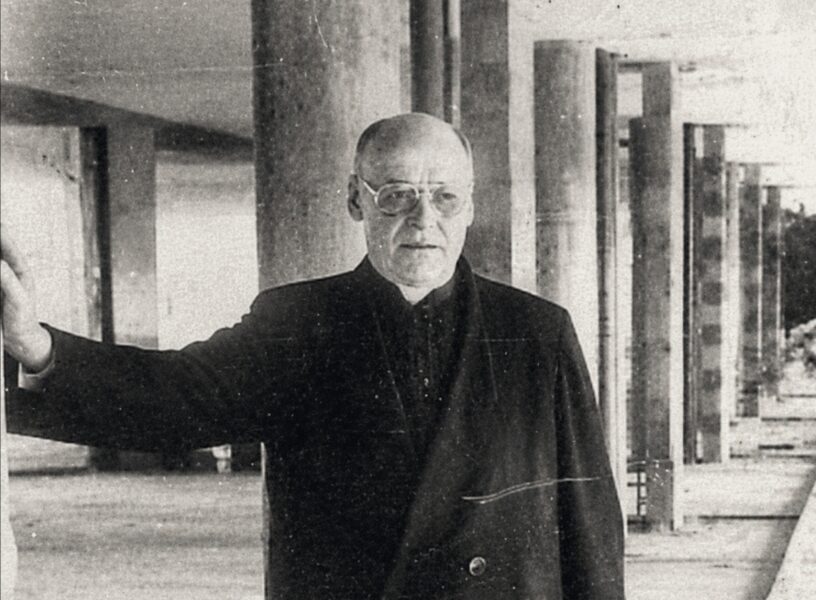
These days, much is being said about a priest from the Spanish city of Torrelavega. He made the news for publicly attacking the Marian dogma of the Assumption before the faithful gathered precisely in the parish of Our Lady of the Assumption on the very solemnity of the Assumption of the Blessed Virgin Mary. I will only say to him, with Pius XII, taking the final point (47) of Munificentissimus Deus:
Let no one, therefore, be permitted to infringe this our declaration, proclamation, and definition (of the Dogma of the bodily Assumption of the Virgin Mary into heaven) or to oppose or contravene it. If anyone should dare to attempt it, let him know that he will incur the indignation of Almighty God and of His holy Apostles Peter and Paul.
Also, during the same celebration, he organized a chromatic profanation, a tasteless grotesque in which both men and women danced in skirts “forming a circle of perfection around the table of the Eucharist, where all may fit,” said the priest of Torrelavega. All of this, of course, seasoned with the overused reference to the poor, the last, the weak, as the meeting point of a Church on the move.
That is why it is a good moment to pay tribute to the priest of Torrelavega. To that priest who took care of everything and everyone, with sacrifice, with effort, with absolute dedication. His works still stand, his memory remains alive, and his example is a constant stimulus to priestly fidelity in every sphere. Of course, first and foremost: fidelity to the Truth, to doctrine, and to the sacredness of the Church.
The priest of Torrelavega was Don Teodosio Herrera Fuente, whom I had the privilege of knowing, who told me some of his adventures and of whom I always kept a fond memory and the feeling of having been close to one of the great saints. The other priest, the one who made the news, will go down in history for what was mentioned at the beginning, unless, repentant of the heresy and the ridiculous profaning inventions, he gives us all a lesson and embraces the Truth he has abandoned.
Don Teodosio Herrera Fuente occupied the pulpits of Torrelavega for decades and belonged to a kind of priest that some today would consider from another era: the priest who believed without complexes what he preached, what the Church had always preached. Without circumlocutions, without dissimulation, without cuts or compromises. The truth, after all, preached opportunely and inopportunely.
Born in Peñacastillo (Cantabria) in 1911, he had been president of the Catholic Action of his town. He was a combatant in the War of National Liberation of 1936, in which he fought, like so many young Spaniards, because he understood that he was enlisting in a crusade in defense of the Faith against atheistic communism.
It was beautifully written by Don Ángel Garralda, another exemplary priest, who was his companion at the old Pontifical University of Comillas and a great friend of Don Teodosio.
Garralda recounts that, after the liberation of Santander, in which he participated, Teodosio Herrera enlisted, despite being ill, in the Tercio de Requetés of Mola. He fought on the front line as a machine gunner. And he advanced toward Covadonga as soon as he heard that those who had already destroyed so many churches throughout Spain might profane the sanctuary of the Santina. According to Don Ángel Garralda, that young requeté advanced on the front toward the Asturian sanctuary, alternating the advance of his machine gun with the praying of the Rosary. He was repeatedly wounded, and his conduct in the campaign was such that he was proposed for the Laureate Cross of Saint Ferdinand. He ended the war with the rank of lieutenant and was the holder of three Red Crosses of Military Merit, the War Cross, the Campaign Medal, two Collective Military Medals, and two Crosses of Suffering for the Fatherland.
Peace came, and that lieutenant laid down his arms, entered the seminary, and was ordained a priest in 1947, at the age of 38, and that same year was sent to Torrelavega, where he remained forever in an immense priestly work.
The man who had advanced toward Covadonga with a machine gun and a Rosary would end up dedicating his life to building churches to the Virgin and tirelessly spreading devotion to Mary. Because Don Teodosio built. And he built a great deal.
But among all his works, there was one that had a special meaning for Don Teodosio: to raise a church again where, twenty years earlier, in 1936, another had been demolished. In that place had stood the old church of the Consolation, linked to the very origins of Torrelavega. In 1936, at the beginning of the Civil War, the Popular Front ordered its closure and demolition, citing reasons of “aesthetics and hygiene.” During that summer its walls and even its bell tower were torn down, to the pain of many people of Torrelavega who saw disappear not only a church, but the place where entire generations had been baptized, married, and prayed.
Nearly twenty years later, Don Teodosio was determined that a church should rise there again. On August 14, 1955, before the ruins of the old church and on the eve of the feast of the Assumption of the Virgin, he announced before thousands of the faithful his purpose of building a great temple for the Great Virgin. And he wanted it, in his own words, “on a grand scale”: because it was the House of God and because it was to be the house of the Patroness of Torrelavega.
But Don Teodosio also wanted the stones to speak, in case some era should come when the dogs, or the shepherds, should suffer from aphonia or fall mute: “if these were silent, the stones would cry out” (Lk 19:40).
He rescued stones from that ancient and ruined church so that they might support the main altar of the new temple. Upon them he ordered an inscription to be carved in Latin, whose translation recalls: “With these ancient stones was built here the tower of the Garcilasos (de la Vega) and their chapel, after whose name the city and the parish have been called ever since.”
Where they had wanted to make a church disappear, Don Teodosio built a greater one. And where ruins had remained, he placed upon those very stones the altar on which the Holy Sacrifice would once again be celebrated. He did not erase history, nor did he wish to hide it. Those stones were not hidden, for the priest of Torrelavega, Don Teodosio, embedded them in the foundation, and upon them he raised the church of Saint Joseph the Worker and the great Sanctuary of the Great Virgin.
He promoted the church of Our Lady of Covadonga: that young requeté who had advanced toward Covadonga in the Crusade of 1936 to defend the Santina also built her a church as the priest of Torrelavega. He promoted the church of Saint Michael of Campuzano and was also behind the church of the Sacred Heart of Mies de Vega.
But Don Teodosio’s Catholicism did not end at the doors of the churches. The Church on the move is not an invention of today, nor a whim of those who seek to reformulate the Church. As if the Church had not always cared for the poor, the humble, the disadvantaged, the discarded… Because that priest of Torrelavega who rolled up his cassock to climb the scaffolding and supervise the construction of the churches, that traditional, Marian, Eucharistic priest scrupulously faithful to doctrine, dedicated a gigantic part of his existence to those most in need of help. And no, not merely with words from homily to homily to caress the ears of his parishioners.
Don Teodosio completed the works of the new Asylum Hospital of Torrelavega and promoted its expansion. He was lifelong president of the Asylum Foundation. He created the Santa Marta residence for elderly priests. He promoted the Fernando Arce Special Education Center, a pioneer in Cantabria, and the Victoria Gómez de Arce nursery school.
He also promoted the Emilio Revuelta neighborhood, providing housing for working families who had come to a Torrelavega growing with industrialization. He is also responsible for the construction, in 1965, of the monumental Minor Seminary of Saint Louis, in Argomilla de Cayón, today closed and abandoned for lack of vocations.
Churches. Housing. Asylum. Residences. Special education. Nursery school. Seminary… And while doing all this, he continued to be a priest. The priest of Torrelavega, but not only of Torrelavega, for his missionary zeal was overflowing and repeatedly took him to Spanish Guinea, although his great desire as a seminarian and as a newly ordained priest had always been to mission in the Spanish lands of America.
While carrying out that frenzied activity, he found time to obtain the title of civil aviation pilot, thinking of the difficulties he would have in traveling through those Hispanic overseas territories if one day God should call him to go there.
In 1963 he even participated in a Tour of Spain in a light aircraft. The photograph is wonderful: a priest in a cassock, the priest of Torrelavega Don Teodosio, seated at the controls of a light aircraft. He was not the chaplain of the pilots. He was one of the pilots.
From his aeronautical passion remain numerous anecdotes, some of which were told by the writer Pedro Arce. On one occasion, flying between San Sebastián and Santander, he ran out of fuel and had to land in a meadow near Castro Urdiales. Those flights in a light aircraft fit perfectly with a great and necessary obsession of his life: obtaining resources for his works. Don Teodosio needed money. A great deal of money. Building churches, housing, asylums, residences, and care centers is not paid for with speeches and pretty words that generate headlines. That priest of Torrelavega was an extraordinary seeker of benefactors and would go after them, if necessary, even by light aircraft. How many hours of flight, how many landings, and how many millions obtained. Nothing stopped him because he was devoted to a higher cause.
He received small inheritances, donations, and significant contributions from people who trusted him and knew that the money given to Don Teodosio was money given to a great work, the work of God. It was not the work of the priest of Torrelavega, nor the work for the poor, the elderly, or the seminarians. It was the work of God. “Seek first the kingdom of God and his justice, and all the rest will be given to you as well.” Perhaps here is condensed the entire difference between two ways of understanding the priesthood.
For decades they have explained that to draw closer to those who were outside, one had to lower the certainties of those who were inside. That dogmas had to be reinterpreted, uncomfortable truths softened, desacralized, adapted, questioned, modernized. They do so thinking that in this way those outside will enter, or so I believe. But the result has always been exactly the opposite: those outside did not enter, and those inside ended up leaving.
Don Teodosio represents the opposite path. He affirmed the dogmas. He preached the faith. He adored the Blessed Sacrament. He believed in the real presence of Jesus Christ in the Eucharist. Once, his bishop indicated that he should move the Blessed Sacrament and change its place, moving it from the central nave to the crypt. Don Teodosio asked if it was an order. The bishop answered yes. Don Teodosio’s response was to point slowly with his finger throughout the church and say to the bishop: this church was built by me, and if I must hide the Lord, I prefer to destroy it myself. Of course, the Blessed Sacrament remained in the principal place designated by the priest of Torrelavega, Don Teodosio.
Because Don Teodosio needed to build churches, because he filled them, he did not empty them. And he prayed the Rosary and honored Mary to fill them, which is what the Church has always done.
Because Catholicism never conquered anyone by being ashamed of itself. Men do not give their lives for a doubt, nor do they go to the front to defend mythological tales. It is somewhat obvious to write this, but martyrs do not die to defend their opinion in a world of consensuses.
The Church filled churches when it offered man something the world could not offer him: the certainty of a Truth and the richness of a Tradition treasured for centuries. And therefore the priest is not the owner of that Truth; he is its servant, nor is he the owner of that Tradition, being a legatee obliged to preserve, increase, and transmit that treasure.
Here is where the figure of Don Teodosio acquires an unexpected relevance.
These days Torrelavega has once again appeared linked to a priest. It is difficult to imagine a greater contrast. On one side, the contemporary temptation to believe that casting doubt from the pulpit on a truth defined by the Church can make Christianity more accessible to modern man. On the other, a priest who accepted those truths on his knees and then rose to work without rest, without wasting time, without inventing anything new.
And it is not insignificant that it was those priests who preached Catholic truths without complexes who needed to expand parishes and build new churches for their faithful, as we see today in those traditional movements.
The priest of Torrelavega, Don Teodosio Herrera Fuente, was not a famous theologian. He did not seek to found a school of thought. He did not need to surprise his parishioners from the ambo, nor be original or colorful.
He received a faith he had not invented and dedicated his life to transmitting it, in an extraordinary way, without rest, without discounts, without compromises. Because his entire life was an absolute surrender to God, an untiring search for his kingdom, knowing that the rest would be given to him as well.
Our priest, the priest of Torrelavega Don Teodosio, was named Adoptive Son of Torrelavega (1967), received the Gold Medal of the city (1968), was proclaimed Favorite Son of Cantabria (1993), and received the Silver Medal for Merit in Work (2002).
There even exists in Torrelavega a Teodosio Herrera Residence for people with physical and mental disabilities, built by the Asylum Foundation which he presided over for life and which recognized in him one of its great architects.
The priest of Torrelavega was a monsignor, for Don Teodosio was named by Paul VI a Prelate of Honor of His Holiness.
He died in 2006, at the age of 95.
His funeral was massive, and his remains rest where they probably should rest: in the church of the Great Virgin, beside the altar of the Virgin and Patroness of the City.
That young requeté who arrived at Covadonga with the machine gun and the Rosary ended his days resting beneath the walls of a Marian sanctuary that he himself had raised. By their fruits you will know them.
To Don Teodosio Herrera Fuente. To the priest of Torrelavega, my remembrance, homage, and gratitude.
May God keep him in His glory.
Miguel Menéndez Piñar