


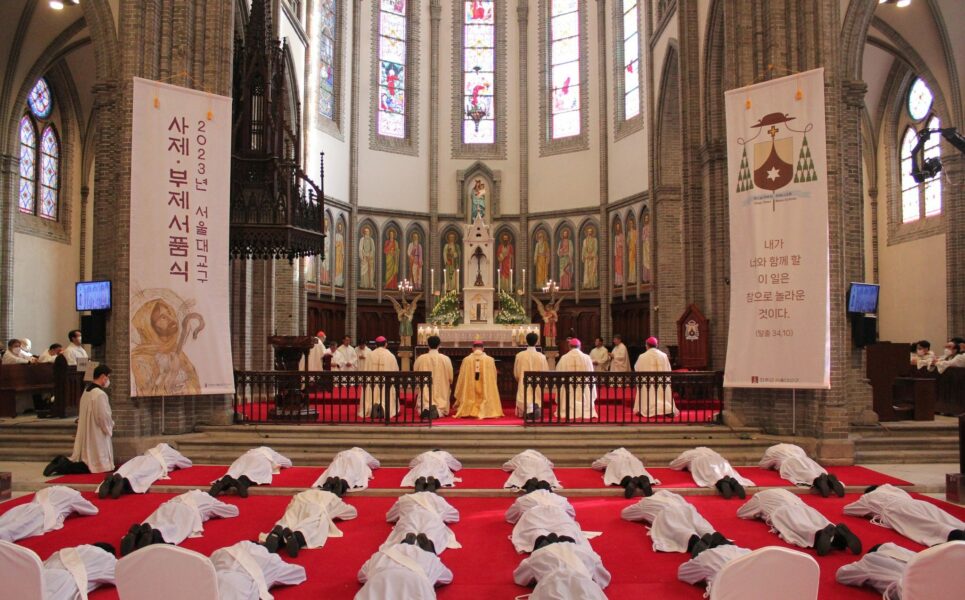
While numerous dioceses face a sustained decline in vocations, the Archdiocese of Seoul, South Korea, maintains a presbyterate of more than a thousand priests and a lay structure dedicated for half a century to supporting vocations through prayer, financial assistance to seminarians, and formation. Following the new ordinations celebrated in February 2026, the number of priests belonging to the archdiocese rose from 994 to 1,009.
The current figure updates a milestone reached the previous year. On February 7, 2025, 26 new priests were ordained—25 from the archdiocese and one from the Redemptoris Mater seminary—bringing Seoul to the symbolic number of one thousand presbyters. The local Church also counts more than 1.5 million Catholics.
Fifty years of praying and funding the formation of seminarians
One of Seoul’s distinctive features is the Association for the Support of Vocations, founded on April 17, 1975. It began as a small support group for seminarians, promoted by seminary staff and fifteen lay women, under the spiritual direction of Father Kim Deok-jae. In 1977 it adopted its current name and became linked to the Archdiocese’s Department of Vocations.
Its activity has been sustained for five decades on three pillars. Its members pray and offer Masses for vocations, make contributions to cover the studies and maintenance of seminarians, and receive formation to continue promoting priestly vocations in their communities.
The Archbishop of Seoul, Peter Chung Soon-taick, highlighted the role of this network during the Mass celebrated in April 2025 for its 50th anniversary, attended by around 700 people.
“This growth would not have been possible without the grace of God and without the dedicated efforts of the priests and members who have served in this mission,” Chung noted.
The archbishop also summarized the principle that has guided the association’s work: “A vocation is a gift given by God, but it is also a gift that must be nourished and cultivated so that it may flourish”.
A Church that was born without priests
The importance that the laity has had in promoting vocations is linked to the very origins of Korean Catholicism. The Church in South Korea has the peculiarity of having begun to develop at the end of the 18th century through the initiative of laypeople who came to know Christianity through books that arrived from China.
Without priests at first, those early Catholics studied the doctrine, were baptized, and formed communities while awaiting the arrival of missionaries. Subsequent persecutions left around 10,000 martyrs, whose witness continues to occupy a central place in the identity of Korean Catholicism.
Among them is Saint Andrew Kim Dae-geon, the first Korean priest, ordained in 1845 and martyred the following year at the age of 25. The growth of Seoul’s clergy to surpass one thousand therefore occurred barely 180 years after that first ordination.
The number of seminarians is also falling in Korea
Seoul’s figures do not mean, however, that the South Korean Church has remained unaffected by the vocational crisis. Archbishop Chung himself warned during the association’s anniversary that a “constant decline in priestly vocations” is currently being recorded and called for intensified prayer and support from parishes and communities.
National data show a considerable drop. In 2013 there were 1,264 candidates for the priesthood in the Korean dioceses; ten years later, 790 remained—approximately 40% fewer. This is compounded by South Korea’s demographic crisis, whose fertility rate is among the lowest in the world.
The weight of Catholicism is also diminishing among younger generations. According to statistics from the Korean Episcopal Conference cited by the Fides Agency, Catholics represented 11.5% of the country’s population, but the percentage was significantly lower among children and adolescents.
Seoul’s case thus combines a still-numerous presbyterate with clear signs of vocational decline. In the face of this trend, the archdiocese maintains a formula that predates the current crisis by decades: constant prayer for vocations, direct involvement of the laity, and material support for those who enter the seminary.
The South Korean Church will also be especially exposed to international attention in 2027, when Seoul will host the next World Youth Day.