


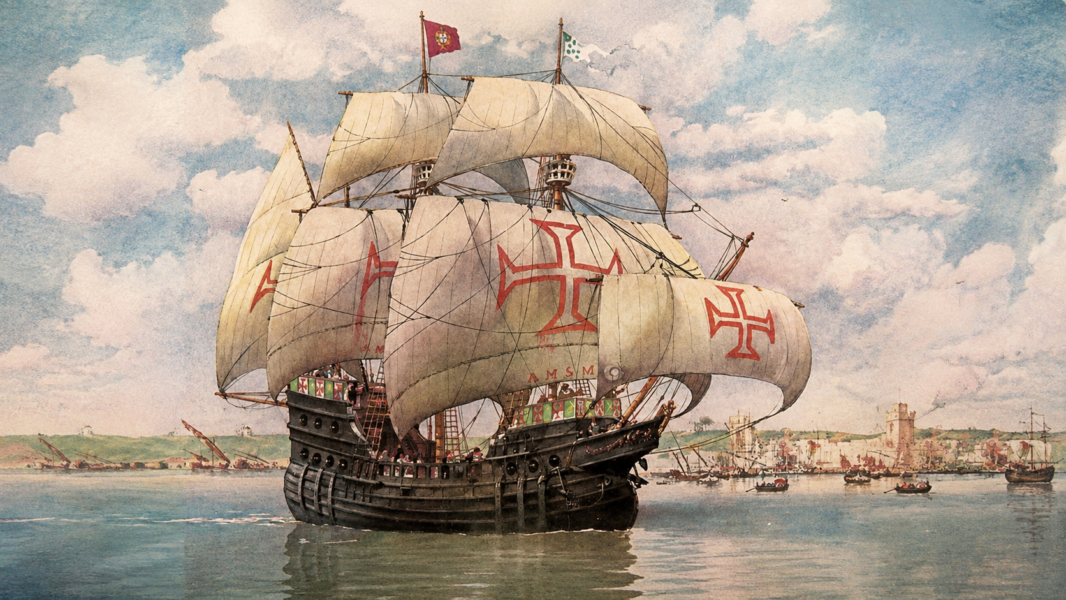
I have always been fascinated by this quote from the Letter to the Hebrews, “By faith they subdued (or “conquered”) kingdoms,” a biblical passage that the letter presents as “models of faith in Sacred History,” because it helps explain the motivations behind many historical episodes, including those we intend to narrate: the Portuguese expansion toward the Indian Ocean and the evangelization of Goa, in India.
With this text we present a historical series that will consist of between 10 and 12 chapters and that may be considered as a history of the Church, of Christendom, “when the philosophy of the gospel governed the States,” in the words of Leo XIII.
How could a small kingdom like Portugal, after expelling the Muslims from its territory, launch itself into the conquest of North Africa and, later, into the circumnavigation of Africa to reach the Asian continent and, thus, surprise the Turks from behind as they advanced through the Mediterranean and liberate the holy city of Jerusalem? For the mentality of Christendom that governed the actions of the Portuguese crown and missionaries – also that of merchants and politicians, though they had additional economic interests –, that maritime expansion of Portugal from the fifteenth century onward is understood as a crusade, a war of religion, for they sought to neutralize the Turkish threat over Europe and liberate the Holy Land.
Little or nothing of this appears in history books except to construct a Black Legend about these events, as most contemporary historians are incapable of understanding that Christ’s command to go and make disciples of all nations, baptizing them in the name of the Father, and of the Son, and of the Holy Spirit, and teaching them to observe all that He commanded (Mt 28:19-20) is what drove not only the crusades studied as such, whose main purpose was to liberate the Holy Land, but also the Reconquista of the Iberian Peninsula and the voyages of expansion of the Iberian kingdoms.
History as a scientific discipline was born in the nineteenth century. The development of the scientific method in the preceding centuries generated, within the framework of nineteenth-century positivist and objectivist philosophy, an approach to scientific knowledge that sought to be applied to the study of the past. The evolution carried out in historical studies of the twentieth and twenty-first centuries has, however, revealed the difficulty History faces in fulfilling some of the basic requirements of science, especially since, throughout this time, it has been “aligning itself” with the ideological fashions of the present to study past events and mentalities. From Marxism to feminism, including the woke phenomenon, in most cases the academic studies of scientific, academic, professional historians apply these presentist perspectives that are entirely alien to those who lived in the past or on other continents, with other worldviews.
Let us start from the principle that history is the discipline that seeks to reconstruct past societies and the events they experienced based on epistemological criteria of truthfulness. To this end, it draws on various sources, whether written or material cultural remains, through which it can construct that knowledge about the past. All of this is expressed through the historian’s work in written texts that bring the historiographical discipline closer to the category of humanistic art or social science. This reality requires from the historian a prior methodological reflection, essential for defining their work. The keystone of the methodological problem in the writing of history lies in the relationship between facts and the person who collects, develops, and analyzes them, seeking to extract some kind of meaning from them. Although at times it may seem, from reading various history books, that what is recounted in them are objective truths, due to the omniscient narrative style in which many historiographical works are written, the truth is that the historian’s role in constructing that narrative is essential, and it generates an epistemological and methodological problem that is difficult to solve, one that many historians at times do not even seem to consider. It is, in essence, a debate that has long been framed in terms of objectivity versus subjectivity. And in all this debate we must not lose sight of truthfulness either. These are three elements that combine in the historiographical debate and lie at the root of the main epistemological difficulties faced by the writing of history.
If we place this definition of History as a scientific discipline within the broader context of the evolution of thought, we understand why transcendence, the supernatural, and God remain outside History as a science, and whether there is any way to reframe the question in a historical study that claims to be scientific while not ignoring the existence of God and His action in the history of men.
As a professor, Father Javier Olivera Ravasi observed how the faith of young university students was undermined not by attacks on dogmas or doctrine, but by attacks on facts from the history of the Church. Starting then from the words of Leo XIII, Fr. Javier coined the concept of historical apologetics, which is, in his own words, a “defense of the faith through history.” Thus, he developed syllabi to counter the Black Legend.
The words of Leo XIII from which he started are contained in the Saepenumero Considerantes, a brief document “on the study of the history of the Church” by Leo XIII, written in 1883 on the occasion of the opening of the Vatican Archives, in which the pontiff highlighted the importance of historical studies for a Catholic. What can and should a Catholic historian do? Basically, the pope’s approach is the one the Church has always taken: the search for truth, analyzing facts in an undistorted manner, without prejudiced opinions.
Referring specifically to the historiographical construction of the Black Legend about the Church, Leo XIII observed how not only have events of the past been distorted, but false stories have also been invented and true facts concealed, in order to seize upon and spread those that seemed most likely to provide spectacle and mockery for the multitude, always eager for scandals (…). Machinations that are still very active in the nineteenth century through historical science which, in the pontiff’s words, “seems to be a conspiracy of men against the truth.” The pope prophetically lamented how, in his time, this way of doing history had even invaded the schools.
In this apostolic letter, Leo XIII added a crucial element for Catholic historians by affirming that “it is not only a matter of studying the truth, but also of being its defenders,” in order to counter disinformation and the distortion of historical facts, “devoting themselves diligently so that the historical disciplines, noble as they are, may not become a source of great evils, both public and private.” To this end, the pope exhorted that “men of good will, well-documented and competent in these matters, devote themselves carefully to writing historical texts with the precise aim of making appear what is authentically true and of refuting, with sound doctrine, the criminal insults that for too long have been accumulating. To feeble narration, oppose the labor of research and reflection; to the rashness of assertions, the prudence of judgment; to the levity of prejudices, the profound classification of facts. With every effort, lies and inventions must be repudiated, adhering to the sources; in the mind of the writer let it always be present that ‘the first law of history is that nothing false be dared to be said, nor anything true be hidden’; so that, in writing, there may be no suspicion of partisanship or aversions” (…)”.
Well then, this perspective of historical apologetics is the approach we will adopt in the study of the proposed theme, attempting to dismantle the prejudices of the Black Legend and the methodological error of presentism in order to bring to light the motivations and facts as they truly occurred.
We cannot fail to pay due attention to the serious error of presentism in historical studies; presentism implies studying the past with a present-day mentality. As Joseph Pearce affirms, “if we attempt to study History through the prejudices and preconceptions of our own time, we will only succeed in misinterpreting the motives and intentions of historical actions. If we do not know what those people believed, we will not understand why they acted and behaved as they did. We will not truly understand what happened. Our prejudice or our ignorance will have blinded us. To understand History, we must understand its protagonists well enough to empathize with them, even if we do not sympathize with them. The more historical evidence comes to light, the less the deans of postmodernity can make historical characters think in present-day terms”.
Pearce develops this idea in his work “Through Shakespeare’s Eyes” in a very graphic way: “the crucial question that there are two ways of thinking: a subjective way and an objective way. To think objectively requires an engagement with a reality that exists beyond ourselves, so that we understand the need to conform to that reality (…). On the other hand, thinking subjectively involves all experience from one’s own perspective, and judges it accordingly. Thinking objectively is called realism; while thinking subjectively is called nominalism or philosophical relativism”. And it is in this second option that the scientific discipline of History is framed, despite its claim to objectivity. And since both options cannot be true, if one is true, the other is false ipso facto,” Pearce concludes.
Based on all that has been set forth, we present this study consisting of two well-differentiated blocks: on the one hand, we will study the Portuguese expansion toward the Indian Ocean with its most outstanding events, its encounter with the Islamized Swahili commercial culture on the eastern coast of Africa, and its arrival on the Indian subcontinent. In addition to the events, we will reflect on whether we are correct in considering that expansion a crusade, based on the definitions and history of the crusades, and we will analyze the historical expansion of Islam and its intrinsic violence, with the consequences this has for contemporary society.
In the second major block, we will narrate the conquest of Goa from the sixteenth century onward and analyze the legitimacy of evangelization, which sadly native historians of Goa, even Jesuits, have taken it upon themselves to demonize in the last decades of the twentieth century, crafting their own Black Legend. We will analyze the birth and development both of Goa’s structure as a Portuguese colony of settlement and the emergence of a new social model and a new socio-religious group, the Goans (or goanos, or goeses – there is no translation of the demonym into Spanish, since they have not been studied here) who are Catholic and Westernized and who maintained – and still maintain today – the caste system.
We will show how, from the nineteenth century onward, with the crisis in Goa due to the exhaustion of the Portuguese Empire and the establishment of a British protectorate in various enclaves of the Indian Ocean, thousands of Goans emigrated to East Africa, where their Catholic identity was reinforced in the face of Anglicans and Muslims; and how, with the advent of the independences of African countries in the mid-1960s, most members of the Goan communities well established in many cities of Tanzania, Kenya, and Uganda emigrated once again, this time toward the West: mainly, the United Kingdom and Canada.
The objective of these texts is educational; or, as it is now said in academia, “knowledge transmission,” through a critical revisionism of historiography. We start from bibliography not available in Spanish and from work in the national archive of Zanzibar with a scholarship in different periods between the years 2000 and 2004 and fieldwork with the Goan community of the island in the same years, with interviews to reconstruct their family histories. We will hardly provide any information that has not already been published, even if not in Spanish. But what we will indeed try to contribute is a new perspective, that of historical apologetics, which we consider much more faithful to the motivations of the protagonists of the events and also more capable of the faithful reconstruction of the events themselves; and we will apply it to the specific case of Portuguese expansion in the Indian Ocean. To give just one example, the Jesuit historian Teotónio R. de Souza considers that the evangelization of Goa constituted a forcible destruction of its “Indian” identity (whatever that may have been in the sixteenth century). But among the Goans I have been able to meet, who number in the hundreds, I have never heard a lament about it; on the contrary, gratitude and pride for their Catholic faith and identity and Westernized way of life. In a hostile environment, with 95% Muslim population, as is the case of Zanzibar, where a bomb exploded in Saint Joseph’s Cathedral during Midnight Mass in 2002 or 2003, their Catholic faith and identity have kept these people and communities steadfast.
I will try to minimize bibliographical references in the text to make reading smoother, but there will be footnotes and at the end of the chapters I will include the list of the main bibliography consulted, for those who wish to expand on or verify what has been presented.
We begin these texts with the purpose of offering a formative and engaging reading that helps us reframe the facts from new perspectives, which help dismantle the Black Legend and other prejudices. It is certainly an “academically incorrect” or “from the peripheries of academia” perspective: both because of the inherent limitations of the historiographical scientific discipline and because of the dominant woke ideology in Spanish public universities, this type of study has no place in them today. Unfortunately, neither does it in some faculties of history or humanities at Catholic universities, many of which have not only adopted atheist and secularist positions against certain events in the history of the Church, but also do not share the notions of Christendom, of crusade, nor that of just war, and the evangelization of the gentiles has been left in a kind of limbo in the face of the religious indifferentism dominant in the Church.
About the author: M. Pilar Abellán is a Consecrated Virgin (OV), with a degree in History from the University of Barcelona. She has produced various scientific and educational publications, has been part of a consolidated research group in the department of contemporary history at the same university, and has completed third-cycle studies (Doctorate), prior to the implementation of the Bologna Plan, and three doctoral courses from 2020–2023 in the department of medieval history. Between 2000 and 2004 she was a beneficiary of a training scholarship for research personnel (FPI) from the Ministry of the Interior, as research staff in an R&D program of the department of contemporary history. In the same years she simultaneously formed part of a non-consolidated research group, ARDA – LISA, Association for Research and Dissemination on Africa, under the direction of Dr. Ferran Iniesta, a period during which she devoted herself to the theme presented in this series, and on which she has given various presentations at conferences and published in specialized journals.