


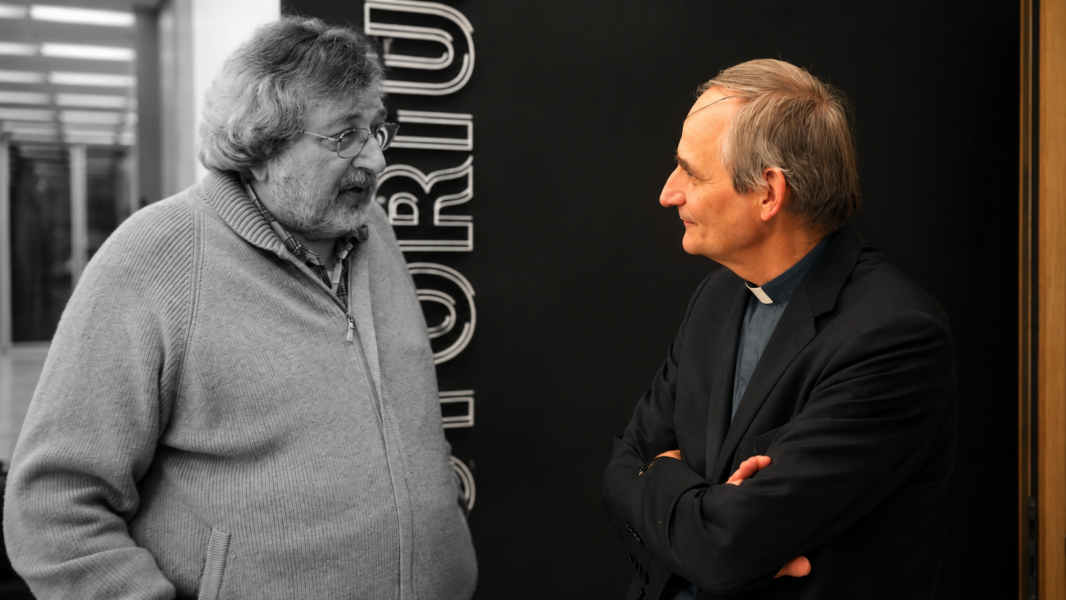
Cardinal Matteo Zuppi, Archbishop of Bologna and President of the Italian Episcopal Conference (CEI), took part on August 8 in the secular farewell ceremony for singer-songwriter Francesco Guccini, held in Pavana, Pistoia province, Italy. Before the musician’s coffin—who described himself as an “agnostic possibilist”—Zuppi interpreted his doubts and search for meaning from a Christian faith perspective and told him: “Today you find the answer.” The ceremony concluded with the Psalm of the Good Shepherd, a prayer, and the cardinal’s blessing.
Guccini had personally requested Zuppi’s presence, as the two shared a friendship. The prelate recalled that they had previously discussed death and that the singer had expressed his wish to have him by his side at his farewell. The ceremony formally maintained the secular character desired by the musician and his family: Zuppi did not celebrate a Catholic funeral rite but participated as a friend and cardinal.
From “agnostic possibilist” to the search for God
Zuppi began precisely with the religious self-description Guccini had given. The singer did not profess the Christian faith and considered himself an “agnostic possibilist,” an expression that left open the possibility of God’s existence without declaring himself a believer.
The cardinal presented that uncertainty as a lifelong search. “Doubt was the way of facing things without cheating, with integrity,” he stated. “You never stopped asking and listening,” he added, addressing the deceased.
Throughout his remarks, Zuppi drew on Guccini’s own songs to address his questions about the passage of time, friendship, politics, injustice, death, and the infinite. He recalled, among other verses, the question from Lettera: “But time—who will give me back the time?”
The religious question appeared at various stages of the singer-songwriter’s work. One of his best-known songs was Dio è morto (“God is Dead”), released in 1967, which described the moral crisis of his generation and ended by expressing hope for renewal.
“Whoever makes the human question their own always discovers the presence of God”
Addressing death directly, Zuppi more explicitly linked Guccini’s concerns with God.
“Whoever makes the human question their own always discovers the presence of God,” the president of the CEI affirmed.
The cardinal then cited a poem related to Guccini in which an agnostic imagines standing before God: “When I stand before you, Lord, if you do not forgive those who did not join the chorus of hosannas, perhaps you will forgive those who confessed, Lord, to having suffered your absence.”
Zuppi used these words to present faith as the answer to the questions the musician had kept open. He also recalled the image of a child in the womb, unable to imagine the world into which it will be born, to refer to the mystery of life after death.
“Faith gives words and certainty to that intuition of love, of the heart,” he stated.
Read also: Two Italian dioceses block Catholic funerals for prominent Freemasons
“Today you find the answer”
Toward the end of his remarks, the cardinal addressed the deceased singer directly and took a further step in interpreting that search:
“Today you find the answer, which was actually in the nostalgia, in the search for light, and in the wonder at the humanity you described in so many characters and encounters you made known to us.”
Zuppi also recalled the singer-songwriter’s political and social commitment. He highlighted his rejection of ideologies turned into dogmas, of prejudices, and of the division between friends and enemies, linking that attitude to a Christian vision of the person.
“Ideologies confuse and harm,” he stated. “We need giants, and those who please the Lord are not the great ones of this world, but those with a great heart, with much humanity, freely given, who share and do not calculate, who give and do not possess.”
He also recalled Guccini’s words against fear “of the different and the opposite” and his call to confront injustice.
Psalm, prayer, and blessing in a secular ceremony
The ceremony had been organized as a private, secular farewell. Zuppi did not preside over a Mass or celebrate the Catholic funeral rite, but his intervention concluded with explicitly religious elements.
The cardinal recited the Psalm of the Good Shepherd, offered a Christian prayer, and gave a blessing beside the coffin.
The intervention came at a time when the issue of funeral rites had gained particular relevance in Italy. The dioceses of Rome and Ventimiglia-San Remo had recently denied Catholic funerals to prominent Freemasons, while the bishop of the latter diocese, Antonio Suetta, later published a handbook recalling the limits of funeral celebrations and warning that the Church’s mercy cannot become “indifference to the truth.”
Zuppi’s words went beyond a personal remembrance of the singer. Before the coffin of the man who had defined himself as an “agnostic possibilist,” the president of the Italian bishops affirmed that Guccini had finally found “the answer,” which, according to the cardinal, was already present in his “nostalgia” and his “search for light.”