


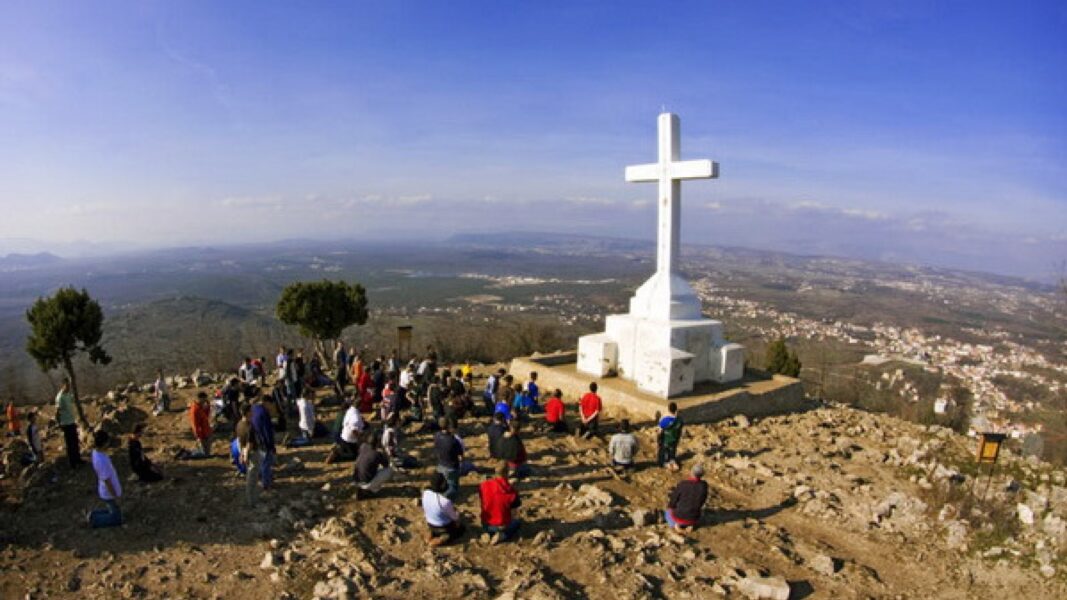
A few days ago, Infovaticana published an article about a secret consultation conducted in 2016 among 33 cardinals, bishops, and experts linked to the then Congregation for the Doctrine of the Faith, which reportedly yielded a wide majority opposed to the supernatural origin of the alleged apparitions of the Virgin Mary in Medjugorje. The international Commission had been commissioned by Pope Benedict XVI in 2010 to study in depth and assess the credibility of the alleged Marian apparitions. The confidential documentation published by Italian journalist Davide Murgia (a journalist who believes in the authenticity of the Medjugorje apparitions) revealed that 21 of those consulted voted for the constat de non supernaturalitate, nine for the constat de supernaturalitate, and three considered that there were insufficient elements to issue a definitive judgment.
In 2014, Bergoglio had dissolved the Commission created by his predecessor in 2010. Despite the negative opinion, the Pope sent Polish archbishop and nuncio Henryk Hoser to Medjugorje to analyze the phenomenon not from a doctrinal point of view, but from a pastoral one. That is, to understand whether the phenomenon had produced positive fruits such as conversions, prayer, devotion, fidelity to the Magisterium, etc. In 2019, following Hoser’s favorable opinion, Francis decided to officially authorize pilgrimages to Medjugorje, although this did not imply approval of the authenticity of the phenomena that had been occurring there since 1981. Thus the separation between the doctrinal judgment and the pastoral judgment began to emerge, which Pope Bergoglio would soon elevate to an official criterion of discernment: the changes made by Pope Francis in 2024 were significant, as they modified the process of discernment of apparitions and, more generally, of so-called private revelations. But the new norms introduce a decisive clarification: “As a general rule, these Norms do not foresee that ecclesiastical authority positively recognize the divine origin of supposed supernatural phenomena.” In other words: the Church should no longer approve private revelations. At most, it may grant a Nihil obstat, as happened precisely in the case of Medjugorje. The formula does not indicate that the phenomenon has been recognized as supernatural. Rather, it means that, without expressing certainty about its authenticity, many signs of the action of the Holy Spirit are acknowledged. For this reason, the bishop is encouraged to promote the experience pastorally and even to foster pilgrimages. From this humble platform we echoed the coincidental or causal convenience of that document (https://infovaticana.com/2024/10/12/medjugorje-el-aparicionismo-exaltado-y-el-dialogo-interreligioso/).
Much has been said and written, and much can still be said, about Medjugorje. In this text, I would simply like to return to the beginnings of the apparitions, presenting dates and facts, to note that the question of the alleged apparitions of Medjugorje is far from resolved, since its very principles (temporal and conceptual) are flawed. Simply and strangely, it aligns with the signs of the ecclesial times. That has been its fortune forty years after the beginning of the phenomenon.
To return to the dates and facts, we will rely mainly on the work of the French historian Yves Chiron, Medjugorje demasqué (1981 – 2010) (“Medjugorje Unmasked”), initially published in 2006 and reissued in a revised and expanded version in 2010. Chiron’s fieldwork dates back to Holy Week of 1993, when he traveled there as a pilgrim on a group trip organized in the midst of the Balkan war. He met with some visionaries and some of the guides, attended the “apparitions,” and met with the bishop of Mostar. Medjugorje, with a Croatian and Catholic majority, was not directly affected by the fighting, which is why his trip was possible. We will also highlight some ideas from an article by Gaetano Masciullo that appeared on the portal The Remnant on August 15, which we find very relevant.
We will focus on a few very specific issues from the first two decades: 1) the nature of the first alleged apparitions to the young visionaries; 2) the relationship between the Franciscans, in charge of the parish of Medjugorje, and the diocesan bishop; and 3) the role of the charismatic renewal. We will also mention, though secondarily, some unusual aspects of these alleged apparitions compared to others approved by the Church, and the doctrinal problems of some of the messages.
On the first day of the alleged apparitions, June 24, 1981, three teenagers claimed to have seen the Virgin (the Gospa) on the hill of Podbrdo, near the village of Medjugorje: Ivanka (15 years old), Mirjana (16 years old), and Milka (12 years old). Later, a fourth young woman, Vicka (16 years old), also “saw” the Virgin, and two other young men, Ivan Dragicevic (16 years old) and Ivan Ivankovik (20 years old), glimpsed a vague form, but fled in fear. Ivan Ivankovik did not return in the following days, nor did Milka. On the other hand, on June 25, the second day of the apparitions, two other people “saw”: Marija (16 years old) and Jakov (10 years old). Thus, from that day onward, the group of the “six” was formed, who for years would see the Virgin every day. Later, some (who received the famous ten “secrets”) would see her only once a year, while the others (who have not yet received their ten “secrets”) continue to see the Virgin daily. All of this culminates in the well-known promise of the “last apparitions of Mary and Jesus on earth” and in the ten secrets, a scheme that clearly seeks to reproduce that of Fatima, but distorts its meaning: while Fatima presented a single mystery of eschatological-ecclesiological scope, Medjugorje—like Garabandal—offers an apocalyptic version of the same, more spectacular than spiritual, a sign of a phenomenon that progressively moves away from Catholic theology to acquire features of mystification.
Because of the way the apparitions occurred, it is practically impossible to calculate the number. How many messages have there been to date? Thousands or tens of thousands? The question is further complicated by the fact that, while in the early years the visionaries had a daily apparition in common, later they began to have apparitions “separately.” In the entire history of the Church, no recognized apparition has lasted so long.
On the other hand, it is entirely disturbing how the first alleged apparitions occurred: An aspect often overlooked in Medjugorje circles concerns the anomalous nature of the first manifestations. The cycle of the alleged apparitions did not originate in an atmosphere of spiritual tranquility, as in Lourdes or Fatima, but in a context of genuine terror. According to the mariologist René Laurentin, a supporter of the authenticity of the phenomenon, the first vision was of a black creature that terrified the visionaries, forcing them to flee. Only later, when the visionaries returned to the hill, did the figure appear that was subsequently identified as the Virgin Mary.
On August 2, 1981, the apparition supposedly allowed those present to touch her. However, while they were “touching” her (whatever that may mean), the Virgin took on an increasingly dark appearance. The visionary Marija explained that this was due to the sins of those who touched her. On another occasion, on December 25, 1982, the visionary Mirjana claimed that, instead of the Virgin Mary, she had received the apparition of a monstrous creature that promised her success and wealth. Suddenly, this apparition transformed into the Virgin, who apologized to the visionary and explained that they had seen the devil and that everything had been a test.
The presence of fear, metamorphosis, laughter, and darkness undoubtedly contrasts with the Catholic mystical tradition, which associates authentic Marian manifestations with signs of grace and supernatural serenity, not with phenomena of ambiguity or terror.
Before the “apparitions” began, the parish of Medjugorje was under the care of a community of Franciscan friars who were in conflict with the diocesan bishop. Father Jozo Zovko was the parish priest of Medjugorje when the apparitions began. Although he was absent during the first three days of the apparitions, “a special grace of revelation,” according to his own words, led him to protect the visionaries from the communist militia. From then on, he played a decisive role as guide and formator alongside the visionaries. When the apparitions began on June 24, 1981, the six visionaries were spiritually guided by two other Franciscan friars from the Medjugorje community, Ivica Vego and Ivan Prusina, who had just been admonished by Bishop Žanić precisely for disobedience: the bishop ordered them to leave the place where they exercised their ministry, but the two friars, relying on the power that the Franciscan order had historically exercised in Bosnia-Herzegovina, resisted. While this controversy was unfolding, the alleged apparitions began. The Franciscans’ support for a phenomenon that the bishop did not believe in from the beginning aggravated the problems. Strangely, the supposed apparition began to intervene in the matter, in favor of the Franciscans: on December 19, 1981, barely six months after the apparitions began, Vicka Ivanković, one of the visionaries, recorded in her diary a response attributed to the Gospa regarding the controversy. According to that record, the supposed Virgin Mary stated that Bishop Žanić was “responsible for the disorder” and that Ivica Vego “was innocent,” even ordering him to remain in Mostar and not leave.
The parish priest, Father Jozo, had been arrested in August 1981 by the communist authorities and remained imprisoned for a long time. For this reason, he is considered the first martyr of the Medjugorje apparitions. He claimed that, in prison, the Virgin also appeared to him, which strengthened his determination to become a defender of the authenticity of the apparitions. After his release from prison, Father Jozo had to leave Medjugorje, moving to reside in the convent of Siroki-Brijeg, just 30 km from Medjugorje. In the early 1990s, when Yves Chiron traveled to the place, groups of pilgrims would visit him and listen to him at his convent. The visit Chiron describes is a textbook charismatic performance: Father Jozo delivered a mixture of preaching and prayer lasting an hour and a half, at the end of which he went through the temple crowded with pilgrims laying hands on them in the charismatic manner, causing dozens of pilgrims to fall for minutes in the well-known “resting in the Spirit.”
Chiron interviewed on his trip the Franciscan Father Slavo Barbaric (who died on November 24, 2000), who had been exercising his ministry in the parish of Medjugorje since 1982 and was the Franciscan best informed about the events of Medjugorje, but also the one with the broadest view of the phenomenon, based on a vast knowledge of religious psychology and the history of mysticism. He was the spiritual director of the visionaries, but from 1986 onward, “the greater influx of pilgrims” prevented him from continuing regularly with that spiritual direction.
Another obligatory visit in the 1990s, at least for French-speaking pilgrims, was to Sister Emmanuel, belonging to the Community of the Beatitudes, a charismatic community established in Medjugorje shortly after the beginning of the “apparitions”. Sister Emmanuel offered pilgrims a conference on the phenomena of Medjugorje, with anecdotes that seemed edifying to her and which, according to her—Chiron states—constituted proofs of the authenticity of the apparitions. To the French historian, on the contrary, the facts narrated by the religious sister seemed incongruent in relation to the authentic apparitions recognized by the Church. Sister Emmanuel said that “the Virgin, during some apparitions, lays her hands on the visionaries to bless them”; that “one day, the Virgin took from the hands of a visionary a photograph of the Pope and kissed it; and that, on another occasion, during the apparitions, the visionaries were writhing with laughter. When afterward they were asked why they had burst out laughing, they replied that the Virgin also ‘laughed.’”
Sister Emmanuel also explained how the charismatics arrived there: in August 1983, the Virgin asked two prominent figures of the charismatic world, Philippe Madre and Father Emiliano Tardif, to “transmit (her) messages to the world.” Some of the Franciscan religious in charge of the parish of Medjugorje, who had been assisting the visionaries from the beginning and spreading the Virgin’s messages, already belonged to the Charismatic Renewal.
From the end of 1983 onward, a kind of division of tasks took place: the Franciscans continued accompanying the visionaries, at least attempting to guide them spiritually, while the charismatics of the Community of the Beatitudes took charge of spreading the Virgin’s messages. A man played an essential role alongside the visionaries: Cyrille Auboyneau, both friend and interpreter, settled in Medjugorje since 1984. He was the one who translated, until 1991, the messages received in Croatian by the visionaries.
Yves Chiron considers that two phases in the apparitions can be distinguished: from 1981 to 1983, the visionaries managed on their own, although very close to the Franciscan fathers of the parish. The messages of the Virgin they transmitted then had very varied content; some apparently contradictory to Catholic doctrine. Then, from 1983—early 1984, the date when the Charismatic Renewal and Cyrille Auboyneau took charge of spreading the messages, these became very repetitive, stereotyped, of the same length each time, and lacking new elements.
Father Slavko had also spoken with Chiron about the contrast between the words of the first years of the apparitions and the stereotyped messages from 1984 onward. He acknowledges: “Before March 1984, there were no messages properly speaking. It was a repetitive pedagogy, like that of a mother with her child.”
Chiron also interviewed in 1993 the coadjutor bishop of the diocese of Mostar—to which the parish of Medjugorje belongs—Mgr Peric. In a city destroyed by bombings, the bishop had set up his offices in the basement of the cathedral. Monsignor Zanic, the titular bishop, was hospitalized in Split; and Monsignor Peric had been appointed coadjutor in May 1992. Like Monsignor Zanic, who was the first to have to judge the events of Medjugorje, and like the Commission of Inquiry that ruled against them on April 10, 1991, Monsignor Peric considers that there is nothing supernatural in the events of Medjugorje. Monsignor Zanic had lived with great anguish the issue of the apparitions. For him, it was a matter of conscience, according to his coadjutor. In addition, Monsignor Peric provided an important clarification: “The majority of the faithful of the diocese do not believe in the apparitions; only some of the parishioners of the parishes administered by the Franciscans believe in them.”
Regarding this negative judgment of the diocesan authorities, Father Slavko had responded to Chiron that “recognition by the Church is not important. The Virgin Mary does not wait to be recognized.”
What is a fact is that the particularities of the alleged apparitions of Medjugorje and the doctrinal errors contained in the messages transmitted there were pointed out, from the beginning, by the ecclesiastical authorities on whom the parish of Medjugorje depends. The bishop of Mostar at the beginning of the apparitions, Monsignor Zanic, personally questioned the visionaries. He created, from the beginning, a commission of inquiry. Two other commissions of inquiry were created. Already in 1984, pastoral guidelines were issued and official pilgrimages to Medjugorje were prohibited. In 1991, the Yugoslav Episcopal Conference published the result of the long work of its commission of inquiry and declared: “It is not possible to affirm that these are supernatural apparitions or revelations”. It was a Non constat de supernaturalitate. In 1997, Monsignor Peric, successor to Monsignor Zanic at the head of the diocese of Mostar, went further in the assessment of the events, since he affirmed a Constat de non supernaturalitate. The same was said by the majority of those consulted in the 2016 survey we mentioned at the beginning.
To date, the multiple investigations and interrogations carried out have not allowed establishing the supernatural character of the events and the messages. But the successive negative rulings of the episcopal and diocesan authorities from the beginning also could not stop the pace of pilgrimages to Medjugorje: already in 2010, some 20 million had been counted since 1981; nor did they prevent the publication of books that presented the events of Medjugorje as supernatural. A great specialist in Marian issues, such as Father René Laurentin, bet on it, as we have said, with his authority for nearly twenty years before “stopping publishing on Medjugorje” at the request of ecclesiastical authorities.
Many of the supposed messages of the Virgin in Medjugorje focus on world peace (Mary in Medjugorje is called “Queen of Peace”), the call to conversion, and fasting, but there are many problems in them, to such an extent that, with such a quantity of messages, it is impossible to cover in a single article all the theological errors, the contradictions hidden in the thousands of messages that the Gospa supposedly transmitted continuously to the Bosnian visionaries, the numerous seriously problematic implications for spiritual and ecclesial life that arise from a possible acceptance of what was “communicated” to the six Bosnian visionaries. Much has been said about the messages bearing religious indifferentism (“Muslims and Orthodox, like Catholics, are equal before my Son and before me”), unverified catastrophic and apocalyptic predictions (“I have come to call the world to conversion for the last time, for after this I will no longer appear on earth,” “This century is under the power of the devil, but when the secrets entrusted to you are revealed, his power will be destroyed”), and others, consultable in various critical works published over the years.
From this confrontation between the Franciscans and the charismatics on one side and the diocesan authorities on the other, for Gaetano Masciullo in his article in The Remnant, the most serious aspect of the Medjugorje phenomenon in terms of its fruits is that of disobedience. For the journalist, “in fact, we could say that the case of Medjugorje was conceived in this sin”.
Have there been and are there good fruits of conversion in Medjugorje? It seems so. Did the Lord say that the tree is known by its fruits? No Catholic can deny the importance of spiritual fruits—Masciullo affirms, precisely because of this statement of Our Lord (Matthew 7:20). However, this evangelical principle does not imply that every phenomenon that produces good fruits necessarily comes from a good tree. This is also because the goodness of certain fruits may be only perceived, not real. For the Scriptures also say: “Do not believe every spirit, but test the spirits to see whether they really come from God” (1 John 4:1). Therefore, Christian discernment does not consist simply in counting conversions and returns to the sacraments. But if one starts from the premise that everything that produces positive spiritual fruits automatically comes from God—an idea very common in Medjugorje—the presence of conversions, vocations, prayers, and works of charity becomes a kind of implicit certification of divine origin; and in this the change introduced by Pope Francis in 2024 contributes even more confusion, highlighting the good fruits, but without pronouncing on supernaturality.
Masciullo highlights that the main criterion of discernment in the history of the Church is obedience: “It is not enough to limit oneself to the ‘pastoral’ judgment to approve, at least indirectly, a supposed private revelation; in fact, it can be very misleading. Therefore, it is necessary to recover a traditional criterion of Catholic discernment that runs the risk of being obscured by the contemporary emphasis on ‘pastoral fruits.’
This ambiguity in everything surrounding Medjugorje, increased by the contributions of Pope Bergoglio, is perhaps what makes the case of Medjugorje such an emblematic symbol of the contemporary Church, Masciullo considers: “a Church that, when it should exercise its work of discernment, prefers to suspend judgment, take refuge in indeterminacy, and let time—in other words: the ‘pastoral’ success of personal experiences and the economic machinery—decide in its place. In this sense, Medjugorje seems almost to be a ‘support’ for the synodal Church: both represent a Church indulgent with the ambiguous, as long as it produces broad consensus, participation, and ‘pastoral’ results in which personal experience prevails over the infallibility of dogma. And perhaps this is the true anomaly that the case of Medjugorje leaves us: not only that of an apparition that has been waiting forty-five years for a definitive judgment, but that of a Church that seems to have lost the courage, and even the interest, to pronounce it.”
Note: Articles published as Tribune express the opinion of their authors and do not necessarily represent the editorial line of Infovaticana, which offers this space as a forum for reflection and dialogue.