


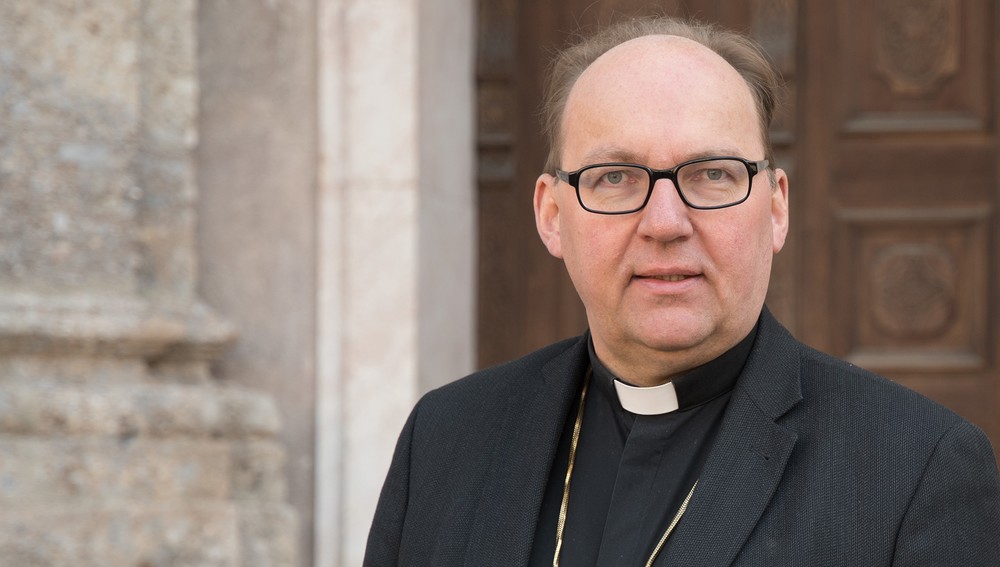
The Bishop of Innsbruck, Austria, Hermann Glettler, has expressed concern over the links of some leaders of pro-life organizations with right-wing parties and has warned that associations dedicated to the protection of life are being “instrumentalized or infiltrated” by forces he places between “right-wing populism” and the “far right.” The Austrian prelate, who in recent years has sparked controversy over his positions on blessings for same-sex couples, women’s ordination, and various art installations in churches, also maintained that “the protection of life is neither right-wing nor left-wing” and rejected the promotion from the left of a supposed “right to abortion.”
The statements were made to the Austrian weekly Die Furche after the newspaper Der Standard reported on the political ties of two leaders of Jugend für das Leben (Youth for Life). The organization has been recognized since 1999 as a private ecclesiastical association by the Austrian Episcopal Conference, although it does not act officially on behalf of the Church.
The political links highlighted
One case is that of Frederik Koller, president of Jugend für das Leben and municipal councilor for Alternative for Germany (AfD) in Altomünster, Bavaria (Germany).
The second concerns Natalie Walch, spokesperson for the organization, who participated together with her husband, Fabian Walch —a politician from the Freedom Party of Austria (FPÖ)— in an event organized by the Antaios publishing house held in Schnellroda, Saxony-Anhalt (Germany). According to information gathered by the Diocese of Innsbruck itself, Martin Sellner, leader of the Austrian identitarian movement, was also present at that event.
Based on these facts, Glettler stated that he finds it “alarming” that organizations committed to the integral protection of life could be “instrumentalized or infiltrated” by parties that range, according to his own characterization, from right-wing populism to the far right.
The bishop, however, did not extend this assessment to the entirety of Jugend für das Leben. He stated that he is convinced that the majority of its members do not come from right-wing populist circles and noted that he maintains conversations with the leadership of the association.
“The protection of life is neither right-wing nor left-wing”
Glettler maintained that the position on abortion is being used as an element of political affiliation and called for the defense of life to be “depoliticized” and “de-ideologized.”
“The protection of life is neither right-wing nor left-wing. It must not become a vehicle for ideological polarization or, worse still, a political weapon against those who think differently,” he stated.
His criticism was also directed at the left. The bishop expressly rejected the campaign to establish a “right to abortion” promoted by that political sector and stated that he also opposes that claim.
According to Glettler, the debate should place women, children, families, and people in need of support in difficult situations at the forefront, rather than turning the defense of life into an instrument of partisan confrontation.
Glettler had supported the pro-life organization
The statements come just weeks after Glettler himself publicly supported a rally organized by Jugend für das Leben in Innsbruck.
On August 1, the bishop sent a written message to the participants in which he stated that the humanity of a society can be measured by the way it treats its weakest members. “Every child, from the moment of conception, is a unique and precious gift from God,” he affirmed.
Glettler was also explicit in his rejection of abortion: “Abortion is not a health service”, he stated. The prelate argued that, precisely for this reason, it should not be performed in public health centers and concluded his intervention by calling for all conceived children to be allowed to be born.
This position coincides with the one he had expressed in May, when the regional government of Tyrol, Austria, decided to allow abortions as a private service in a center belonging to the regional public clinics. At that time, he stated that “a pregnancy is not a disease and an abortion is not a therapy” and maintained that a woman’s right to self-determination cannot be opposed to the fundamental right to life.
The current controversy, therefore, does not stem from a disagreement between Glettler and Jugend für das Leben on the defense of the unborn child, but rather from the political ties of some leaders of the organization and the risk of partisan instrumentalization that the bishop says he perceives in them.
Glettler’s controversial positions
The bishop’s criticisms of the political ties of some pro-life leaders occur in the context of a trajectory marked by various ecclesiastical controversies.
In 2021, after the then Congregation for the Doctrine of the Faith denied that the Church had the power to bless unions between persons of the same sex, Glettler publicly criticized the Roman response. The prelate described the attempt to address such an issue through a declaration as “old school” and maintained that the document could be received as an “offense.”
Glettler even proposed that family members themselves bless same-sex couples, arguing that “a blessing is not a sacrament.” At the same time, he acknowledged that the Church would continue to defend marriage as a union between a man and a woman.
Read also: The Bishop of Innsbruck, on the ‘responsum’: “A blessing is not a sacrament”
The prelate has also made controversial statements regarding women’s ordination. In 2020, he described the impossibility of ordaining women as priests as an inequality that is “difficult to justify.” The Church maintains that it does not have the faculty to confer priestly ordination on women, a doctrine that Saint John Paul II established must be definitively upheld by all the faithful.
Glettler has also promoted pastoral initiatives aimed at divorced and civilly remarried persons and has shown himself favorable to ecclesial welcome formulas for homosexual persons.
His controversial art installations in churches
Another aspect that has repeatedly placed the Bishop of Innsbruck at the center of controversy has been his promotion of contemporary art installations in sacred spaces.
During Lent 2022, the university church of Saint John Nepomucene in Innsbruck was decorated with a large image of a semi-naked man placed in the presbytery space. Glettler himself participated in the inauguration of the installation and publicly defended it against criticism.
Read also: Bishop of Austria defends the decoration of a church with the image of a semi-naked man
In 2023, another Lenten installation in the hospital church of Innsbruck caused controversy, showing a pig’s heart partially covered by a condom.
These positions have made Glettler one of the most controversial Austrian prelates on pastoral and artistic issues. On abortion, however, the bishop publicly maintains a pro-life stance: he rejects the existence of a right to abortion, denies that it can be considered a health service, and defends the protection of the child from conception.
His current warning is directed specifically at the partisan connections of some leaders of the pro-life movement: Glettler believes they could lead to a political appropriation of the cause by right-wing sectors, while maintaining that the same criticism must be directed at the left when it seeks to turn abortion into a right.