


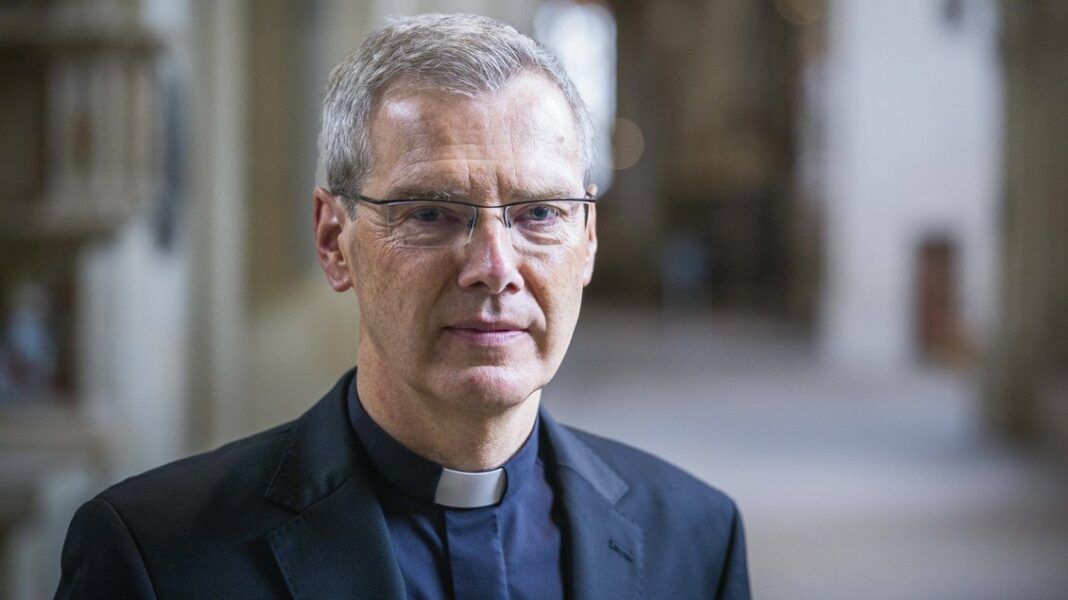
The president of the German Episcopal Conference and bishop of Münster, Germany, Heiner Wilmer, has expressed his “great respect” and “deep gratitude” for the practice of lay preaching during Mass, despite the Vatican’s rejection in June of the request submitted by the German episcopate itself to authorize it in exceptional circumstances. In a wide-ranging interview published by Kirche+Leben, Wilmer also stated that he trusts the pastoral agents of his diocese to find “a good path” to address the situation following Rome’s response.
The German request had formally reached the Vatican on March 30. The Episcopal Conference requested an indult allowing duly authorized lay faithful to preach in place of the homily during the Eucharistic celebration in certain cases. The Dicastery for Divine Worship and the Discipline of the Sacraments responded negatively in a letter dated June 17.
Read also: Rome says no to Germany: the homily will remain reserved for priests and deacons
“I have great respect for this tradition”
Asked about the situation of the pastoral agents of Münster after that refusal, Wilmer highlighted the practice that has existed for years in his new diocese.
“Although I am still quite new as bishop of Münster, I know that in our diocese for many years many baptized women and men have been dealing with this issue and a culture has been developing,” he stated.
“I have great respect for this tradition that has been growing and I feel deep gratitude,” added the president of the German bishops.
Wilmer also said he had “respect for Rome’s response,” but did not suggest abandoning the practice in the interview. “At the same time, I am firmly convinced that the excellent pastoral agents of our diocese will find a good path to adequately address the circumstances. I have great confidence in them and am very grateful to them for their great work and their witness,” he noted.
The question also referred to the position adopted by the bishop of Mainz, Germany, Peter Kohlgraf, who has stated that he will not sanction the lay preachings already taking place in German dioceses. Wilmer did not announce disciplinary measures nor indicate that he would modify the existing practice in Münster.
Rome rejected the German request in June
The Vatican’s refusal responded to a request made by the German bishops following one of the agreements of the Synodal Way. Wilmer had submitted the request for an indult on March 30 that would allow authorized laypeople to preach during the Eucharistic celebration in exceptional circumstances.
The Dicastery for Divine Worship responded that the reservation of the homily to the priest or deacon “is not merely a disciplinary norm”, but derives from the very nature of the liturgy. It also recalled that the homily is an integral part of the Liturgy of the Word and is linked to the teaching mission sacramentally received by ordained ministers.
The Roman response also excluded the possibility of introducing into the Mass an intervention equivalent to the homily under another name. At the same time, it recalled the possibilities provided by Church discipline for the laity to participate in other forms of preaching and proclamation of the Word outside the homily.
Read also: The German Synodal Way does not accept Rome’s NO and calls for renewed negotiations on lay preaching
The reforms of the Synodal Way “continue to be worked on”
Lay preaching is part of the proposals promoted during the German Synodal Way. Following the Vatican’s refusal, the Central Committee of German Catholics (ZdK) called for the issue not to be considered closed and urged the bishops to continue negotiating it with Rome.
Wilmer also confirmed that he does not consider other matters promoted during the synodal process to be concluded either. Asked by Kirche+Leben about women, sexual morality, celibacy, and ecclesial participation, he replied: “The issues are not settled; they continue to be worked on”.
The president of the German episcopate explained that in the autumn he will participate in Linz, Austria, in a meeting of theologians, bishops, and other European representatives to address these questions. He also announced that he will travel in October to Rome, Italy, to take part in an eight-day meeting convened by Leo XIV with the presidents of the episcopal conferences.
Rome is also studying the statutes of the future German Synodal Conference, submitted in March. Asked about their processing, Wilmer stated that the text continues to be examined at the Vatican and expressed that he is “confident” the process will move forward.
Read also: Msgr. Wilmer personally delivers the statutes of the controversial German Synodal Way in Rome
Wilmer has presided over the German Episcopal Conference since February of this year and subsequently assumed the pastoral governance of Münster, the diocese with the largest number of Catholics in Germany.