


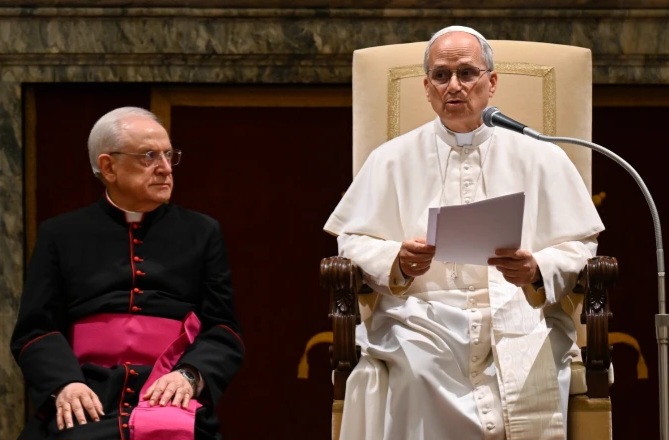
Pope Leo XIV received participants in the XVII Annual Meeting of the International Catholic Legislators Network this Friday, August 21, at the Vatican Apostolic Palace. This year’s gathering focused on the theme “Human Dignity and Artificial Intelligence: Challenges, Opportunities, and Control.” The Pope centered his address on the responsibility of legislators in the development of artificial intelligence, stating that the task of politics “is not to hinder innovation, but to guide it wisely,” and calling for robust legal frameworks that protect fundamental rights, privacy, and transparency, while preventing any single ideology or interest from determining the values embedded in AI systems.
The Pontiff also warned of the risk of new forms of dependency between rich and poor countries and urged that innovation not become a vehicle for “ideological or economic colonialism.” Pope Leo XIV paid particular attention to the family, which he described as “the first school of humanity,” and maintained that artificial intelligence must never erode it by reducing human relationships to data and simulations, content that “distorts the desire” of young people, or economic models that render family life precarious. For this reason, he expressly encouraged legislators to promote policies that strengthen marriage and families and support parents in their educational mission.
Below, we offer the full address of Pope Leo XIV:
Your Eminences,
distinguished ladies and gentlemen,
dear brothers and sisters in Christ:
It is a joy for me to greet you, members of the International Catholic Legislators Network, and in particular Cardinal Schönborn and Cardinal Bo, patrons of this Network.
The theme of your annual meeting, “Human Dignity and Artificial Intelligence: Challenges, Opportunities, and Control,” offers you the opportunity to reflect on one of the defining issues of our time. The extraordinary progress of artificial intelligence is opening horizons that previous generations could scarcely have imagined. Yet every technological achievement also confronts humanity with a moral question: not simply what can we do?, but what ought we to do?
Indeed, our human family today faces a decisive choice. As I wrote in the Encyclical Letter Magnifica Humanitas, we may be tempted to build a new Tower of Babel, where power, efficiency, and control obscure the face of the human person; or we may build a civilization in which technology serves the integral development of every person (cf. nn. 7-10).
The decisive question remains the same: does technology help people to become more fraternal and responsible toward themselves and others? In this regard, the principles of the Church’s Social Doctrine—the inviolable dignity of every person, the common good, the universal destination of goods, subsidiarity, and solidarity—provide reliable criteria for discernment.
Dear legislators, your vocation places you at the heart of this challenge. Responsible for establishing policies to manage technology in service of the common good, your task is not to hinder innovation, but to guide it wisely (cf. Francis, Address to Participants in the Meeting Promoted by the International Catholic Legislators Network, 27 August 2021).
Appropriate legislation must foster scientific and technological creativity while safeguarding fundamental rights and freedoms. It must protect users from exploitation, preserve personal privacy, ensure transparency in the use of emerging technologies, and guarantee that these technologies strengthen democratic institutions.
To this end, “solid legal frameworks, independent oversight, informed users, and a political system that does not abdicate its responsibility are required” (Magnifica Humanitas, n. 106). This oversight can be exercised at multiple levels—local, national, and international—facilitating open debate on “the ethical frameworks involved and subjecting them to shared criteria of social justice” (n. 107), and ensuring that no ideology or particular interest dictates the values embedded in artificial intelligence systems.
At the same time, the rapid development of artificial intelligence risks creating new forms of technological dependency, making poorer nations increasingly reliant on richer ones. We must remain vigilant in this regard, to prevent innovation from becoming another vehicle of ideological or economic colonialism (cf. nn. 178-179).
Unfortunately, a subtle form of domination presents itself when algorithms decide who is seen and who remains invisible, when digital platforms shape public discourse without accountability, and when the dignity of workers is subordinated to system optimization (cf. nn. 95, 150, 171). These developments reveal a new face of the ancient temptation to dominate and exercise power without serving.
In the face of this culture of power, the Church proposes “the civilization of love” (Paul VI, Regina Caeli, 17 May 1970; cf. Magnifica Humanitas, n. 186), a civilization that wisely governs artificial intelligence by cultivating hearts capable of charity, compassion, and responsibility.
In such a society, the first school of humanity would be the family. For it is in the family that we first learn trust before calculation, generosity before competition, dialogue before division, and love before power.
Artificial intelligence must never be allowed to erode this primary cell of society, whether by reducing persons and relationships to data and simulations, flooding young minds with content that distorts desire, or through economic models that render family life economically precarious.
For this reason, I encourage you to promote policies that strengthen marriage and families, support parents in their educational mission, and enable young people to look to the future with confidence.
Dear friends, the world does not need an artificial intelligence that diminishes humanity; rather, it needs a human intelligence enlightened by wisdom, a political authority guided by conscience, and a technological innovation oriented by charity. Only then will artificial intelligence become not a rival of humanity, but a servant of the common good.
With these thoughts, I pray that your deliberations may bear abundant fruit for your nations and for the entire human family. May the Blessed Virgin Mary, Mother of Good Counsel, always accompany you. Upon you, your families, and all those entrusted to your service, I gladly invoke the abundant blessings of God.
Thank you.