


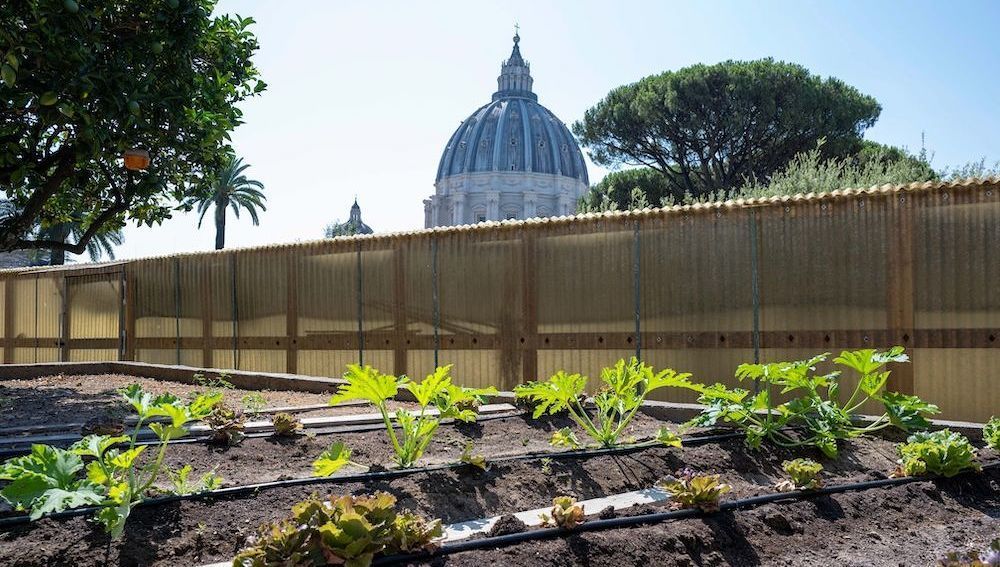
The Vatican will apply the principles of so-called «integral ecology» to the historic orchard located next to the Mater Ecclesiae monastery in the Vatican Gardens. The plot, cultivated for centuries and currently used to supply the nuns, will be managed entirely with ecological methods, in a new practical application of the environmental agenda promoted by Francis starting with Laudato si’ and maintained during the pontificate of Leo XIV.
According to Vatican News, the goal will not be to maximize production, but to preserve the soil and plants, respect the natural cycles of growth and harvest, and minimize the use of phytosanitary products. The land covers nearly 400 square meters distributed across four terraces.
Organic crops and algae-based fertilizers
Management falls to the Gardens and Environment Service of the Governorate of Vatican City State. An experienced gardener works alongside younger employees, while the nuns of Mater Ecclesiae participate by indicating which products the community needs.
Fertilization will be carried out exclusively with certified pellet products. Crop rotation and agronomic techniques aimed at preserving soil fertility will also be used. Among these is the planting of legumes to promote nitrogen fixation in the soil.
A fertilizer made from algae is also currently being tested on tomato plants. Irrigation, despite the introduction of these new criteria, continues to be done entirely by hand.
Depending on the time of year, the orchard grows garlic, basil, chili peppers, tomatoes, eggplants, peppers, zucchini, cucumbers, and pumpkins. At the end of August, sowing for the winter season will begin, with cabbages, broccoli, spinach, and lettuce.
The environmental agenda of Laudato si’
The transformation of the orchard is linked to the principles of Laudato si’, the encyclical on the care of the «common home» published by Francis in 2015 and which became a reference during his pontificate for numerous environmental initiatives of the Holy See.
Leo XIV has maintained this line. In an address to Italian agronomists and forestry professionals, the Pope presented their work as a concrete form of responsibility toward the land and future generations and recalled that the earth «is not a possession, but a gift.»
Continuity was also reflected in July 2025, when Leo XIV celebrated at Castel Gandolfo the first Mass with the new form Pro custodia creationis, incorporated into the Roman Missal to pray for the care of creation.
Read also: Leo XIV celebrates the first Mass «Pro custodia creationis» at Castel Gandolfo
The Mater Ecclesiae initiative now brings this environmental orientation to a much more domestic scale: an orchard primarily intended for the consumption of a religious community.
150-year-old citrus trees and products made by the nuns
One of the most distinctive elements of the land is its citrus trees, some of which are around 150 years old. Their fruits are used without treatments, and the nuns use them to make jams, candied peels, and cookies.
The harvests from the orchard mainly serve the needs of the nuns themselves, and a portion may also be allocated for charitable purposes.
Mater Ecclesiae once again housed a contemplative community in January 2024, when six Benedictine nuns arrived from the Abbey of Santa Escolástica in Victoria, Argentina. Francis had arranged for the building to recover the purpose for which it was conceived by Saint John Paul II.
An orchard with eight centuries of history
The agricultural history of this area of the Vatican predates the current monastery. Its origins date back to the late 13th century, when Pope Nicholas III, after moving the papal residence from the Lateran to the Vatican, ordered the creation of an orchard and a fruit tree garden on the land to supply the papal household.
The agricultural tradition of the place thus spans about 800 years of history, although the land and its uses have undergone numerous transformations since then.
The Mater Ecclesiae monastery, for its part, was established by Saint John Paul II in the 1990s to successively welcome contemplative women’s communities dedicated in particular to praying for the Pope and for the Church.
The last home of Benedict XVI
The place gained special relevance after Benedict XVI’s resignation. After leaving Castel Gandolfo, Joseph Ratzinger moved into Mater Ecclesiae on May 2, 2013, and turned the former monastery into his residence.
His final years were spent there, marked by prayer, study, and a life withdrawn from public activity, until his death on December 31, 2022.
Read also: Benedict XVI’s last home will house a community of Benedictine nuns from Buenos Aires
With the arrival of the Argentine nuns, Mater Ecclesiae recovered its original contemplative function. Its former orchard also retains its most basic purpose—providing food for those who live there—although the Vatican now expressly incorporates it into initiatives inspired by the «integral ecology» of Laudato si’.