


By P. Gerald E. Murray
The recent annual assembly of the Leadership Conference of Women Religious received a video message from Pope Leo XIV, in which he stated:
All Christians are called to be builders of Christ’s communion, formed in a synodal Church in which all cooperate in the same mission according to their own charism and ministry. In a special way, those in religious life are called to become experts in synodality because of the opportunities that community life affords them to practice it, as well as the very structure in which their congregations are organized.
However, what is “a synodal Church” in which religious sisters are “called to become experts in synodality”?
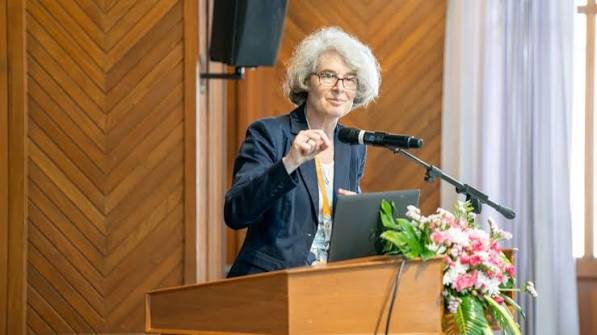
An answer to this question was offered by Sister Nathalie Becquart, XMCJ, undersecretary of the Synod of Bishops, who addressed the assembly in person:
Synodality is not a program to be implemented, nor a project with a deadline in 2028, nor just another meeting. It is our deep identity as Church, rooted in the mystery of the Trinity. It is not about being another Church, but about being the Church in a different way… moving from one culture to another: from a culture of clericalism, hierarchism, and institutional self-sufficiency to a culture of listening, co-responsibility, discernment, and genuine exchange.
She went on to describe synodality as a “social prophecy” and a “grammar of peace.” She also added: “What I have learned in these years accompanying the synodal process of the Universal Church is this: the Holy Spirit is not waiting for us to be ready. The Spirit is already acting.”
Sister Becquart’s remarks are opaquely revealing: synodality is presented as a necessary innovation, a distinct culture, an indispensable reform effort to recover the Church’s true identity and vitality. Synodality would imply the birth of a new style of “being Church,” yet it would not be “another Church” in contradiction with the pre-synodal Church. Incoherent reassurances like these are a smokescreen that conceals the obvious: the synodal project is an attempt to reshape the Catholic Church into a new entity, akin to various Protestant churches.
A close examination of Sister Becquart’s statements reveals that this is simply an exercise in propaganda. Slogans are useful in advertising. Synodality is a new and unknown product on the market. Cautious customers must be convinced to buy it.
-
If synodality “is not a program to be implemented,” why does the website of the Synod Secretariat present it as a program that must be implemented?
-
In 2028 the Synod Secretariat will hold an Ecclesial Assembly. If synodality “is not a project with a deadline in 2028,” does that mean the Ecclesial Assembly is simply the first of an endless series of Ecclesial Assemblies?
-
If synodality “is not just another meeting,” why are more meetings being scheduled?
-
What is the “deep identity of the Church”? Was this identity unknown until Pope Francis invented synodality? Who identified this deep identity and how did they do so?
-
What is the difference between being “another Church” and “being the Church in a different way”? What does “being the Church in a different way” mean? Different from what?
-
What do “clericalism, hierarchism, and institutional self-sufficiency” mean? What is clericalism and who are the clericalists? What on earth is hierarchism? Is the Catholic Church not hierarchical by nature, meaning it is governed by ordained hierarchs? Does God not give the Church, the Mystical Body of Christ, enough to carry out its mission of preaching the Gospel, sanctifying humanity through the administration of the sacraments, and providing pastors for the wise governance of Christ’s flock? What does the Church lack and who can supply that need?
-
Why is it claimed that the Church currently lacks “a culture of listening, co-responsibility, discernment, and genuine exchange”? What does co-responsibility mean? Does it mean that decision-making by the hierarchy alone must be set aside in favor of joint decision-making in which the hierarchy and the laity govern the Church together?
-
What is social prophecy? Who exercises that prophecy? Who decides that it is a true prophecy and not a false prophecy, that is, someone’s opinion falsely presented as the will of God?
-
What is the grammar of peace? Does peace have a grammar?
The Holy Spirit is always acting within the Church of God. How does Sister Becquart know that He is acting now to call us to accept the emergence of a synodal “Church in a different way”?
Sister Becquart’s observations confirm that synodality is a word practically devoid of content, used by those in charge of the synodal process to promote a series of ideas of a scandalously revolutionary nature, and which therefore require semantic camouflage.
Those in charge of the Synod have created a semantic shield for their project. They attempt to hide the plain and simple truth: they want to create a new Church with a new doctrine, in which the hierarchy shares governing authority with the laity and in which heterodox impositions are presented as the communal discernment of where the Holy Spirit is leading the Church.
They present themselves as reformers, not as revolutionaries. They simply claim to want to eliminate an outdated clericalist and “hierarchist” culture, a remnant of a lamentable past, which supposedly diverted the Church from its true synodal nature; a nature that would now be restored by the common effort of all the faithful, guided by the Holy Spirit (and by the Synod Secretariat) to shake off that obsolete culture.
The synodal steamroller poses a danger to the Church. It must be recognized for what it is and stopped before it causes further havoc in the Church.
About the author
Rev. Gerald E. Murray, J.C.D., is a canonist and pastor of St. Joseph’s Church in New York City. His new book (co-authored with Diane Montagna), Calming the Storm: Navigating the Crises Facing the Catholic Church and Society, is now available.