


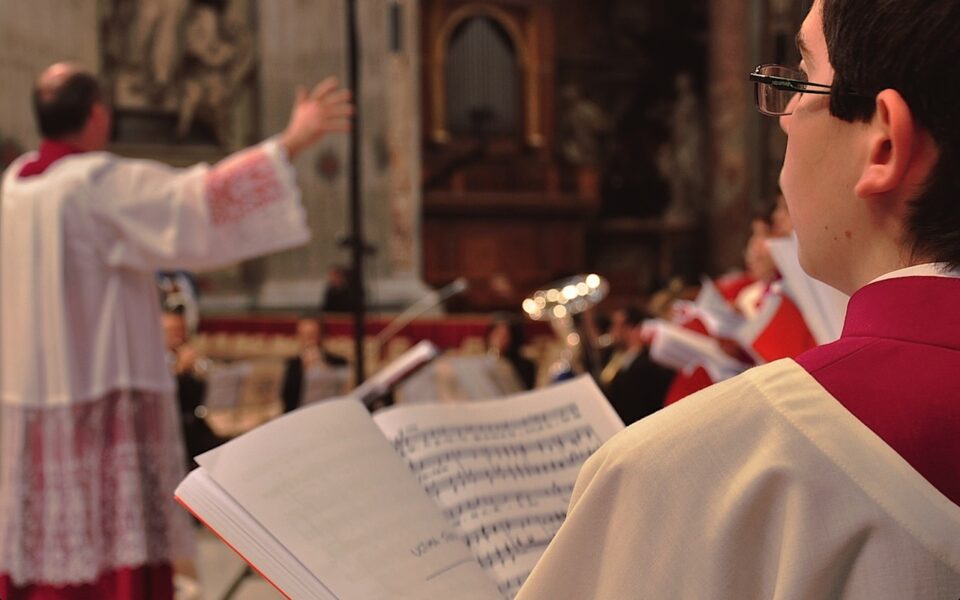
Pope Leo XIV has dedicated this Wednesday’s general audience, August 19, to sacred music, within his cycle of catechesis on the documents of the Second Vatican Council. Addressing the sixth chapter of Sacrosanctum Concilium, the Pope stressed that music “is part of the liturgical action and not mere decoration of the celebration” and recalled that it must be closely united to the liturgy, respond to its sacred character, and foster the prayer and communion of the faithful.
The Pontiff also claimed the particular place the Council assigns to Gregorian chant and the organ, while calling for music that is “noble and simple,” texts inspired primarily by Sacred Scripture, the liturgical books, and Tradition, and solid formation for composers and singers. Pope Leo XIV likewise warned against “careless music and texts that are not in keeping with the greatness of the act being celebrated” and placed the active participation of the faithful in a balance between singing, the various ministries, and “sacred silence.”
Complete Catechesis of Pope Leo XIV
The Documents of the Second Vatican Council. II. Constitution Sacrosanctum Concilium. 7. Sacred Music
Dear brothers and sisters:
The sixth chapter of the Constitution Sacrosanctum Concilium (SC) of the Second Vatican Council is dedicated to sacred music. It states: “The musical tradition of the universal Church is a treasure of inestimable value, greater even than that of any other art, especially because the sacred song, united to the words, forms a necessary or integral part of the solemn liturgy” (SC, 112); and it specifies: “Sacred music will be the more holy the more closely it is joined to the liturgical action, whether expressing prayer with greater delicacy, fostering unanimity, or enriching the sacred rites with greater solemnity” (ibid.).
Here we find the core of the conciliar teaching, which confirms and deepens the ministerial function of music in the liturgy, already highlighted by Saint Pius X in the motu proprio Inter sollicitudines (November 22, 1903). Music, in fact, is part of the liturgical action and not mere decoration of the celebration. In the liturgy, to sing and to play means to pray, placing one’s own heart in harmony with that of brothers and sisters and with God, through active participation in the mystery being celebrated. In particular, music expresses the affective dimension of prayer, as Saint Augustine affirms: “Cantare amantis est,” that is, “singing belongs to one who loves” (Sermo 336, 1). This is very important, because it helps to open the heart to God’s action in grace and to allow oneself to be shaped by it.
Singing, moreover, fosters communion. Through the symphony of voices it contributes to the union of hearts, overcoming differences among persons and gathering all in the praise of God. It thus becomes an epiphany of the Church, a sensible manifestation of the communion that belongs to her very nature.
From the profound theological dimension of sacred song, as an integral part of the liturgical action, certain requirements follow. The first is that, beyond fashions or the particular sensibilities of composers, it must respond at every level to what is most fitting for the celebratory moment. The form, moreover, especially in its melodic aspect, must be at once noble and simple, of high musical quality and easily performed, especially when it is intended to be sung by the entire assembly (cf. SC, 121).
For the same reason, the Council recommends that the texts also be fitting, profound, and at the same time easily comprehensible, inspired primarily by Sacred Scripture, the liturgical books, and the spiritual Tradition of the Church. On this point it is necessary to be vigilant, so that the dynamic expressed in the ancient principle lex orandi, lex credendi—that is, the law of prayer is also the law of faith—may remain alive and grow.
Sacrosanctum Concilium devotes ample space to the theme of the active participation of the faithful (cf. n. 114). This “must be understood […] from a greater awareness of the mystery being celebrated and of its relationship to daily life” (Benedict XVI, apostolic exhortation Sacramentum caritatis, 52), in a “spirit of constant conversion that must characterize the life of all the faithful” (ibid., 55).
As for the concrete way in which this participation can be realized through the specific function of sacred music, the Constitution offers a clear response: “The acclamations of the faithful, the responses, the psalmody, the antiphons, and the hymns” should be fostered, along with “sacred silence” (SC, 30); and it exhorts each one, minister or faithful, to do “only and all of that which pertains to him by reason of the nature of the rite and the norms of the liturgy” (SC, 28), in a harmonious balance among the different ministries, the various interventions, and the moments of silence.
The Council also attributes great value to Gregorian chant, without excluding other genres of sacred music from the celebration. Particular attention is likewise given to the organ (cf. SC, 120), while the use of other instruments is permitted “provided they are suitable for sacred use, or can be made so, accord with the dignity of the temple, and truly contribute to the edification of the faithful” (SC, 120).
A theme dear to the conciliar reform is that of inculturation, also in the field of sacred music. It is emphasized, in particular, with regard to the musical traditions of different cultures, the importance of taking them seriously into account as part of the religious and social life of peoples.
Therefore, it is recommended, on the one hand, to provide everyone with an adequate “religious formation of the sense of music” (SC, 119) and, on the other, “as far as possible […] to promote the traditional music of these peoples, both in schools and in sacred actions” (ibid.).
In the liturgical context, a particular task is recognized for the schola cantorum, a pastoral instrument whose promotion is recommended, with the mission “of ensuring the correct execution of the parts proper to it, according to the different kinds of chant, and of fostering the active participation of the faithful in the singing” (Sacred Congregation of Rites, Instruction Musicam sacram, 19).
For this reason, the composer of sacred music is called to know and safeguard the musical heritage of the Church, allowing himself to be inspired by it in order to give life to new compositions at the service of the liturgy, respecting contemporary sensibility and the various cultural traditions, so that it may be possible “to purify worship of stylistic inaccuracies, careless forms of expression, sloppy music and texts not in keeping with the greatness of the act being celebrated, in order to ensure dignity and goodness of form to liturgical music” (Saint John Paul II, Chirograph on Sacred Music, November 22, 2003, 3).
For all these reasons, the conciliar Fathers recommend promoting the formation and practice of sacred music “in seminaries, in the novitiates of religious men and women, and in houses of study, as well as in other Catholic institutes and schools” (SC, 115), and ensuring solid liturgical formation for musicians and singers (cf. ibid.).
Dear brothers and sisters, the Fathers of the Church held liturgical singing in high esteem, as a symbol of ecclesial communion. Therefore, we may conclude with these beautiful words of Saint Ignatius of Antioch: “You, each one of you, become a choir, so that, harmonious in concord and taking up in unity the key of God, you may sing with one voice through Jesus Christ to the Father, that He may hear you and, by the good works you do, recognize that you are members of His Son” (Letter to the Ephesians, 4, 2).
Greetings
I cordially greet the French-speaking faithful, in particular the pilgrims from Burkina Faso and Côte d’Ivoire. Brothers and sisters, may the active participation of the faithful through liturgical singing strengthen the bonds of love and unity in the people of God and be a sign of ecclesial communion. May God bless you!
I extend a warm welcome to all the English-speaking pilgrims and visitors taking part in today’s audience, especially those from Malta. Upon you and your families I invoke the joy and peace of our Lord Jesus Christ. May God bless you all!
Dear German-speaking faithful, it is beautiful to remember that, when we take part in the liturgy, we are always also in invisible communion with all the angels and saints and that, together with them, we can sing with one voice the hymn of praise to the Lord. To Him be honor and glory for ever and ever.
I cordially greet the Spanish-speaking pilgrims. I invite you to reflect on liturgical singing as a symbol of ecclesial communion, asking the Lord to help us live in harmony and concord, as a single choir whose melodies and good works glorify and praise the Father through Jesus Christ. May God bless you. Thank you very much.
I address my cordial greeting to Chinese-speaking persons. Dear brothers and sisters, may the charity of Christ inspire your relationships in the family, in the community, and in society. I bless you from my heart.
I cordially greet the Portuguese-speaking faithful. Saint Augustine wrote: “He who sings praise does not only sing, but loves Him to whom he directs his song” (Enarrationes in Psalmos 72, 1). Let us make liturgical singing an expression of our love for God. I bless you from my heart!
I greet the Arabic-speaking faithful, in particular those from Lebanon. Liturgical music is a most precious instrument through which we render the service of praise to God and express the joy of new life in Christ. May the Lord bless you all and protect you always from every evil!
I cordially greet the Polish faithful. On August 23, the European Day of Remembrance for the Victims of Stalinism and Nazism is celebrated. On that day, the liturgy commemorates Władysław Findysz, a priest and the first Pole beatified as a martyr of the communist persecutions. During the Second Vatican Council he spiritually supported its work, involving the faithful in the “Conciliar Work of Goodness” through acts of charity and moral renewal. May his witness remind us that the civilization of love is built by forgiving and overcoming evil with good. My blessing to all!
I extend my cordial welcome to the Italian-speaking pilgrims. In particular, I greet the Sisters Daughters of Divine Providence, gathered for their General Chapter, and I encourage them to rekindle the flame of charity that characterized the life of the foundress, the Venerable Mother Elena Bettini.
I also greet the Passionist and Capuchin religious; the faithful of the parishes of Macchia Valfortore and Castello di Godego and those of the Pastoral Unit of Ponteranica, as well as the Serpeddì choir of Sinnai. To all of you I invite you to bear joyful witness to Christ’s love for every creature.
My thoughts finally turn to the young people, the sick, and the newly married. I wish to address to each one the invitation to develop always in yourselves an authentic awareness of peace. Have the sincere conviction that peace is a precious and great good and that a strong and constant commitment is needed to make it a reality, honestly and truthfully following the paths that build and strengthen it in society.
My blessing to all!