


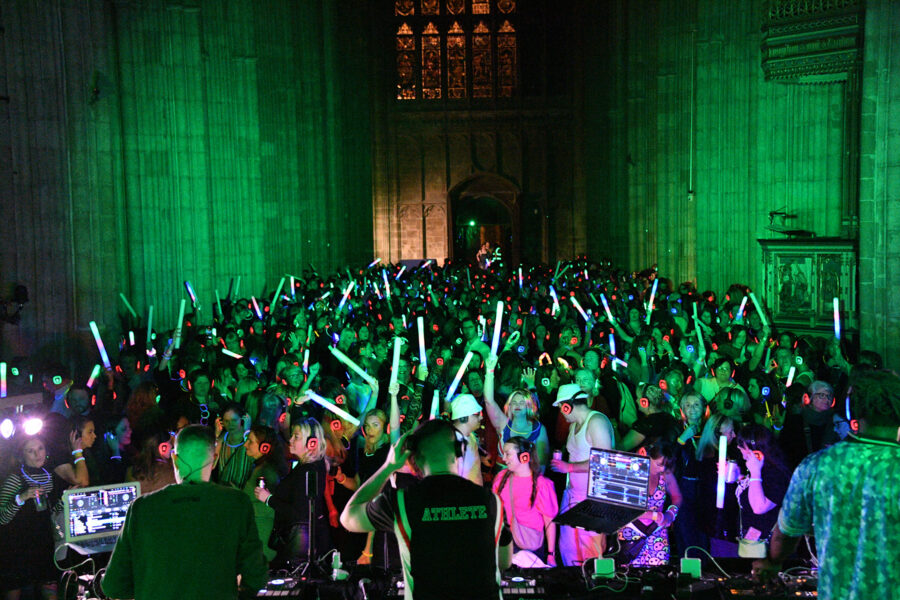
The Cathedral of Canterbury, former primatial see of the Catholic Church in England and one of the great pilgrimage centers of medieval Christendom, hosted on August 15, the Solemnity of the Assumption of the Virgin, a “silent disco” dedicated to 1980s music. The Anglican cathedral organized two evening sessions with a DJ, special lighting, and LED headphones on the same date on which, for centuries, the Benedictine monks of Canterbury solemnly celebrated one of the principal Marian feasts.
The cathedral itself promoted the event as the return of Silent Discos In Incredible Places after previous editions sold out rapidly. The sessions ran from 6:30 p.m. to 9:00 p.m. and from 9:30 p.m. until midnight, were reserved for those over 18, and promised “some of the best 1980s DJs in the United Kingdom” inside the illuminated historic church.
A disco in the former shrine of Saint Thomas Becket
The choice of venue is especially significant because of Canterbury’s history. The present Anglican cathedral dates back to the mission of Saint Augustine of Canterbury, sent to evangelize the Anglo-Saxons by Pope Saint Gregory the Great at the end of the sixth century.
In 1170, Saint Thomas Becket, Archbishop of Canterbury, was murdered there after his long conflict with Henry II over the rights of the Church. His canonization turned the site into one of the great pilgrimage destinations of medieval Europe, later immortalized by Geoffrey Chaucer in his Canterbury Tales.
Before England’s break with Rome, the cathedral also housed a Benedictine community. The monks remained there until the dissolution of the monastery in 1540 under Henry VIII, in the context of the suppression of religious houses.
Precisely in that setting, August 15 once had a very different meaning. The Benedictines celebrated the Assumption as a principal feast, and the daily Mass dedicated to the Virgin in the Lady Chapel of the crypt took on special solemnity that day.
Headphones, DJ, and a bar inside the cathedral
This year’s party was dedicated to the musical hits of the 1980s. Attendees received LED headphones that allowed them to select different music channels while dancing inside the illuminated nave.
The commercial organizers also advertised a bar throughout the event. The cathedral had already confirmed in previous editions that these parties included alcoholic beverages such as cocktails and small bottles of prosecco.
The use of the church for this type of activity contrasts even with Canterbury’s own rules for visitors. The access conditions expressly ask people to respect the building “as a place of Christian worship” and refer to it as a space for prayer, private devotion, and Christian pilgrimage.
It is not, however, the first time that the vaults of Canterbury have served as the setting for a disco. In February 2024, some 3,000 people took part in a similar party dedicated to 1990s music. The initiative then provoked protests outside the cathedral and an online petition against the use of the church for such spectacles.
Read also: A ‘silent disco’ is organized in Canterbury Cathedral
The cathedral defends these events as part of its “mission”
The criticisms of 2024 did not change the minds of Canterbury’s leaders. Dean David Monteith then defended the discos as a way to attract people into the building who had probably never entered a place of worship.
Monteith maintained that these events also had a “missional” dimension and recalled that the income contributed to the cathedral’s upkeep. The first silent disco in February 2024 generated approximately £20,000, according to figures later published by the institution itself.
The economic argument is set against the high conservation costs of a monumental complex of this kind. In 2024 the cathedral stated that its expenses amounted to around £30,000 a day and presented these commercial events as an additional source of funding.
The institution also maintains that cathedral naves have historically hosted community and secular activities and regards the current discos as a contemporary continuation of that function.
From medieval Marian worship to an 1980s party
The coincidence with August 15 adds a particular element this year. During Canterbury’s Catholic period, the Assumption formed part of its liturgical calendar and was solemnly celebrated by the Benedictine community.
After the English Reformation and the successive religious changes of the sixteenth century, the celebration of the Assumption disappeared from the cathedral’s liturgical life. In recent times there have been some approaches to the ancient Marian feast. In 2023, for example, Canterbury announced for August 15 a “Festal Eucharist for the Blessed Virgin Mary” intended to recall “the unique place that Mary holds in the history of our salvation.”
This year, however, the cathedral’s public program for August 15 highlighted the opening of its gardens during the day and the two 1980s disco sessions at night.
The historical contrast is hard to ignore: where the Benedictines once celebrated the Assumption of the Mother of God, the August 15, 2026 program offered visitors a DJ, 1980s music, and a dance floor beneath the cathedral’s vaults.
Acrobats suspended from the nave, the next show
The transformation of the sacred space into a venue for spectacles will continue in the coming months. Canterbury plans to host Circa: Eternity in October, a contemporary circus production conceived specifically for the cathedral.
According to the show’s promotion, acrobats will be suspended from the top of the nave to perform various acts accompanied by a soundtrack of contemporary spiritual music.
The Assumption disco is therefore not an isolated episode but part of a consolidated policy of using the building for cultural and commercial activities. An orientation that Anglican leaders present as an instrument of outreach and funding, but which since 2024 has been drawing criticism precisely because of the sacred nature and Christian history of the church.