


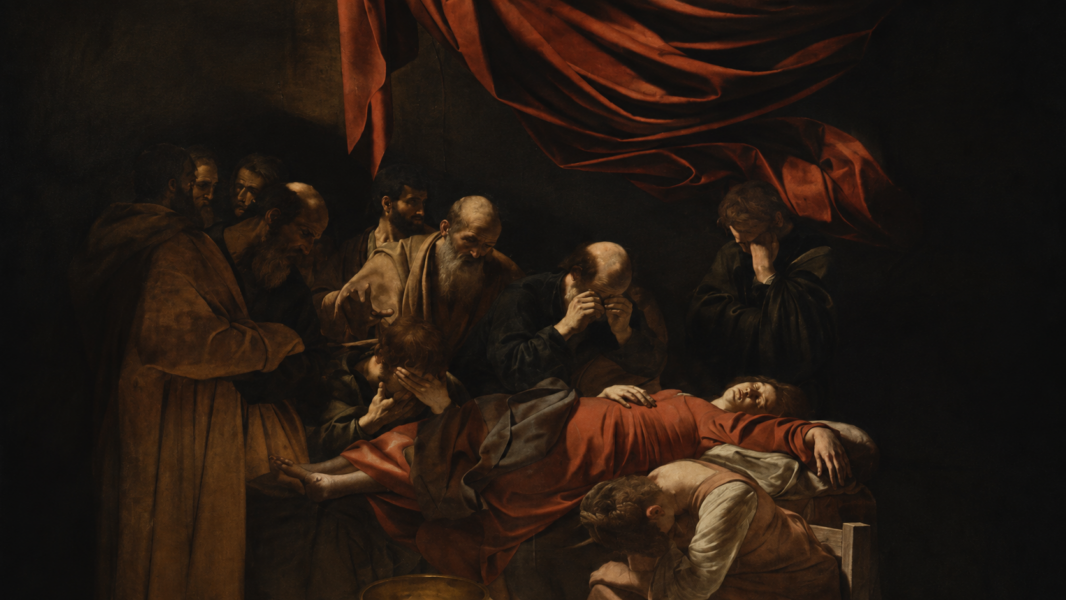
By: Msgr. Alberto José González Chaves
It had been a beautiful day: Mary was in heaven. All of her, body and soul. It was not a metaphor born of the disciples’ nostalgia. It was the same woman who had carried the Word of God in her womb for nine months, who had held Him in her arms in Bethlehem, who had hurried toward the hill country of Judah, and who had stood at the foot of the Cross. And there she was… waiting for me!
I went to bed happy, but I had a nightmare. I dreamed I entered a church dedicated precisely to the Assumption. Everything seemed ready for a solemn celebration of Our Lady: flowers, music, people, authorities… There were even television cameras. Then the priest appeared and began to explain, with the ringing tone of one who clarifies for the Church what the Church has believed for centuries, that when it came to Mary having ascended into heaven body and soul, “obviously,” one should not take it “literally.” “Obviously,” he said, pleased with the adverb, for a compelling reason: “No human being is going to ascend into heaven body and soul.”
At this point my nightmare eased for a philological reason: indeed, Mary did not ascend into heaven; she was assumed. That is precisely why the feast is not called the Ascension. Theology, ever meticulous, carefully distinguishes the words. If Christ ascends to heaven by His own power, Mary does not ascend by herself: she is taken up by God. Latin, ever impertinent?, says Assumptio Beatae Mariae Virginis.
But, “obviously one should not take it literally.” What if Pius XII, rigid as he was, had overstepped in 1950 by solemnly defining that the Immaculate Mother of God, “having completed the course of her earthly life, was assumed body and soul into heavenly glory”—exactly what, we had just learned, no human being could experience?
Yet the matter was even more difficult, because if no human being can be glorified bodily, the problem is no longer only the Virgin’s: it is ours as well. In my dream I recalled the Creed: “I look forward to the resurrection of the dead and the life of the world to come.” It does not say: I look forward to the spiritual survival of a particularly interesting part of my personality. It says resurrectio mortuorum. Then I understood that the Blessed Virgin was not alone in that predicament: St. Paul was also suspect, and St. John, and the Fathers of the Church, and the Catechism, and every Catholic who each Sunday has the temerity to profess the resurrection of the flesh, acknowledging that the human being is not a soul that accidentally drags a body along for a few decades and then is rid of it forever. Man is body and soul, and his final destiny embraces the whole person. Mary already possesses in anticipation what we await at the end of time. We shall all rise.
Though, on second thought, the statement may need an uncomfortable clarification: yes, we shall all rise, but not all for heaven. Our Lord had the unfashionable detail of speaking of a resurrection of life and a resurrection of condemnation. So there will be risen bodies for both destinies. What does not seem prudent is to use the physical non-existence of heaven to abolish the resurrection of the flesh.
Moreover, the claim that “heaven is not a physical place” and is simply “a state of the soul” left me even more perplexed. I looked upward, just in case. Naturally, I did not see God sitting on a cloud. Even my theology, incomparably older than that of the Fray Gerundio de Campazas who was deafening me and giving me a headache, reached that far. But I thought that if Christ has truly risen with His body and Mary is really glorified body and soul, reducing heaven to a mere “state of the soul” posed a small logistical problem: there were two glorified bodies too many in the empyrean. And, at the end of time, there would be many millions more.
But, as Mighty Mouse used to say: “Don’t go away yet—there’s more!” The nightmare continued. It seemed God had chosen Mary because she was “a humble woman, a woman of the people.” Though trite and demagogic, it was beautiful. But the Church had spoiled the original simplicity, for “mythology has exalted her” by giving her “many necklaces, many crowns, many privileges, many titles.”
Here, besides second-hand embarrassment, I felt pity for mythology: it was not to blame for anything! As far as I recalled, it concerned itself with Zeus, Hera, Apollo, Aphrodite, Athena, and other distinguished literary creations of ancient Greece. I did not know it had also intervened in Ephesus, in Chalcedon, in the definition of the Immaculate Conception, in Munificentissimus Deus, in the Catholic faith, and in the Marian soul of Seville, of Spain, of the world. Perhaps I had missed some chapter of Homer! I tried to imagine a poor Greek mythologist bestowing on Mary the title of Theotokos, Mother of God, and I confess that even within my heavy dream I could not visualize it. For to call “mythology” the titles with which the Church has honored Mary is not a theological “audacity”; it is to confuse things of a different nature. One thing is symbolic language—full of which are the Bible, the liturgy, and all great poetry—and quite another is mythology. And one thing are the poetic images with which the Christian people have sung of the Virgin, and another the dogmas and titles that arise from centuries of reflection on Scripture, Tradition, and, above all, the mystery of Christ.
For all those inconvenient privileges of Mary affirm some truth about Jesus Christ. She is Mother of God because her Son is a divine Person, with His perfect human nature. She is ever Virgin because of the mystery of Him who was born of her as a ray of sunlight passes through glass: without breaking or staining it. She is Immaculate in her Conception by the anticipated application of Christ’s redemption. And she is Assumed by the victory of the Risen One over death. The crowns can be removed, the necklaces too; even the flowers, if they bother the mythologists. What is difficult is to remove the privileges without, in pulling at them, something far more important beginning to unravel.
I looked at the Virgin. She, as usual, said nothing. Our Lady has always had an extraordinary elegance.
But then came the most surprising part of the dream. After explaining that it was not advisable to take literally that Mary was in heaven body and soul, that preacher whom I do not think even José Francisco de Isla would recognize as his own, announced that the moment had come to contemplate the “contemplative dance group.” I confess I breathed a sigh of relief: that original theology was proving tiring, and a group of altar boys promised rest. We were told we would see “many colors” symbolizing a rose window, that the colors represented “diversity, joy,” and that they would dance in a circle because “the circle is perfection.” They began to spin. I looked at the altar. They spun again. I kept looking at the altar. There were colors, fabrics, movements, and symbols. Everything must have contained a depth inaccessible to my poor theological formation. I thought, however, that this human need for symbols was endearing. Only minutes earlier we had been warned against the excesses with which the centuries had surrounded the Virgin with crowns, titles, and privileges; now, colorful skirts, a rose window, and a hundred turns around the altar were joy and perfection, according to the hermeneutics of progress. It seemed like a town square covered on a night of festival: color, movement, folklore, applause… And undoubtedly, excellent intentions. But I had the impression that, among so many things meant to make the mystery comprehensible, the mystery itself had discreetly slipped away.
Then I looked at the Virgin again. She was still there, serious, serenely majestic, without needing to cast off her crown to prove she was humble, nor to renounce her privileges to seem approachable, nor to become a metaphor so that modern man could accept her. She was Mary of Nazareth, the handmaid of the Lord, the Immaculate Mother of God ever Virgin, the one Assumed into heaven body and soul. The Queen.
I thought then that Christian humility is caricatured when it diminishes the wonders of God: if Mary never attributed anything to herself, neither did she belittle what God had worked in her; on the contrary: “The Mighty One has done great things for me.” That is why the Church has crowned her for centuries: not because Mary needs our crowns, but because we need to remember who she is.
The nightmare ended suddenly. I opened my eyes. Everything was silent. I felt immense relief. The Assumption was still the Assumption. Heaven was still the destiny of the whole human being and not merely a pleasant state of mind of the soul. The resurrection of the flesh remained in the Creed. Mythology had discreetly returned to Olympus. Pius XII could breathe easy. The bodies of the Fathers of the Church could continue resting in their tombs, awaiting, of course, the day they would rise from them.
Mary was smiling at me, with her face, with her body, with her virginally maternal beauty, from heaven. Not because she had “ascended” by her own strength, but because God had assumed her into His glory. She told me she was there, waiting for me! Then, lulled by her, I went back to sleep, murmuring a Hail Mary, just in case I dreamed again of mythologists or perfect circles. Or, what would be unbearably horrible, of some revived Fray Gerundio de Campazas, alias Zotes.