


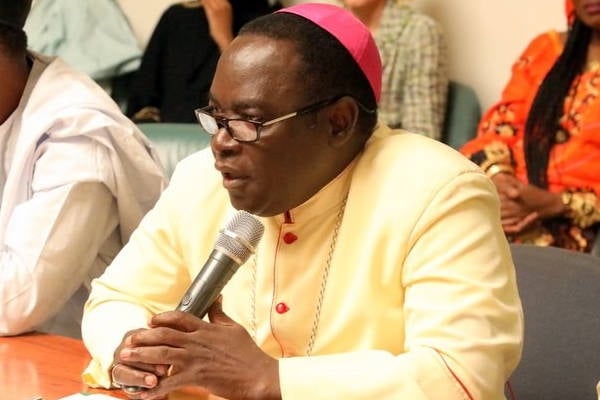
The vitality of Catholicism in Nigeria does not guarantee that the African Church is safe from the process of secularization that has emptied churches in much of Europe. This is the warning issued by Mathew Hassan Kukah, Bishop of Sokoto, who points to the loss of moral authority, the embrace of secular power, relativism, and the inadequate formation of new generations as threats that Africa must avoid.
In a wide-ranging interview with Catholic World Report, Kukah analyzes the growth of the Nigerian Church, the persecution faced by Christians, and the reasons that, in his view, explain the weakening of European Catholicism. The prelate knows this reality firsthand: Sokoto is located in northwestern Nigeria, a predominantly Muslim region where violence and insecurity have affected Christian communities for years. InfoVaticana previously reported his warnings about the loss of Christian fervor in the West.
A Growing Church
Nigeria has about 35 million Catholics and, according to data cited during the interview, records a weekly Mass attendance rate close to 94%, one of the highest figures in the world.
Kukah attributes this vitality, first and foremost, to the work of the missionaries who established the Church in the country. He highlights their sacrifices, the educational and healthcare institutions they founded, and “the life of virtue that Catholicism promoted.”
He also adds the witness of the first generation of native clergy, with figures such as Cardinals Dominic Ekandem, Francis Arinze, Anthony Okogie, and John Onaiyekan, whose authority, he explains, served as a reference for many young people.
However, the bishop urges not to focus solely on the numbers. In light of the growth of African Catholicism—which has risen from about two million faithful in 1900 to 281 million today—Kukah maintains that the decisive question is “the fruits of this faith,” because these will be what sustain it over time.
“The Church Embraced the World”
One of the most significant passages of the interview comes when he is asked about the crisis of the Church in Europe. Kukah contrasts the attitude of the first apostles, persecuted by the Roman Empire and relying solely on the Holy Spirit, with the later closeness of the Church to political power.
“I believe that what eroded the moral authority of the Church was the warm romance and embrace of secular power,” he states.
The Nigerian bishop argues that when the Church abandons the place where the people are and ascends “to the upper chambers of power,” it progressively loses its moral strength.
His diagnosis goes even further: “Secularism took advantage of this; the Church embraced the world and became the world it was meant to change.”
For Kukah, the European experience serves as a direct warning for Africa. The response is not to reject modernity, but to prevent it from leading to what Saint John Paul II and Benedict XVI warned against: “the culture of relativism.”
Read also: Nigerian Bishop: Western youth have not rejected Christianity, but no one has offered it to them
Africa Is Not Immune to Secularism Either
When asked specifically about the possibility that Africa might follow the same path, Kukah rejects any sense of security.
“There is no immunity against this virus. The only immunity is to learn from the history of others,” he maintains.
Among the risks, he especially mentions the situation of African elites and the education of young people abroad. The bishop, who recalls having received his own formation outside Nigeria, does not question such studies, but warns of the danger of sending young people far from their families when they still lack sufficient “emotional, physical, and spiritual” maturity.
For this reason, he believes that the solid formation of children and young people must become a priority for parents and pastors. “It is the only guarantee of the Church’s future,” he assures.
The problem does not affect only the new generations. Kukah acknowledges that, although “the faith of our people is strong,” some African elites “are falling victim and occasionally drifting toward neopaganism.”
A Faith Tested by Persecution
The cultural threat is compounded in Nigeria by a much more immediate reality: violence against Christians. The country remains one of the world’s main hotspots of anti-Christian persecution. The World Watch List 2026 by Open Doors recorded 3,490 Christians killed for their faith in Nigeria during the analyzed period, around 72% of the global total.
Kukah recounts in the interview the murder of an 18-year-old seminarian who had been kidnapped along with three other young men. His companions were released after negotiations and the payment of a ransom, but he was killed.
According to the bishop’s account, when the kidnappers were arrested a year later, they confessed that they had killed the seminarian because, despite being threatened by armed men, he insisted on urging them to repent of their crimes and return to God.
“We cannot fear them because our faith is built on the blood of martyrs,” Kukah states.
The prelate also rejects the idea that the pastoral response to attacks should involve reducing the attendance of the faithful at churches. He recalls that during a meeting of bishops from West Africa, another prelate explained that he had recommended attending Mass in smaller groups to limit the number of potential victims in case of an attack.
Kukah defended the opposite stance: “We cannot surrender to fear.” In his view, in addition to demanding that the State fulfill its responsibility to protect citizens, the Church must prevent terror from ultimately driving the faithful away from religious practice.
Read also: Nigerian Bishops Denounce Violence Against Christians to the Pope
Beyond Demographic Growth
The numerical growth of African Catholicism is also not enough, according to Kukah, to guarantee its future. During the interview, he is asked about the fact that between 85% and 90% of the increase in Catholics in Africa would come from the growth of Catholic families themselves, while adult conversions and evangelization would represent a considerably smaller proportion.
The bishop downplays those statistics and assures that in many dioceses he observes strong enthusiasm among young people and also conversions from other religions. But he admits the underlying principle: no institution can remain strong if it stops cultivating what gives it life.
The question Kukah raises is, therefore, deeper than the statistical contrast between an expanding Catholic Africa and a secularized Europe. For the Bishop of Sokoto, the future will depend on whether numerical growth is accompanied by formation, evangelization, independence from power, and a faith capable of resisting both the seductions of relativism and the violence of persecution.