


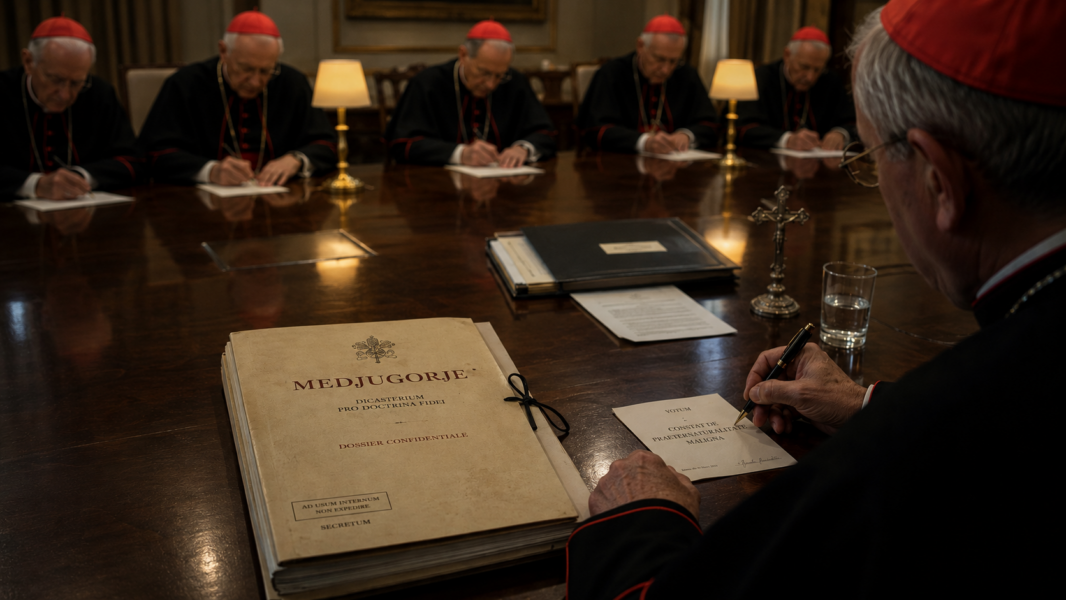
Six of the 21 members of the then Congregation for the Doctrine of the Faith who in 2016 would have spoken against the supernatural origin of Medjugorje held an even stricter position: they considered that the phenomenon should be attributed to a diabolical intervention. This is what Italian journalist David Murgia claims, who says he had access to the written opinions sent to the Holy See and specifies that three of those six votes belonged to cardinals.
The new information, published in Il Segno di Giona, expands on the data revealed about the reserved consultation: out of 33 opinions, 21 would have rejected the supernatural origin, nine would have accepted it, and three would not have reached a conclusion. The exact breakdown of the votes and the motivations now known come from the documentation that the journalist claims to have consulted. It has not been officially confirmed by the Holy See.
Six opinions would have proposed an even stricter formula
Each participant in the consultation would have been asked to justify their position in writing. Among the motivations of the 21 votes against supernaturality, six would not have limited themselves to ruling out a divine origin of the events that began in 1981.
These six opinions would have considered the formula constat de praeternaturalitate maligna applicable, that is, that the phenomenon would have a malignant preternatural origin.
According to the documentation described by Murgia, for these six members of the Congregation what happened in Medjugorje “is not explainable without the original, direct, and foundational intervention of the Evil One.” The position would thus come to consider that it was not a matter of a marian apparition, but of a “satanophany.”
Read also: The secret votes on Medjugorje: almost two thirds rejected its supernatural origin
The arguments collected in the votes
The known motivations would be based fundamentally on two arguments.
The first would be the interpretation of the 1991 Zadar Declaration as a negative pronouncement by the Church on the supernaturality of Medjugorje. That declaration of the Yugoslav Episcopal Conference established that, on the basis of the investigations carried out up to that time, “it cannot be affirmed that these are supernatural apparitions or revelations.”
However, this formulation did not amount to a positive declaration of non-supernaturality. Precisely this distinction is relevant when assessing the argument attributed to the six members of the Congregation.
The second point would be related to the work of the International Commission chaired by Cardinal Camillo Ruini. The six opinions would have considered that its conclusions were compromised because the commission would not have examined all the documentation that was in the possession of the Congregation for the Doctrine of the Faith.
The existence of differences between the conclusions of the Ruini Commission and the subsequent studies carried out at the Doctrine of the Faith has been publicly acknowledged. In September 2024, Cardinal Víctor Manuel Fernández explained that, after the commission’s report, the dicastery carried out new studies and consulted experts who reached “very different” conclusions. Francis had already pointed out in 2017 that doubts arose within the Congregation after receiving the Ruini report.
What the six members proposed
The cited documentation also attributes several concrete proposals to these six members. Among them was “fully rehabilitating” the doctrinal and pastoral actions of Pavao Žanić and Ratko Perić, former bishops of Mostar-Duvno and firmly opposed to recognizing the authenticity of the alleged apparitions.
At the same time, they would have asked not to harm “the good faith, although abused, of the pilgrims” and to attend to the good of the alleged visionaries.
The most severe proposal referred precisely to the latter: the six opinions would have requested their damnatio memoriae. The published information does not offer further details on the specific scope they intended to give to this expression.
Murgia, who personally rejects the hypothesis of a diabolical origin of Medjugorje and describes it as “absurd,” has announced that he will soon publish in a book the entire documentation he claims to have consulted.
The 2016 votes do not constitute the Church’s current judgment
The opinions revealed by Murgia, if confirmed, allow us to know the intensity of the discrepancies that existed within the Congregation for the Doctrine of the Faith, but they do not amount to a decision adopted by the Holy See.
The 21 votes that would have rejected supernaturality in 2016 did not lead to an official declaration of constat de non supernaturalitate. Nor is there a pronouncement from Rome attributing a diabolical origin to the events of Medjugorje.
The currently valid decision responds to the new framework established by the Doctrine of the Faith in 2024. In September of that year, the dicastery granted the nihil obstat to the spiritual experience linked to Medjugorje, recognizing its spiritual fruits and allowing the prudent adherence of the faithful. At the same time, it expressly specified that this decision “does not imply a declaration of the supernatural character of the phenomenon” and ordered that it be referred to as “alleged messages.”
The information now known does not, therefore, modify the current status of Medjugorje. It provides new data on the strong discrepancies that existed within the Doctrine of the Faith during the study of the phenomenon, whose complete documentation remains unpublished.