


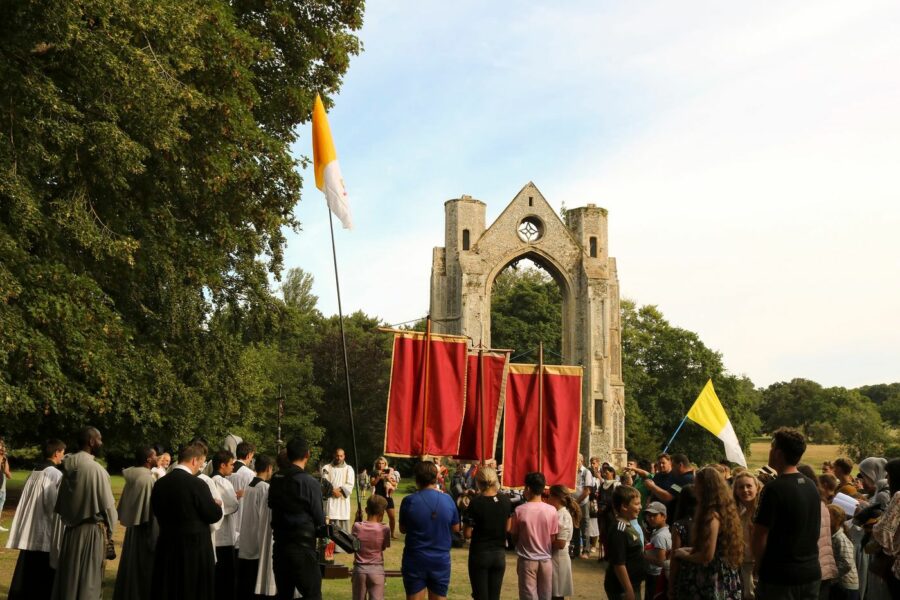
The rise of pilgrimages linked to the traditional liturgy will find a new expression in England this summer. More than 200 Catholics will walk at the end of August the nearly 90 kilometres separating Ely from Walsingham, one of the great Marian shrines in English history, in the annual pilgrimage organised by the Latin Mass Society. The event coincides in the same summer with the birth of another traditional pilgrimage, between Oxford and Evesham, conceived under the influence of the massive French model of Chartres.
The walk to Walsingham will take place from 27 to 30 August, and for three days the participants will cross the English countryside accompanied by priests, with the recitation of the rosary, the singing of hymns and the daily celebration of the traditional Mass, as reported by The Catholic Herald. The pilgrimage began in 2010 with a small group and has grown to more than 200 participants.
Two traditional pilgrimages in the same summer
The pilgrimage to Walsingham coincides this summer with the first edition of Our Lady of Christendom Pilgrimage, another initiative linked to the traditional liturgy that will cross England between Oxford and Evesham. Its appearance strengthens the presence of this type of pilgrimage in the country, at a time also marked by the growth of the great gatherings of Chartres, in France, and Covadonga, in Spain.
The new pilgrimage will cover some 80 kilometres over three days through the Cotswolds to the ruins of the ancient abbey of Evesham. Born under the influence of the Paris-Chartres model, its promoters have also drawn on the experience of the organisers of Our Lady of Christendom to Covadonga.
Read also: From Chartres to England: a new pilgrimage inspired by tradition is born
The march organised by the Latin Mass Society to Walsingham has, for its part, a history dating back to 2010. Since then it has grown from a small group of faithful to more than 200 participants, with its own itinerary to one of the main sites of Catholic history in England.
90 kilometres from Ely to Walsingham
The route begins in Ely, north of Cambridge, and stretches for 56 miles —about 90 kilometres— to Walsingham, in the county of Norfolk, in eastern England.
Each day is marked by prayer and liturgy. Sung Mass is celebrated every morning and several priests walk the route alongside the pilgrims. Along the way, rosaries are recited and hymns are sung.
Although the pilgrimage initially took some elements from the Paris-Chartres model, over the years it has acquired a markedly English character. The route through small villages and the countryside of Norfolk leads to a shrine whose history dates back to medieval Catholic England.
The growth of Walsingham and the appearance this year of the Oxford-Evesham route also show how the model of long traditional pilgrimages is finding new expressions in England, albeit with different identities and destinations.
Walsingham, a shrine destroyed during the Reformation
Walsingham was one of the great pilgrimage centres of medieval Europe. Tradition places its origin in the 11th century, when the noblewoman Richeldis de Faverches is said to have received a vision of the Virgin in which she was asked to build a reproduction of the Holy House of Nazareth.
For centuries pilgrims from all over England came there, including several monarchs. That continuity ended with the English Reformation. In 1538, under Henry VIII, the priory was suppressed and destroyed and the pilgrimage was extinguished for centuries.
Catholic devotion began to recover in the 19th century. The Slipper Chapel, a medieval chapel that had survived and had been put to secular uses, was acquired and restored for Catholic worship. Over time it became the heart of the present National Catholic Shrine of Our Lady of Walsingham.
The very history of the place thus offers a particular background to a pilgrimage associated with the traditional liturgy: both the shrine and a form of worship that for decades faced an uncertain future have found new generations willing to preserve and transmit them.
Six decades of the Latin Mass Society
Behind the pilgrimage is the Latin Mass Society, founded in 1965, when the liturgical changes following the Second Vatican Council were beginning to be introduced. Among the personalities associated with its early years were writers and intellectuals such as Evelyn Waugh and Hugh Ross Williamson.
The association was initially founded to defend the use of Latin in Catholic worship, but the liturgical transformation gradually shifted its efforts towards the preservation of the ancient Roman liturgy.
One of the best-known episodes in its history took place in 1971, when it promoted an appeal addressed to Paul VI to preserve the ancient Mass. It was signed by cultural figures such as Graham Greene, Kenneth Clark, Iris Murdoch, Yehudi Menuhin, Robert Graves, Joan Sutherland and Agatha Christie.
The argument was not limited to strictly religious grounds. The signatories argued that the ancient liturgy also belonged to the European cultural heritage: for centuries churches had been built to house it and some of the great works of Western music had been composed for it.
Paul VI eventually allowed the bishops of England and Wales to authorise certain celebrations of the earlier liturgy. The concession became popularly known as the “Agatha Christie indult”.
From preserving the Mass to carrying it along the roads of England
The day-to-day activity of the Latin Mass Society during its six decades of existence has been less conspicuous than that episode: locating priests, organising celebrations, maintaining a network of local representatives and training priests interested in learning to celebrate according to the traditional liturgical books.
The Walsingham pilgrimage has become one of the visible manifestations of that work. Those who began walking the path in 2010 were only a small group. Sixteen years later, more than 200 pilgrims will once again walk to the ancient Marian shrine.
This summer, moreover, they will not be alone on the English roads. The established route from Ely to Walsingham and the birth of the new pilgrimage between Oxford and Evesham offer two distinct manifestations of the same phenomenon: Catholics who recover walking pilgrimage, the traditional liturgy and ancient sites of English religious history as public ways of living and transmitting the faith.