


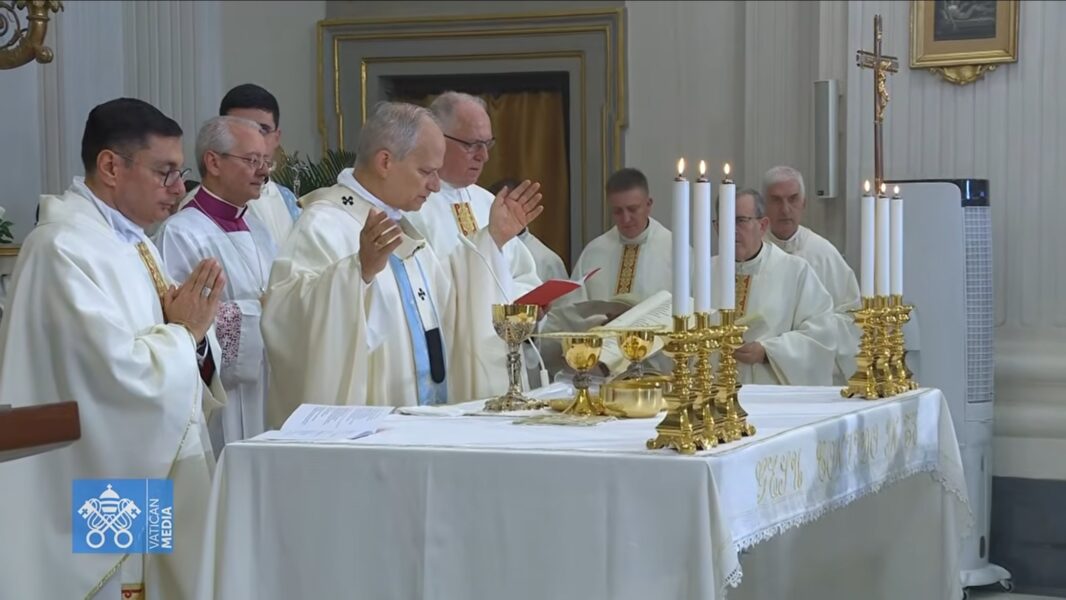
This Saturday, the solemnity of the Assumption of the Blessed Virgin Mary, Leo XIV presided over the Holy Mass at the Pontifical Parish of Saint Thomas of Villanova. And once again, at the central moment of the celebration, the Roman Canon did not sound—the anaphora that venerates the «glorious ever-Virgin Mary, Mother of Jesus Christ, our God and Lord» at the head of the communion of saints—but rather Eucharistic Prayer III, the formula drafted in the 1960s. It is the latest piece in a series that, reviewed with the official booklets in hand, paints an unmistakable picture. In the liturgical year 2026, none of the great solemnities of the Roman calendar celebrated by the Pope has known the Canon.
The litany of absences
The booklets published by the Office of Liturgical Celebrations of the Supreme Pontiff leave no room for interpretation. Eucharistic Prayer III at Santa Maria Madre de Dios, on January 1. Prayer III at the Presentation of the Lord, on February 2. Prayer III on Palm Sunday. Prayer III at the Easter Vigil—the «mother of all vigils,» with ten adult baptisms included. Prayer III on Easter Sunday itself, celebrated in Latin in Saint Peter’s Square. Prayer III at Pentecost. Prayer III at Saints Peter and Paul, also in Latin, with the blessing of the pallia. Prayer III at the three major events of the trip to Spain: Corpus Christi before more than a million faithful in Plaza de Cibeles, the inauguration of the tower of Jesus Christ at the Sagrada Familia, and the Sacred Heart at Gran Canaria Stadium. And Prayer III, now, at the Assumption of the Virgin.
Easter, Pentecost, Corpus Christi, Peter and Paul, the Assumption: these are, with Christmas, the peaks of the Roman liturgical year. In none of them has papal liturgy this year chosen to use the prayer that for more than fourteen hundred years was the only one of the Roman rite, the one prayed by Gregory the Great, Thomas Aquinas, and all the saints of the West, the one the Council of Trent defended as «pure of all error» and Vatican II ordered to be preserved.
The absences are all the more striking because the Canon was, so to speak, waiting at each of those dates. For the Easter octave it preserves a proper Communicantes and Hanc igitur—»celebrating the holy night of the Resurrection…»—unique texts that no other anaphora possesses and that this year were not proclaimed either at the Vigil or on Easter Sunday. For Pentecost it preserves another proper Communicantes, also unheard. At Saints Peter and Paul, the Canon mentions both apostles twice, in the commemoration of the saints and in the Libera nos; the formula that groups them under the generic «apostles and martyrs» was preferred. And at Marian solemnities, no prayer gives the Mother of God the prominence that the Canon gives her, venerating her «above all» (in primis) as it opens the procession of Roman apostles and martyrs.
The exceptions that prove the rule
To be precise: the Roman Canon has not disappeared entirely from the papal altar. It has sounded on three days in 2026. Holy Thursday, in a double appearance—in the Chrism Mass and in the in Coena Domini Mass at Saint John Lateran—that is, on the only day of the year for which the Missal reserves proper Communicantes, Hanc igitur, and Qui pridie for it, to the point that omitting it is almost violent. And, surprisingly, at the Mass of the Sacred Heart celebrated in Spanish at Puerto de Santa Cruz de Tenerife on June 12.
The day before, at Gran Canaria Stadium, the Pope had celebrated the same solemnity of the Sacred Heart with Prayer III. Same feast, same preface, same trip, twenty-four hours apart: two different anaphoras. Its sporadic appearance suggests rather that the choice of the eucharistic prayer at papal Masses does not respond to any liturgical logic, but to ad hoc decisions in which the Roman anaphora has ceased to have its own place: not even the one liturgical law itself assigns it.
Disregarding the orientation of the Missal?
The General Instruction of the Roman Missal, in number 365, does not merely place four prayers on display: it guides their use. Of the Canon it says that it «may be used always,» but notes that its use is particularly appropriate on days with proper Communicantes or Hanc igitur, on feasts of the apostles and saints mentioned in it, and on Sundays. Prayer III is recommended for Sundays and feasts; Prayer II, for its brevity, for weekdays and particular circumstances. Making Prayer III the sole formula for the greatest solemnities does not violate any rubric—it must be said clearly: there is no liturgical abuse in the technical sense here—but it does in fact invert the hierarchy that the Missal itself establishes, treating the legislator’s orientation as a dead letter.
Lex orandi, lex credendi
Someone will object that this is a specialists’ dispute. It is not. The Roman Canon is not one prayer among four: it is the historical expression of the lex orandi of the Roman rite, substantially attested already in the time of Saint Ambrose and fixed by Saint Gregory the Great. Its language is insistently sacrificial—»these gifts, these offerings, this holy and pure sacrifice»; «the pure, immaculate, and holy sacrifice»—; its structure interweaves the altar of earth with the altar of heaven; its double litany of Roman apostles and martyrs anchors each Mass in the concrete Church of Peter. None of this is decorative: it is doctrine prayed.
In the Roman Canon operates the axiom attributed to Prosper of Aquitaine: legem credendi lex statuat supplicandi—that the law of supplication establish the law of faith. What the Church prays shapes what the Church believes; and what it ceases to pray, sooner or later, it ceases to believe with the same depth. If the anaphora that most densely expresses the sacrificial character of the Mass is in fact withdrawn from the most visible celebrations of Christendom—those that millions of faithful follow on television at Easter, at Pentecost, at the Assumption—no decree is needed for the sacrificial dimension to fade from the Christian people’s consciousness. Disuse is enough.
Papal practice does not create juridical norm, but it exercises a paradigmatic function that no one can underestimate: what the Pope habitually celebrates ends up defining, de facto, what the entire Church perceives as ordinary and preferable. For centuries, the ordinary of the Roman rite was the Canon; today, in the great solemnities celebrated by the Successor of Peter, the ordinary is its absence. Neither at Easter, nor at Pentecost, nor at the Assumption. Must we wait until next Holy Thursday—when the proper texts make it all but inevitable—to hear once again, at a papal Mass, the most ancient and venerable prayer of the Latin Church?