


One had decided that August was for reading nothing, or for reading only what demands no response: a Percy Jackson battered by the sand so he could talk to his son, a Russian novel, the latest from Homo Legens… But August has the indelicate habit of slipping current events under the door just when you had settled in. This week two papers arrived.
The first comes from Hamburg. On 20 August a new framework for sex education, “Männlich, weiblich, divers,” begins to be applied in the fifteen Catholic schools of the archdiocese. It sounds like the title of a minor opera and is a curriculum, inspired by the so-called pedagogy of diversity and ultimately approved by Archbishop Stefan Heße. Hundreds of families who pay for those schools, who chose them when they could have chosen others, learned of the document after the fact and not even through the schools. They organized into a Network for the Protection and Prevention of Childhood, requested meetings, obtained one in December 2025, and in February wrote to the Pope through the nuncio asking him to stop it. They are still waiting. Nico Spuntoni reported it in La Nuova Bussola.
It is worth recalling who signs that framework. Heße presented his resignation in March 2021, when the Gercke report on Cologne attributed eleven breaches of duty to him in the handling of abuse cases during the years he was head of personnel and vicar general. Rome took six months to reply and replied no: there were personal procedural errors, yes, but no intention to cover up, and besides the archbishop had humbly acknowledged his faults. One does not dispute mercy, of course not. One only observes, with that August-like perplexity, that the institution possesses a finely tuned theology of mitigating circumstances when the one who errs wears a mitre, and none at all when the one asking for a meeting is holding three children by the hand.
The second paper comes from the Pyrenees, from a principality where one of the two heads of state is a Spanish bishop. Andorra wants to decriminalize abortion; it has been discussing the matter discreetly with the Holy See since 2019, and at the end of July the head of government, Xavier Espot, and his minister Ladislau Baró sat down again in the Vatican with Cardinal Parolin to review the various legal options. None of those options consists of saying no. The one most cited by La Veu Lliure has a notarial elegance that deserves aesthetic admiration: transferring the signature to the French co-prince, as was already done with assisted reproduction, so that the bishop of Urgell does not sign the law approved under his crown. The law is approved anyway. The bishop does not sign. Everyone is reasonably satisfied except the unborn, who in these proceedings never have legal representation. No one has touched the Catechism, of course. There is no need. Doctrine is no longer repealed: it is circumvented, with the patience of one who knows that a dogma cannot run and a joint commission is in no hurry.
And this is where the Catholic father of a family discovers what he had suspected for years without daring to formulate it, because formulating it seems disloyal and it is only a diagnosis: that he is not alone before the world—that much was known, it comes in the contract since the year 33—but before the world and without a castle. One expected to lose the street, television, the ministry, and the faculty lounge. One did not expect to reach the keep and find the drawbridge lowered from within, and a gentleman with a ring explaining over the loudspeaker that lowering it was, properly understood, a gesture of welcome.
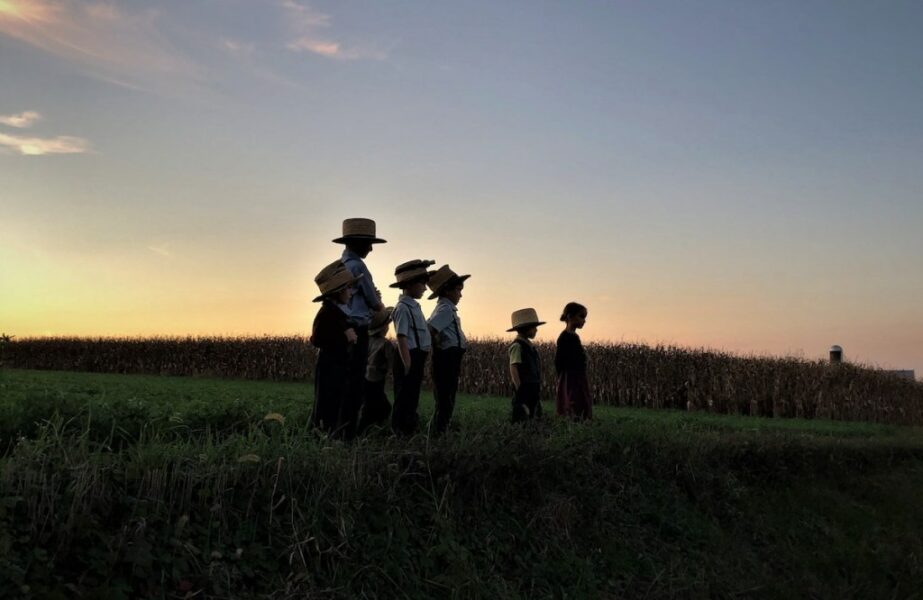
One has spent part of this summer watching carriages pass through Lancaster, and has returned with an uncomfortable idea he can no longer shake: that he feels more of a co-religionist with an Amish farmer from Pennsylvania than with the Secretariat of State. Let us call it the ecumenism of the counter-revolution. It is not the other one, of bilateral commissions and joint communiqués, which for sixty years has sought the unity of faith and has produced mostly photographs. This one is more modest and therefore works: it does not unite in what is believed, it unites in what is rejected. One does not commune with an Anabaptist nor intends to; Trent remains where it was and the filioque too, and one is not willing to give up air conditioning, nor the Summa, nor cold beer. But one and that farmer share today a conviction more divisive than transubstantiation: that a child is not raw material for the State, that the family precedes the school, and that there is no age at which a child must be told that his body is a working hypothesis.
And it is not an August whim; it has jurisprudence. In 1967, when Wisconsin fined some Amish parents five dollars for taking their children out of public school after eighth grade, a National Committee for Amish Religious Freedom was formed to defend them. Its promoters were the legal counsel of the American Jewish Committee, the dean of Boston University Law School, and the director of the religious liberty commission of the National Council of Churches. A Jew, an academic, and a liberal Protestant mounting the defense of a sect of farmers who did not want high schools. The lawyer who took the case to the Supreme Court and won it, pro bono, was named William Bentley Ball; he was Catholic, a Knight of St. Gregory, and in his civil life legal counsel to the Catholic Conference of Pennsylvania—that is, the bishops’ lawyer. The ruling, Wisconsin v. Yoder, May 1972, six votes to one, remains the strongest precedent for parental rights in the entire West. The Amish argument that Ball translated into constitutional English was Romans 12:2: nolite conformari huic saeculo.
Fifty-four years later, in Hamburg, the archdiocese’s jurists draft the plan and the parents are the ones writing to Rome. There is no need to attribute intentions to anyone to see the pattern; it is enough to look at where each sits: in 1972 the Catholic apparatus defended some Protestant peasants against a state curriculum, and in 2026 Catholic parents seek protection against a diocesan curriculum. The structure has turned completely around. And what is notable is that the parents in Hamburg are not asking for anything extravagant or new: they ask that canon 226 be applied to them, which recognizes parents’ right and grave obligation to educate their children, and that phrase from Vatican II that called them the first and principal educators. They claim the Code against the organigram. That is not rebellion: it is litigation.
Hence the good summer news, which exists and is not small. The Hamburg network exists. Six years ago it would not have existed; they would have complained separately at the school gate and ended up enrolling elsewhere. A plan imposed against the parents of fifteen schools is not a plan: it is an occupation, and occupations depend entirely on the owner not returning. The Amish, meanwhile, numbered one hundred seventy-eight thousand in the year 2000 and today exceed four hundred ten thousand; they double every twenty years with almost entirely natural growth and retain eight or nine out of every ten children. They have not won a single televised debate, have no think tank, place no one in any dicastery, and do not seem to miss it. They have done the only thing that in the long run proves incontestable: have children and keep them. All the engineering of the Secretariat of State, all the diplomacy of lacework and displaced signatures, does not produce a single baptized person.
There remains the motto, which one has been mulling over for weeks without deciding to write it down because it sounds like a T-shirt: etiamsi omnes, ego non. Even if all others, not I. It is Matthew 26:33, and it carries the original defect that it was said by Peter, and that Peter held out until the high priest’s courtyard and not even until the cock crowed. Philipp von Boeselager, who planted a bomb for Hitler and survived to tell about it, had it carved on a beam of the family house, which is exactly the place. Not on a banner. On a beam, where weights are borne.
That is why, with apologies to grammar and with apologies to Peter, it comes out in the plural for one: Etiamsi omnes, nos non. Even if all others. We do not. Or in Italian, because everything sounds better: anche se tutti, noi no.