


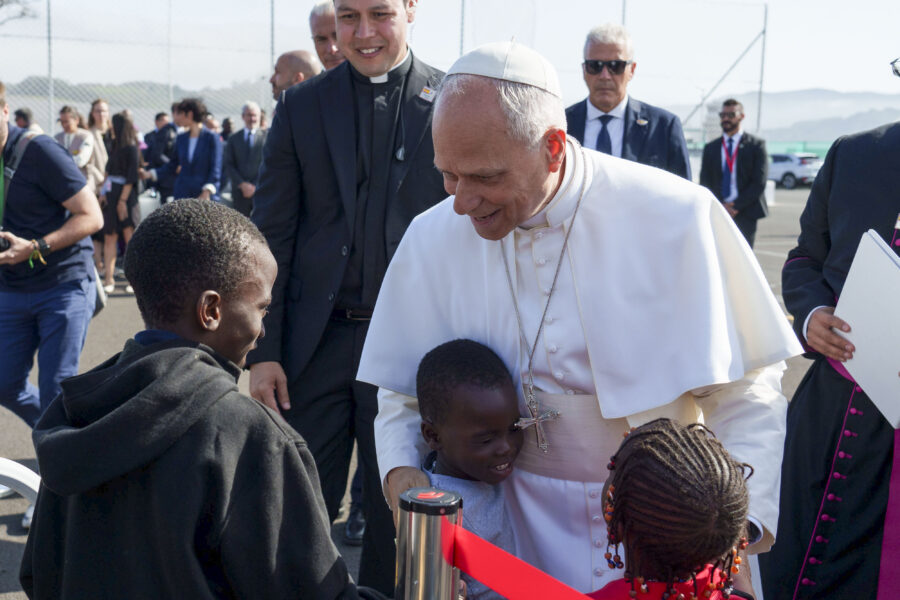
Pope Leo XIV has focused his message for the 112th World Day of Migrants and Refugees on migrant and refugee minors, which the Church will celebrate on September 27 under the theme “Even one of these little ones.” The Pontiff warns of the special vulnerability of children affected by war, poverty, violence, trafficking, exploitation, and forced displacement, and calls for action both in countries of origin, to combat the causes that force them to leave, and in transit and destination countries, where he urges the guarantee of their protection and welcome.
In the message, dated August 11 and published this Friday by the Holy See, Leo XIV insists that “every child, every human being, possesses infinite dignity” and urges Christian communities to integrate migrants and refugees “as full members of the ecclesial family.” The Pope also calls on civil institutions to promote family reunification and avoid traumatic separations, and maintains that the debate must shift from “the mere management of migratory flows” to the protection of human rights. Among the fundamental rights of minors, he explicitly mentions “life, education, and a standard of living that allows them to grow and develop fully.”
Below is the full message of Leo XIV:
Dear brothers and sisters:
Year after year, the World Day of Migrants and Refugees invites us to focus our attention on different aspects of the complex migratory phenomenon. In this 112th World Day, the theme “Even one of these little ones” calls us to pay attention to minors directly affected by the experience of migration and flight, to concern for them, and to the Lord’s promise that whoever “welcomes one such child in my name welcomes me” (Mk 9:37).
Displaced minors: a complex reality of vulnerability
Minors are the most vulnerable within global migratory flows. They are concrete faces, unique stories, that appeal to our conscience. Every year, millions of children and adolescents are forced to leave their land because of war, poverty, violence, environmental disasters, and other tragedies; and, unfortunately, their number continues to rise. The economic, political, and military responsibilities for this disaster are immense. The suffering is not limited to displacement; there are very young children who have lost their parents, brothers, sisters, and friends, and who witness indescribable violence. Others, separated for long periods from their relatives, try to reunite with them, living in the meantime the anguish of distance. There are also minors who face the journey with their parents, but exposed to extreme and traumatic conditions. Finally, we cannot forget the tragic situation of those who are separated from their parents because of repatriation.
To this already dramatic panorama are added other tragedies: deaths along migratory routes, trafficking and exploitation, the recruitment of minors for participation in armed conflicts, sexual violence, forced marriages, and atrocities suffered or witnessed during the journey. Their dignity is trampled in too many ways.
Pope Francis, in the message for the 2017 World Day of Migrants and Refugees, dedicated to the theme “Young Migrants, the Vulnerable and the Voiceless,” recalled that these “find themselves unprotected for three reasons: because they are minors, foreigners, and defenseless; for various reasons, they are forced to live far from their homeland and separated from the affection of their family.”
Nevertheless, amid so much darkness, the light of solidarity is not lacking: people, families, civil institutions, and ecclesial communities choose not to look the other way (cf. Lk 10:29-37). Let us think of families who open the doors of their homes to restore to these minors the warmth of a home, of educators in host communities, of volunteers and workers who, every day, on the routes and in our cities, dedicate themselves to healing the invisible wounds of these little ones. With their commitment, they bear witness that love can overcome indifference.
Even one of these little ones
This dramatic reality makes me think of the words of Jesus that deeply challenge the conscience of each one: “Whoever welcomes one such child in my name welcomes me” (Mt 18:5). It is not a question of numbers or statistics. The Gospel invites us not to make calculations: even one. Every child, every human being, possesses infinite dignity. He or she is the image and likeness of God (cf. Gn 1:26), the presence of the Lord. Before every migrant minor, we are called to perform an act of humanity and faith: in the child, in fact, we can welcome and encounter the Lord. This call becomes even more urgent in light of this other statement of the Lord in the Gospel of Matthew: “I was a stranger and you welcomed me” (Mt 25:35).
Unfortunately, migrant minors are more easily relegated to invisibility, lacking adults to protect and support them. It is necessary to intervene in countries of origin to eliminate the possible causes that force them to flee, as well as to offer protection and welcome in transit and destination countries. The cry of displaced minors rises today to God, just as the one heard in the book of Exodus: “I have seen the oppression of my people in Egypt and have heard their complaints against their oppressors; I know their sufferings. I have come down to deliver them” (Ex 3:7-8). God listens and, to liberate, powerfully challenges the conscience and action of each one of us, just as He did with Moses. We cannot remain indifferent, nor become accustomed to so much suffering.
A call to the responsibility of all
Even one of these little ones calls us, in our personal life, to open our eyes and hearts to listen deeply to their story, their fears, and their dreams, overcoming the indifference that reduces the human being to a statistical datum that does not directly affect us. It is an invitation to recognize the child in his or her dignity, even before in his or her condition as a “migrant,” and to protect his or her fundamental rights: to life, to education, and to a standard of living that allows him or her to grow and develop fully from the physical, mental, spiritual, moral, and social point of view.
Even one of these little ones calls us, in ecclesial life, to turn hospitality from an abstract concept into a constant pastoral practice. We cannot limit ourselves to delegating this task to institutions or associations endowed with a specific charism: before the concrete faces that challenge us day by day, the entire Christian community is called to feel them as its own children and to approach the concrete story of each one. It is necessary to encourage Christian communities to integrate and value refugees and immigrants as full members of the ecclesial family, promoting new educational and spiritual pathways, even personalized ones, that go beyond the logic of mere assistance. In particular, it is essential to prevent loneliness, isolation, and rejection, which not infrequently also affect the children of migrants, and to promote dynamics of encounter and integration in which young people from the territory and young immigrants can strengthen one another, on a path of mutual respect, solidarity, and friendship.
Even one of these little ones, in the context of different religions, reminds us that the vulnerability of the smallest knows no confessional boundaries and unites us in a shared humanitarian and spiritual responsibility. It becomes fertile ground for concrete interreligious dialogue, in which believers, inspired by their own sense of transcendence, cooperate in the creation of protection networks. Faith communities are called to create spaces in which every girl and every boy are respected and valued in their respective cultural identities, thus preventing the risk of radicalization by extremist groups. Protecting a minor ultimately means safeguarding the divine imprint stamped upon him or her.
Even one of these little ones, in the context of civil institutions, urges us to reaffirm the principle of the best interests of the child. Public and private institutions are obliged to place at the center the protection and dignity of every child and adolescent. This implies the adoption of effective legal instruments of protection, promoting family reunification and avoiding the traumas of separation. An urgent change of perspective is needed: the focus of the debate must shift from the mere management of migratory flows to the full and immediate protection of human rights, adopting “a coordinated, solidary, and effective response, capable of guaranteeing protection, welcome, and real opportunities for integration to those who migrate” (Address to the Spanish Parliament, Madrid, June 8, 2026).
We entrust migrant and refugee minors to the maternal protection of the Blessed Virgin Mary, who, together with Saint Joseph and the child Jesus, knew the cruelty of Herod’s violence and the drama of exile in Egypt (cf. Mt 2:13-15); may She accompany their steps and help our communities to become living and credible signs of the Gospel.
Vatican, August 11, 2026, memorial of Saint Clare of Assisi.
LEO PP. XIV