


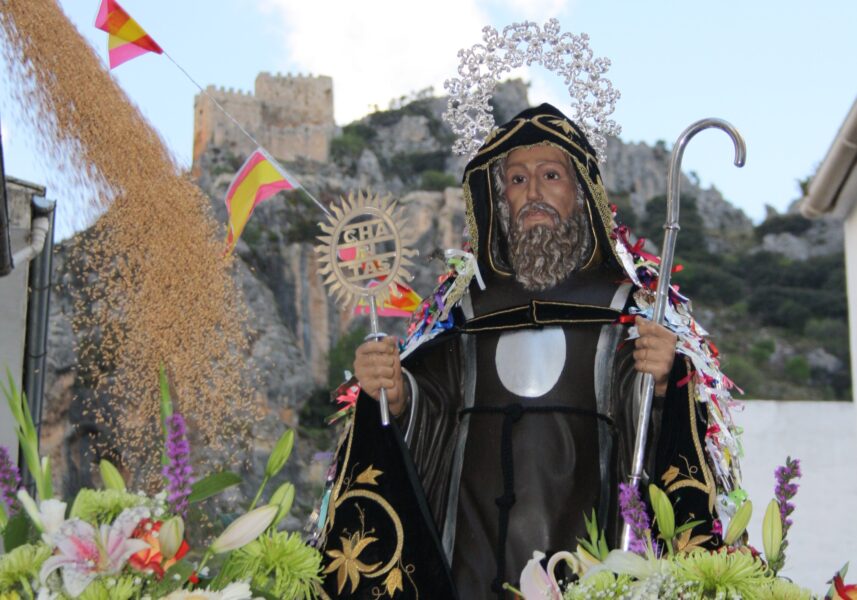
The patronal festivals of Albanchez de Mágina, a small municipality in Sierra Mágina, Jaén, have been celebrated for generations around two dates closely linked to its religious tradition: on May 3 the Procession of the Rosario de los Hachones takes place, and on May 4 San Francisco de Paula, the town’s patron saint, is honored. However, in 2027 the patron saint’s day will no longer be a local holiday: the Town Council has approved moving the holiday to Friday, April 30, to allow the celebrations to be concentrated over the first weekend in May.
The change has sparked opposition from the Plataforma Ciudadana en Defensa de las Tradiciones de San Francisco de Paula, which warns that shifting the calendar for reasons of convenience progressively separates the patronal festivals from the religious dates that gave rise to them. “April 30 is not the feast of San Francisco de Paula,” the residents remind.
A weekend instead of the patron saint’s day
The Town Council, governed by the PSOE, has used its municipal majority to approve Friday, April 30, 2027, as a local holiday in place of the traditional May 4. The stated aim of reorganizing the celebrations is to make it easier for albanchurros living outside the municipality to take part.
The issue that has sparked controversy is whether patronal festivals can be moved primarily to fit the weekend calendar without ultimately altering what makes them patronal in the first place.
The citizens’ platform argues that this is not “a simple administrative or labor matter.” Residents claim that choosing April 30 helps establish “an alternative calendar that allows the patronal festivals to be moved to the first weekend in May, even if that means separating the local holiday from the actual date of the Patron’s feast.”
The criticism aligns with that voiced by the local PP, whose spokesperson, Mario León, has accused the municipal government of trying to “detach the festivals from the Christian faith and invent a civil weekend of festivities.”
May 3, the Hachones; May 4, San Francisco de Paula
The platform insists that the dates are not a secondary element of the celebrations. For generations, Albanchez’s patronal calendar has been anchored on May 3 and 4.
The first day corresponds to the Procession of the Rosario de los Hachones. The following day brings the feast of San Francisco de Paula. For those defending its preservation, altering these reference points to adapt the festivals to the weekend affects the continuity of a religious and popular tradition passed down through generations.
“These dates are not a recent whim or a political construct,” the platform states. “They are part of Albanchez’s collective memory and the way generations of albanchurros have celebrated their Patron.”
The organization does not question the Town Council’s legal authority to set local holidays. Its objection concerns the criterion used: it believes that this power should not be employed “to artificially construct a calendar alternative to that of the traditional patronal festivals.”
When the date itself is part of the tradition
For the platform, preserving a patronal festival does not consist solely of maintaining certain acts, processions, or external elements. It also involves safeguarding the calendar that gives them their religious meaning.
That is why it demands that May 4 once again be recognized as a local holiday and calls for any modification of such deeply rooted celebrations to be carried out through dialogue with residents, devotees, and the institutions linked to them.
The debate that has arisen in Albanchez de Mágina thus raises a question affecting many festivals of religious origin: to what extent can their dates be adapted to contemporary needs without the popular celebration gradually becoming detached from the Christian feast from which it was born.
“Albanchez does not need any political party to reinvent its traditions,” the platform concludes. “It needs those in government to know how to respect, protect, and pass them on.”