


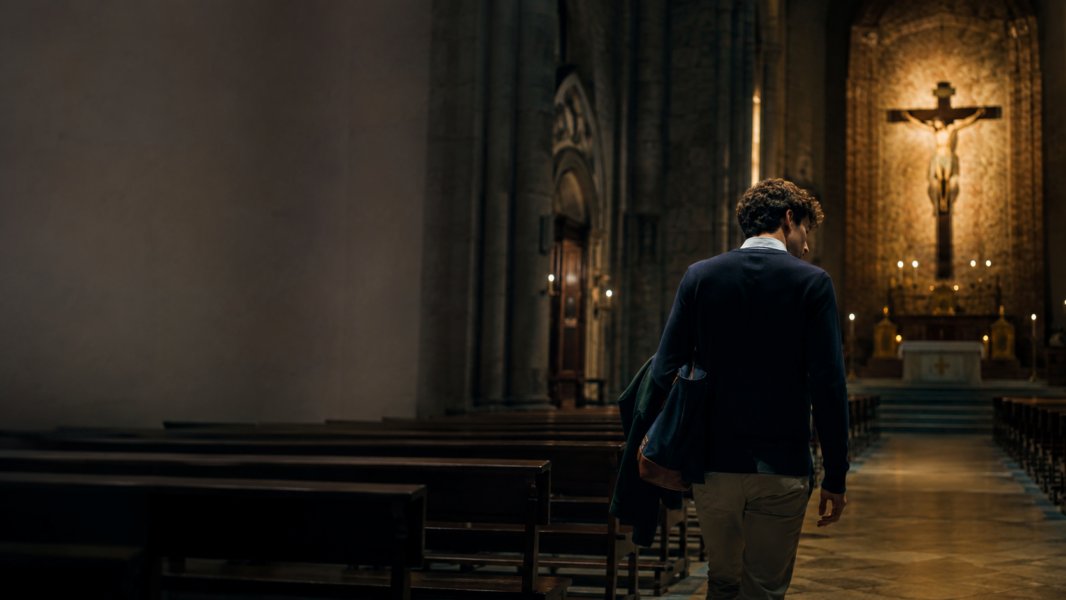
One will confess, to begin where one must, that one has sympathy for the people of Hakuna. Not the condescending sympathy of the older gentleman who celebrates that the young are doing something, anything, as long as it is not worse, but the other kind: that of someone who has seen twenty-two-year-old lads kneeling at half past eleven at night in a freezing crypt, in August, when they could be anywhere else in this sweaty, summery Spain where one can be at half past eleven on a Tuesday night. That is real, and it is no small thing. De hoc satis, as the scholastics used to say when they wished to move on to the unpleasant.
Because what is unpleasant is that the name of the matter already says everything, and it says it in Swahili, and it says it with a frankness that no external critique will ever improve.
Hakuna matata: no problem. A phrase that most Spanish-speakers first encountered in 1994, in a dubbed version, sung by a warthog and a meerkat, in a Walt Disney Company film about dynastic succession on the savanna. The movement’s leaders explain—and rightly so, because the misunderstanding is obvious—that theirs is not the matata but the hakuna, that there is no problem because God is there, that the carefreeness is theological, not pharmacological. One accepts this willingly. But one has also read enough to know that brands, like symptoms, tell the truth against the will of those who choose them. And that no previous generation of Catholics, in twenty centuries of a Christianity that has produced names like Carthusians, Discalced, Passionists or Daughters of Charity, had ever adopted as its corporate name the abolition of the problem.
The problem, in the Gospel, is exactly what there is.
The reader will recall the passage, found in all three Synoptics and best read in Matthew. A young man approaches—not just any young man, but one with questions, one of the good ones, one who today would go to Holy Hour: he asks what he must do to have eternal life, the commandments are recalled to him, and he answers with that splendid and utterly sincere phrase of all boys formed in good schools from then until now, “All these I have kept; what do I still lack?” And then the blade falls. Sell what you have, give it to the poor, and follow me. Vade, vende quae habes. And the young man, who was good, who was pious, who had kept the commandments, goes away sad because he had many possessions. Abiit tristis. There is no final song. No embrace. No second part of the passage in which the Lord comes running after him to explain that it was a metaphor, that he should take it easy, that the journey matters more than the destination, that he will see in time. The young man leaves, and Christ lets him go, and it is probably the most terrifying moment in the entire New Testament precisely because no one has done anything wrong.
Very well. One will maintain that the emotional Spanish Catholicism of the last two decades, of which Hakuna is the most accomplished—and therefore the most instructive—manifestation, has resolved that passage by means of a procedure of remarkable technical elegance: it has preserved the imperative entire, word for word, and reversed its direction.
It is no longer God who says to the young man, “Leave what you have and follow me.” It is the young man who says it to God.
And one must admit that the operation works wonderfully, because the command still sounds evangelical, still retains its radicality, still allows the language of all or nothing, of falling in love, of total surrender, of tout ou rien, and yet the one who must sell the patrimony is the Other. Leave your Latin, which no one understands. Leave your rubrics, which belong to another century and are constricting. Leave your silence, which makes people uncomfortable and does not fill two hours. Leave your sexual morality, or at least do not mention it until the third year, once there is already a bond. Leave your institution, which is stained, and keep only the personal encounter. Leave your bishops. Leave your weight. Leave your demands, for I already demand enough of myself in my master’s program. And come, come to my hour, come to my crypt, come to my beach, come with my soundtrack and my typography and my IKEA candles, come to the format I have prepared for you, a good format, a full format, a format where you will feel very much at ease.
Sequere me, but conjugated by the other.
Bonhoeffer, who wrote The Cost of Discipleship in 1937 and knew well what he was talking about because he ended up hanging from a butcher’s hook in Flossenbürg, called it cheap grace: grace as doctrine, as principle, as system; the forgiveness of sins proclaimed as a general truth; the love of God understood as a Christian conception of God. Grace without discipleship, grace without the cross, grace without the living, incarnate Jesus Christ. And he added a definition that one recommends every spiritual director of a youth movement should have tattooed: cheap grace is the grace one grants oneself. What is costly, on the other hand, is costly because it costs something. It costs the rich young man. It costs, very precisely, the possibility that the lad may go away sad and not return, and that one may be left without the photo, without the attendance, without the testimony on the stage.
Philip Rieff diagnosed in 1966, in The Triumph of the Therapeutic, the passage from religious man to psychological man: the former was born to be saved, the latter is born to be pleased, and the institutions that once demanded renunciation are transformed into providers of well-being on pain of emptying out. The crypt in Santander is Rieff with incense. Kierkegaard, for his part, described the aesthetic stage as that in which the subject lives on the intensity of the moment and flees from repetition because repetition is where one becomes bored and, therefore, where one commits. The monthly Holy Hour with live band, warm lighting and annual slogan belongs properly to the aesthetic stage. The grandmother’s rosary at half past seven in the evening, on the other hand, every day, with the same fifty identical Hail Marys and no possibility of new content, belongs to the religious stage. The reader may guess which of the two things draws three thousand people today and which is literally dying of old age.
And let no one think that one is proposing the opposite, which would be the symmetrical and considerably more tedious error: it is not that faith must be ugly, or cold, or sad, or sung exclusively in Gregorian chant by gentlemen with horn-rimmed glasses. Beauty is a transcendental and the guitar is not heretical. It is something else, finer and more serious: it is whether the act of worship is ordered to God or to the experience of the subject who consumes it. Ad Deum or ad me. The entire question fits in that preposition, and anyone who thinks it is a sacristy nuance has never understood why entire councils have been held over prepositions.
So the question one would put to the organizers, without any acrimony and with genuine interest, is not about the letters on the frontal or the number of candles, which already received their answer elsewhere in this newspaper. It is this other, far more uncomfortable question: when, at what point in the itinerary, in what month of the academic year, do you tell a twenty-four-year-old lad that he has to sell what he has? Not the feelings. Not the wounds, for that is always asked for and costs nothing because it is also appealing. What he has. The life plan, the prestige, the girlfriend he sleeps with, next year’s salary, Sunday morning, the entire career if necessary.
Because if that question is never asked, we already know who the rich young man is in this story.
And we already know, above all, who it is that is going away sad.