


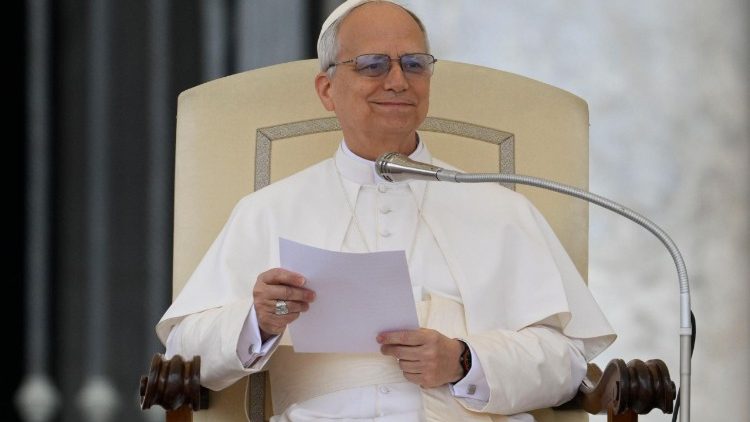
Pope Leo XIV has dedicated this Wednesday, August 12 general audience to the importance of the liturgical year and, especially, to the centrality of Sunday as the “day of the Lord.” Before the pilgrims gathered in St. Peter’s Basilica, the Pontiff recalled that the Sunday celebration of the Eucharist requires the gathering of the faithful and emphasized that this “cannot be replaced by a merely virtual presence.” He also encouraged creating the necessary conditions so that those who must work on Sundays can participate in Holy Mass.
At the end of the audience, Leo XIV made a special appeal to Colombia following the devastating earthquake that has left numerous victims, injured, and severe material damage. The Pope prayed for the eternal rest of the deceased, assured his closeness to the families and those affected, and thanked the work of those involved in rescue and assistance efforts.
Below we leave the complete intervention of Leo XIV:
Dear brothers and sisters,
the fifth chapter of the conciliar Constitution Sacrosanctum Concilium (SC) is dedicated to the liturgical year, a theme on which we wish to dwell today, to explain its importance in the life of every believer.
First of all, it must be recalled that this way of defining the cycle of Christian celebrations as the “liturgical year” spread in ecclesial language thanks to the work of the Servant of God, Abbot Prosper Guéranger (1805-1875).
In the encyclical Mediator Dei, Pope Pius XII affirms that “it is not a cold and lifeless representation of things belonging to past times, nor a simple […] remembrance of a bygone age. Rather, the liturgical year is Christ himself who perseveres in his Church and who continues that path of immense mercy which he began in this mortal life […] with the most loving purpose that the souls of men may come into contact with his mysteries and through them in a certain way live; mysteries which are present and constantly at work” (III Divinum Officium et Annus Liturgicus, II Cyclus Mysteriorum). Therefore, the liturgical year must be understood as the constant actualization of the work of salvation which Christ accomplishes in history. Throughout this temporal cycle, the Church remains in contact with the redemptive action of the Lord, so that the faithful may be filled with the grace of salvation (cf. SC, 102c). The encounter with Jesus, who died and rose for us, is the end which the Church always pursues, placing at the center of every moment the celebration of the paschal event.
For this reason, the conciliar fathers consider “the foundation and the heart of the whole liturgical year” precisely Sunday, “the primordial feast day” (cf. SC, 106). In several modern languages, its name attests that it is the “dies Domini,” “the day of the Lord.” Even in those languages in which the reference to the “day of the sun” has prevailed (Sunday, Sonntag), the link with Christ is glimpsed: Christ is the true “sun of justice” who enlightens every man!
Saint John Paul II, in the apostolic letter Dies Domini (May 31, 1998), teaches that Sunday is the day of the Lord, the day of the Church, the day of man, and finally “the day of days”: “Being Sunday the weekly Easter, in which the day on which Christ rose from the dead is recalled and made present, it is also the day that reveals the meaning of time. […] Springing from the Resurrection, it passes through the times of man, the months, the years, the centuries like a straight arrow that penetrates them, orienting them toward the second coming of Christ. Sunday prefigures the final day, that of the Parousia” (n.75), when we shall all rise.
To sanctify Sunday it is fundamental to celebrate the Eucharist. The hearing of the Word and participation in the Body of Christ imply, according to the conciliar fathers, the convenire in unum (cf. SC, 106), that is, the festive convocation of the faithful. In this assembly, the Christian community makes visible its communion with the Lord and bears witness to its belonging to Christ and its fidelity to the Church. This assembly cannot be replaced by a merely virtual presence, nor is it reduced to a merely passive gathering. The liturgical assembly is realized, in effect, in the active participation of brothers and sisters, gathered together so that “they may give thanks to God, who ‘has caused them to be born again to a living hope through the resurrection of Jesus Christ from the dead’ (1 Pet 1:3)” (ibid.).
In this sense, I encourage all of you to create the best possible conditions so that those who on Sundays do not have the possibility of being absent from work may also participate in Holy Mass.
Dear brothers, the liturgical year, marked by Sundays, has an interesting history, in which the faith and devotion of the Church are intertwined. In fact, already from the second century A.D., the celebration of the weekly Easter was joined by that of the annual Easter, “the greatest solemnity” (SC, 102), which extended to what is called the “time of great joy” of fifty days, which culminated in Pentecost and was prepared through the season of Lent with its penitential character (cf. SC, 109). The development of the Christmas cycle, which took place later following the model of the Easter cycle, has made it possible to relive the mysteries of the incarnation of the Word of God, of his birth, and of his manifestation to the world. The Church has also incorporated into the various seasons the veneration of the Blessed Virgin Mary, “united by an indissoluble bond to the saving work of her Son” (SC, 103), and “the memory of the martyrs and of the other saints […] sing perfect praise to God in heaven and intercede for us” (SC, 104).
The liturgical year thus proposes, in a sacramental way, the pedagogy of the history of salvation, guiding the faithful from the expectation of the Messiah to the fullness of the paschal mystery and the anticipation of future glory. In it, the Church celebrates the saving actuality of the mystery of Christ, allowing believers to participate in it ever more deeply. For this reason, the liturgical year constitutes the inspiring principle and the essential frame of reference for all pastoral action.
Greetings
I cordially greet the Spanish-speaking pilgrims. Let us ask the Virgin Mary, who carried Christ in her womb, to intercede for us so that, like her, we may participate in the mysteries of Christ, especially in the Sunday celebration of the Eucharist.
May God bless you. Thank you very much.
Appeal
I wish to express my closeness to the Colombian brothers and sisters who suffered the effects of the recent earthquake that caused numerous victims and injured, as well as great material damage. While I pray to the Lord for the eternal rest of the deceased, I assure my prayers for their families and all those who have been struck by this tragedy. I express my gratitude to all those who work in the tasks of rescue and assistance to the victims.