


Before deciding to buy the house in Los Monegros and come to live here, I considered for a time the possibility of living as an urban hermit.
I had read about the well-known proposal of urban eremitism represented by the Communities of Jerusalem, which bring together monks, nuns, and laypeople, each according to their charism and personal commitment, to share the same spirituality that invites them to live “in the heart of the cities, in the heart of God”.
- J. Chitty points out in his classic work on urban monasticism “The Desert a City”, that we can say that the city is a desert. But what does this desert, so fundamental to the monk’s life, imply?The desert is the desolate and wild land; the arid solitude and the deep silence. The desert is the seclusion where the monk seeks, through prayer and penance, the free renunciation of selfish desires, awaiting God’s time. The urban hermit is a type of monk among the many that exist. And like monks everywhere, he is consecrated to God through vows or sacred promises, whether public or private, temporary or perpetual. And they are formulated in the traditional way, with poverty, chastity, obedience, and stability; or they may be expressed in new creative forms. But the meaning is the same. The monk is one, consecrated, offered, surrendered to the complete service of God”.
Finally, I discarded the idea for three main reasons:
- The term “hermit” derives from “eremos,” desert. Likewise, “monk,” “monachos,” means “alone”.
- From the earliest times of Christianity, those who wished to seek God and surrender themselves to Him with radicality abandoned the cities and withdrew to solitary places. And there, in the desert, life could be solitary (hermit, anchorite) or in community (cenobite). If I am not mistaken, religious with vows only began to live in cities when the phenomenon of the mendicant orders appeared in the thirteenth century and the friars began to build their convents in the cities or very close to them; whereas it was common among monks for their monasteries to be located in remote places.
- It seemed to me that these hermits or city monks of the monastic communities of Jerusalem and others like them were a creative invention after the Second Vatican Council, at the initiative—in the case of the monks of Jerusalem—of Cardinal Marty, then Archbishop of Paris, and Father Pierre-Marie Delfieux.
Regarding this third reason, it seemed to me almost outrageous, the typical arrogance of many Catholics in the twentieth century: if hermits had always withdrawn in search of the desert, why propose that the city could be a desert? A medieval city might still be acceptable, as when the mendicants built their convents very close to or within urban centers to preach in the cities. But because they were preaching and mendicant friars, they were not monks.
The proposal of urban eremitism seemed to me not only contrary to what hermits had done historically, but also full of inconsistencies and conceptual errors, especially that of confusing any city with the city of God (constitution #128), the heavenly Jerusalem, which cannot be lived here and now. The human, earthly city more closely resembles the concept of “the world” as St. John considers it, which is, as Benedict XVI said, that which hates God. It is true that there are Christian vocations that consist in living in the world, such as families, but it seems to me that the city is not for a monk or a hermit. And above all, that confusing the city of God with any city of the world is a mistaken, immanentist way of interpreting the City of God.
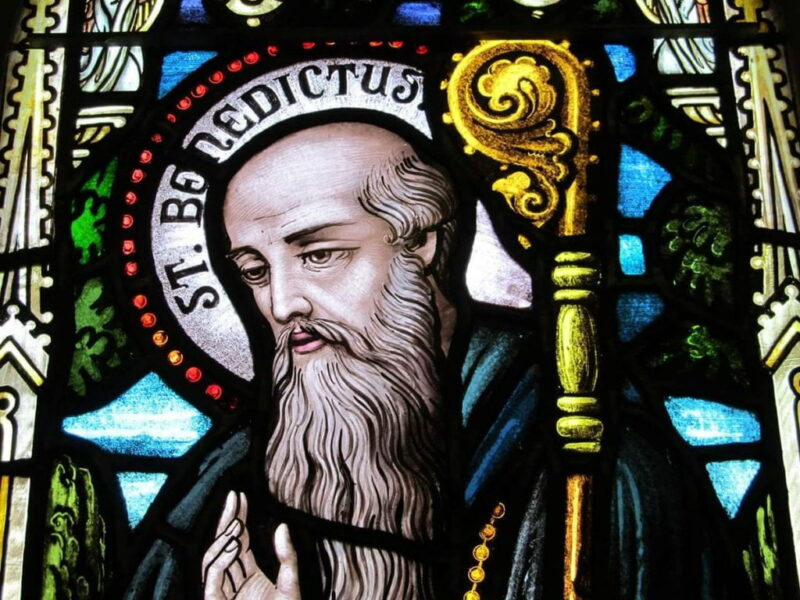
I would like, in connection with this reflection, to discuss a famous case of a hermit from the early centuries of the Church who did not think of becoming a hermit in the city, but precisely of fleeing from it and going to a solitary place: St. Benedict.
St. Benedict is the monk who has brought me to the desert. His life, and above all his Rule, seem to me the most perfect way on earth in which a baptized person can live, being configured to Christ and seeking holiness. I will not give a scholarly exposition of his life and work, but simply transcribe, as in a monastic scriptorium, the words that Dr. Rubén Peretó Rivas dedicates to him in his work “The Birth of Christian Culture”, which I recommend to anyone who has not read it. I will not reproduce the entire chapter, but only the young Benedict of Nursia’s departure to the desert.
“As St. Gregory explains, Benedict conformed his life to God’s designs without taking into account the expectations that had been placed upon him, nor the precautions that worldly prudence advised. He decided to live according to God’s will, in full fidelity.
It is striking, when reading the Life written by St. Gregory, the geography he recounts. An Italian peninsula populated with small monasteries; some of pious life; others, of dissipated life (…). An elongated country where holy men and sinful men anarchically swarmed, choosing the common life, in poverty, chastity, and obedience, fleeing from a decadent world that was falling to pieces amid lusts, feasts, wars, and massacres, quite similar to our own. And among all of them, among all the different modes and codes of life they had, almost in silence, Benedict, with his Rule, changed Europe. That is what is remarkable and surprising: the simplicity with which God does things. He did not use an army or a great prince; not even a legion of bishops; He preferred a monk who, in the simplicity of an austere and secluded life, in the midst of a hostile and brutalized territory and world, was able, without intending or knowing it, to contribute to shaping a world we call Christendom.
Benedict was a native of Nursia, a small city located in a mountainous area, a few hundred kilometers north of Rome, in Umbria. Benedict’s family, who enjoyed a certain degree of comfort, decided that their son, barely past adolescence, should go to Rome to study the liberal arts. In this regard, St. Gregory explains: “But, seeing that in the midst of such studies many slipped down the swift slope of vices, he drew back the foot he had already almost placed at the entrance of the world, lest, if he came to know a little of it, he too might soon fall, all of him, into a huge precipice”. The biographer does not tell us what the young Benedict saw in the Roman student world, but we can suppose it: a licentious life that irresistibly pushed those who approached the vices proper to youth. St. Gregory himself relates a little later an episode that occurred when Benedict had already spent some years of hermit life. He writes: “The evil spirit represented before the eyes of his soul a certain woman whom he had seen long ago, and the memory of her beauty so inflamed the mind of the servant of God that the flame of love could scarcely be contained in his breast. Overcome by passion, he was almost decided to leave the solitude”. It is very likely that the vicious atmosphere to which he managed to glimpse in Rome consisted, above all, in the vices of the flesh, related to sexual passion, which is the most difficult to master in youth. “A beautiful woman” still hovered in his memory, and this memory, revived by the demons, almost made him abandon his purpose of a holy life.
It is interesting to pause at this aspect of St. Benedict’s life, who lived in a world with several aspects similar to ours. He had to go through a brief period of life in a vicious city, where pleasures were offered at every turn. It would not, certainly, be the current situation in which one so easily accesses this type of pleasures—the sexual ones—since internet pornography poses an enormous challenge, not only to preserve virtue, but also sanity, because it is a vice, as St. Thomas pointed out, from which it is very difficult to free oneself”.
Pausing in Rubén Peretó’s narration, I would like to emphasize that withdrawing to the desert does not mean that one escapes temptations. Certainly, St. Jerome said that he had withdrawn to flee from the corrupting world and be able to save himself, but he continued to be painfully and intensely tempted, to the point that he lived only two years in the desert of Calcis and abandoned it, preferring thereafter to live in community, to receive the support and example of others like himself.
The fact that the temptation of the flesh, one of the three enemies of the soul pointed out by St. John of the Cross, is, according to Rubén Peretó, the most difficult to combat in youth, touches me very directly. I explained it in the first of these installments. The pain of sins, already confessed and absolved, committed against the sixth commandment torments me, as it did St. Augustine in his last years. As a result of the time in which I happened to grow up, and although educated in a family of Catholic principles, my mind lived for years understanding that love must always have to do with the carnal relationship. It took me years to become aware of it, and more years it is taking me to cleanse my mind and soul, through prayer and bodily mortifications. I recently read in this regard a striking phrase from the former bishop of Córdoba, Msgr. Demetrio Fernández, in an article in Infovaticana: “Chastity is the virtue by which one learns to love”. I have been praying with these words for days.
Dr. Rubén Peretó continues narrating that “the young Benedict, then newly arrived in Rome from a small provincial city, probably with enthusiasm and predisposition to become a prosperous man of law, was overwhelmed as he glimpsed the abyss of pleasures that his newly begun student life offered him, and decided to withdraw. In St. Gregory’s account it is clear that his decision was not due to any problem of shyness, inferiority complex, or socialization problems: it was not due to a weakness or some psychological trauma. It was due to a decision: “he drew his foot back”. His will prevailed over the desires of the flesh, and the will can only prevail when the ends proposed to it by reason are firm and clear. “The will is blind,” says scholastic philosophy, and it is right. Man decides, or chooses, according to what the intellect presents to him, and that is the reason why, when a man does not have a clear and well-formed intellect, his will usually decides according to the options presented to him by the passions. And thus, the formation of the will through habits must be accompanied by the formation of the intellect through knowledge of the Truth.
That is why we can infer that Benedict had in his home in Nursia a good Christian formation, basic surely in terms of the quantity of knowledge, but solid enough so that, when the moment came, he could present to the will the option to which it should incline: to leave the city, to flee from Rome and change his plans”.
At the time, I did not have such a clear and well-formed intellect, and therefore my will decided according to the options presented by the passions.
These lines are only a few pages of Rubén Peretó’s magnificent work. Be encouraged and read it in full. It deserves it. Since I discovered it in 2022, I read it twice a year. I transcribe Dr. Peretó’s words without any bad conscience of plagiarizing because, as he himself explains, medieval people knew that we are dwarfs on the shoulders of giants, and that the preservation for the transmission of received wisdom is a hidden but fundamental task. This is, moreover, the life according to the Rule of St. Benedict, so essential to every baptized person: to pray, to study, and to work. To study in order to know God.
Up to this point, I have tried to present my experience as a hermit; the struggles, the doubts, and the difficulties. Why have I exposed it in such a detailed and extensive way? Because I thought it might help other men, more or less young, who wish to consecrate their lives to God but do not find a place in diocesan structures or religious orders; I also had in mind those who, because of age, entering an international seminary of a traditional institute is not an option. We are in times of profound crisis. It is about saving the remains of the shipwreck. To pray and to be formed in order to learn the Catholic apostolic faith and be able to transmit it without any change to the new generations.
Henceforth I intend not to speak of myself, but to reflect fundamentally on Benedictine spirituality, although also, to a lesser extent, on my incipient inquiries into traditional Catholicism in Spain after the Second Vatican Council. I do not know how often I will be able to put reflections on these topics in writing, but I propose to do so because they are the ones that fundamentally compose my life of prayer and study and I believe they can be a source of reflection for other baptized persons.
Note: This article is part of a series in which the author recounts his experience of hermit life and his spiritual journey. To be continued.
Chapter 1: A House in Ruins in Los Monegros
Chapter 2: From the Corrupting World to the Desert, to Seek God… and Be Tempted
Chapter 3: If They Are Benedictines and Hermits, Why Not Camaldoli?