


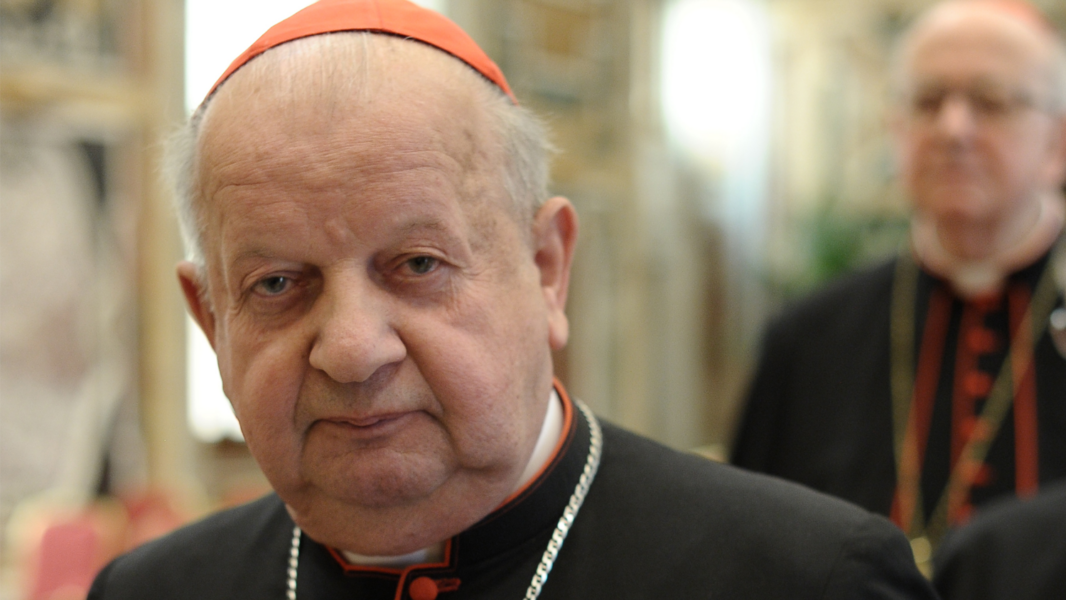
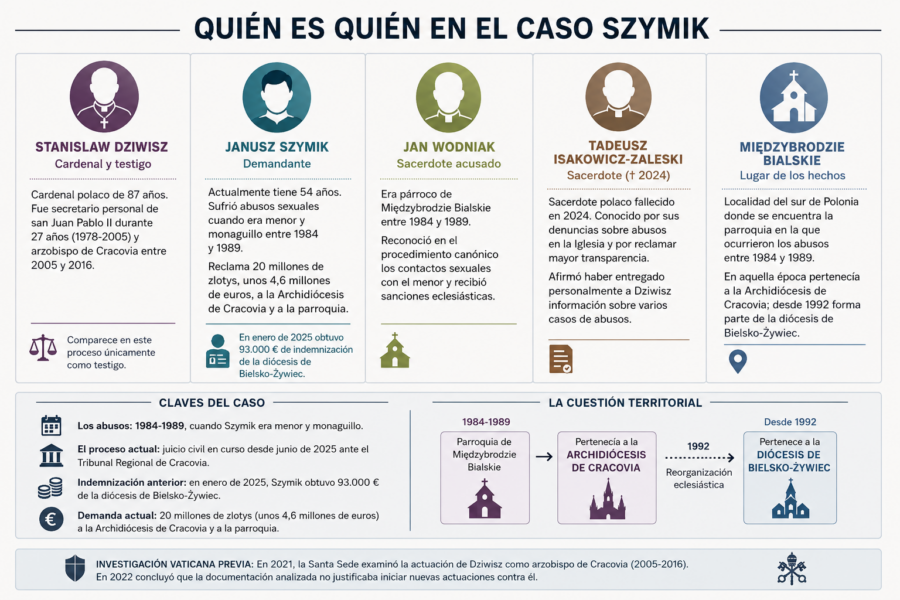
Cardinal Stanislaw Dziwisz, who served for 27 years as personal secretary to Saint John Paul II and later as Archbishop of Krakow, testified last Monday, August 3, as a witness before the Regional Court of Krakow in the civil proceedings initiated by Janusz Szymik, 54, who suffered sexual abuse as a minor while serving as an altar boy between 1984 and 1989 by priest Jan Wodniak. Szymik is claiming 20 million zlotys, approximately 4.6 million euros, from the Archdiocese of Krakow and the parish where the incidents occurred.
Dziwisz, 87, denied having knowledge of the abuse during the years it took place and maintained that he was then in the Vatican serving John Paul II and had no governing responsibilities over the Archdiocese of Krakow. The cardinal appears solely as a witness: he is not accused nor listed as a defendant in the proceedings.
The abuse continued for five years
The incidents occurred at the parish of Międzybrodzie Bialskie, in southern Poland. At that time it belonged to the Archdiocese of Krakow; following an ecclesiastical reorganization in 1992 it became part of the Diocese of Bielsko-Żywiec.
This circumstance explains why the victim has pursued proceedings against various Church institutions connected to the case.
Wodniak acknowledged during the canonical proceedings having had sexual contact with the minor and received ecclesiastical sanctions. Szymik has for years publicly recounted the abuse he suffered and demanded accountability for what happened.
The current lawsuit seeks to determine the possible civil liability of the Archdiocese of Krakow and the parish during the period when the incidents occurred.
Dziwisz: “I had no knowledge of it”
Much of the cardinal’s questioning focused on establishing what he knew about Wodniak and when he might have become aware of the allegations.
Dziwisz explained that he knew the priest, as he knew many other members of the Krakow clergy, from his time alongside then-Archbishop Karol Wojtyła. He denied, however, that there had been a personal or friendly relationship between them.
When the abuse reported by Szymik occurred, between 1984 and 1989, Dziwisz was living in Rome as personal secretary to John Paul II. He remained with the pontiff from his election in 1978 until his death in 2005.
His situation changed later, when Benedict XVI appointed him Archbishop of Krakow. Dziwisz governed the archdiocese between 2005 and 2016, a period on which he was also questioned.
The cardinal acknowledged having received during those years an “unpleasant” letter that mentioned Wodniak and other priests, although he claimed not to remember Szymik’s name appearing in it.
Photographs and documents discussed during the interrogation
The plaintiff’s lawyers presented several old photographs during the testimony which, according to their interpretation, would place Dziwisz and Wodniak together during a vacation.
The cardinal did not confirm that interpretation. He noted that, after so many years, he could not identify all the people appearing in the images and maintained that he had not had a friendly relationship with Wodniak.
The name of priest Tadeusz Isakowicz-Zaleski, who died in 2024 and was known in Poland for his reports on abuse and for years demanding greater transparency in the Church, also came up during the interrogation.
Isakowicz-Zaleski maintained that he had personally delivered documentation to Dziwisz on cases of abuse committed by priests. The plaintiff’s side considers that these documents may be relevant to establishing when the cardinal became aware of certain allegations.
Dziwisz has denied remembering having received that documentation and has maintained that there is no record of its receipt in the curia’s registers. It will be up to the court to assess the versions and evidence presented by the parties.
The cardinal had missed two summonses
Last Monday’s testimony had generated expectation in Poland because Dziwisz had not appeared at two previous summonses.
His defense cited, among other reasons, his age, issues related to his health, and a prolonged stay in Rome during July. The cardinal even requested that his testimony be dispensed with, considering that he lacked relevant information about the facts.
He finally appeared before the Regional Court of Krakow on August 3 and gave testimony for approximately one hour.
After hearing his explanations, Szymik reacted harshly and publicly accused the cardinal of lying. This is the plaintiff’s assessment of the testimony, while it will be up to the court to determine the credibility and relevance of the statements and documents incorporated into the proceedings.
Szymik already received about 93,000 euros in another proceeding
The current trial is not the first initiated by Szymik to claim compensation for the abuse suffered.
In January 2025 he obtained a favorable ruling against the Diocese of Bielsko-Żywiec, to which the parish where the incidents occurred now belongs. The court then ordered payment of 400,000 zlotys, approximately 93,000 euros.
Now Szymik is claiming a much higher amount—about 4.6 million euros—from the Archdiocese of Krakow and the parish itself. The inclusion of Krakow is due to the fact that, during the years when the abuse occurred, the territory was under the jurisdiction of that archdiocese.
The proceedings remain open and there is still no ruling on this new claim.
The Vatican previously examined Dziwisz’s conduct
The handling of abuse cases during Dziwisz’s time as Archbishop of Krakow had already been examined by the Holy See.
In 2021, the Vatican commissioned Cardinal Angelo Bagnasco, Archbishop Emeritus of Genoa, to gather information on various allegations regarding Dziwisz’s conduct during the years he governed the archdiocese.
In 2022, after reviewing the documentation collected, the Holy See stated that the analysis had not identified elements that would justify new actions against the cardinal for his handling of the cases examined.
The ecclesiastical investigation must be distinguished from the proceedings currently taking place in Krakow. Dziwisz is not the defendant in this trial, but one of its witnesses, and the court must determine whether civil liability should be attributed to the Archdiocese of Krakow and the parish for the abuse suffered by Szymik between 1984 and 1989.