


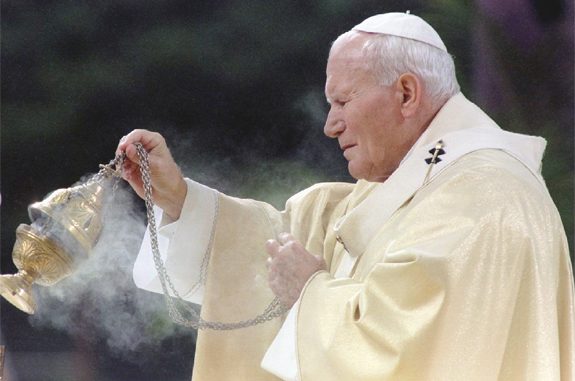
One of the least-known aspects of the long pontificate of Saint John Paul II were his attempts to free the traditional Mass, to grant full freedom to the priests and faithful who desired it.
We had already referred earlier to Jean Madiran’s work History of the Forbidden Mass, and this will be the main source on which we will rely to discuss the indult issued by John Paul II in 1984, the secret commission he established to investigate whether the traditional Mass had been prohibited, and his general attitude toward the Mass of all time.
Madiran recounts that “during the ten years that followed the death of Paul VI (1978-1988), the situation of the forbidden Mass remained practically unchanged; (although) not without incidents: the confrontation between the Montinians (progressives who supported Paul VI and the new Mass) and the refractories (or traditionalists) seemed endless, though without any decisive event despite the intensity of the tensions: the traditionalists, and chiefly the Priestly Fraternity of Saint Pius X founded by Archbishop Marcel Lefebvre, developed communities, founded schools, and rooted their organizations; all this while remaining a minority and suffering marginalization both inside and outside the Church, always despised and morally lynched by all the audiovisual media. For their part, the religious revolution continued, according to the “spirit of the Council,” its destruction of traditional ideas, institutions, and customs, enraptured by the wonders of the “renewal” undertaken, which nevertheless manifested itself above all, in the dioceses, through the scarcity of clergy, the decline of vocations, the disappearance of the parish spirit and of parish reality, the galloping decrease in religious practice, the disorientation of ideas, the continuous advance of moral laxity, and spiritual indifference.
The Roman Congregation for Divine Worship, by order of John Paul II, issued in 1980 a communication asking all bishops of the Latin Church to open an investigation into the possible persistence of an attachment to the celebration of the Mass in Latin and according to the traditional rite. The Pope would have wished this survey to remain secret, but the magazine presided over by Madiran in France, Itinéraires, revealed it in its September-October 1981 issue.
2,317 diocesan bishops of the Latin rite received a letter from Cardinal Knox, Prefect of the Congregation for Divine Worship, which posed two questions:
First question:
- a) Are Latin Masses celebrated in your diocese?
- b) Is the demand for Latin Masses increasing or decreasing?
Second question:
Are there in your diocese persons or groups who insist on having the Mass in Latin according to the ancient rite (“Tridentine Mass”)?
What is the size of these groups?
What are their motivations?
Since the bishops were the ones responsible for answering these questions, the responses were systematically biased by the fact that almost all of them omitted or even refused to listen to the persons and groups who remained attached to the traditional Mass. As if obeying an order from the Montinian party, they considered that the survey concerned only Catholics who remained in their parish and not at all those who had left it. Hence the conclusion of the survey, which did not reflect the reality of the persons and communities attached to the traditional Mass.
The attempts of John Paul II to free the traditional Mass—that is, to grant full freedom to the priests and faithful who desired it—remain to this day largely unknown to the public and to the clergy. The chief of these attempts, the “indult” theoretically granted by Quattuor Abhinc annos (1984), had no effective result, sabotaged by the Montinian revolutionaries, underestimated or misunderstood by the counter-revolutionaries. The latter bitterly reproached John Paul II for doing so little and so poorly for the Mass, without realizing at the time that that “little,” which was indeed practically little, always advanced by small steps in the same direction.
The letter Quattuor abhinc annos was addressed by the Roman Congregation for Divine Worship to the presidents of the episcopal conferences. It declared that it was fulfilling a personal desire of Pope John Paul II (“ipse summus pontifex”) and granted the bishops the faculty to permit, by way of “indult,” celebrations of the Mass that until then had been forbidden: for this reason it is usually called the “indult to use the Roman Missal of 1962 at the discretion of the diocesan bishop.” The original of the letter was in Latin, as were all ecclesiastical documents until very recently, and it stated:
“Most Excellent and Reverend,
Four years ago, by order of Pope John Paul II, the bishops of the universal Church were invited to conduct a survey: on the way in which, in their dioceses, priests and faithful had received the Missal promulgated by Pope Paul VI by virtue of the decisions of the Second Vatican Council; on the difficulties encountered; on the resistances that eventually had to be overcome.” The result of this survey was communicated to all the bishops (cf. “Notitiae,” no. 185). According to their responses, the problem of priests and faithful still attached to the so-called “Tridentine” rite seemed to have been almost completely resolved.
But since this problem persists…”.
This beginning – Madiran points out – clearly bears the personal mark of John Paul II: the Pope wished to indicate from the very beginning (“quattuor abhinc annos”) that he had been deceived four years earlier, or at least that they had gravely erred in assuring him that the disappearance of Latin and of the traditional Mass was about to be completed and no longer posed any problem; and, four years later, the problem persisted!).
“But since the problem persists, the Sovereign Pontiff in person, wishing to show favor to these groups, grants to the bishops of the dioceses the faculty to consent, by indult, that priests and faithful who expressly request it from their bishop may celebrate the Mass using the Roman Missal in its official 1962 edition, but…”.
With this “but” the declaration of what John Paul II decides “in person” ends, and from there begins the regulatory application that practically nullified everything that had just been granted. The episcopal conferences that remained progressive and the clan that Madiran calls Montinian, which continued to be the most numerous and powerful within the Curia, succeeded in imposing “norms” radically destructive of what had been granted:
Quattuor abhinc annos explicitly decided to grant the traditional Mass to those who requested it. Today it is clearer that this was John Paul II’s idea since his election in 1978.
But the opposition of the progressives, who continued – and continue – to constitute the leading nucleus of the episcopal conferences, was violent and fierce. John Paul II took their existence into account. His intention, it seems, was to free the traditional Mass by small steps, insofar as he could get the episcopate and public opinion to accept it little by little. But he went no further. And therefore he accepted that requests for authorization be directed to the bishops, so that they might join the movement: but they remained, on the contrary, those who did not want it and who would know how to ensure that it did not prosper. As for the traditionalists, they saw above all the fact that the traditional Mass was thus subjected to an inappropriate regime of prior authorization.
The difficulty for the Pope was real; the obstacle he encountered was enormously powerful: any measure in favor of the traditional Mass implied, implicitly but inevitably, a grave denial and an evident reproof to the bishops who, since 1969, had so often repeated that the Latin Mass, the Tridentine Mass, the ancient Mass, had been abolished, dead. They had said and repeated it ad nauseam “in the name” of the Pope and of the Council. As for the Council and its document Sacrosanctum Concilium, it was not true, but the “spirit of the Council” had been made to function in this sense, with Paul VI at the head. Because Montini himself, the Pope in person, wished, said, and made it so that his new Mass “replaced the old one” everywhere. By the early 1980s, Paul VI was no longer there, but the majority of the prevaricating bishops, responsible for the same abuse of power as his, were still there, controlled the ecclesiastical hierarchy, and had on their side public opinion, both Catholic and non-Catholic, already strongly mobilized against the Mass in the name of anti-fascism, the fight against racism, against anti-Semitism, against the extreme right, and against discrimination in all its forms. The ancient Mass was presented as a return to the obscurantism of the Middle Ages, to clerical intolerance, to contempt for human rights. All this, solidly amalgamated and, unfortunately, as a “sign of the times,” was very widely accepted by believers and non-believers.
John Paul II, however, and despite the obstacles, did not cease in his effort to free the traditional Mass, involving the bishops. For this purpose, before the promulgation of Quattuor abhinc annos, he had created a secret commission dedicated to investigating whether the traditional Mass had come to be prohibited or not (one can imagine the confusion caused by the documents emanating from Rome and their translations into various vernacular languages that such a commission had to be created). Between 1982 and 1995, and even beyond, a secret cardinal commission that John Paul II had instituted to study the matter of the forbidden Mass functioned, which managed to pass unnoticed by the mass media.
The existence of this secret commission and its conclusions were revealed, apparently for the first time, by Éric de Saventhem (founder of Una Voce) in 1984, in his conference in Düsseldorf. This revelation went unnoticed or was considered unimportant in the major media and in ecclesiastical circles. “October 1982” is the date that Éric de Saventhem revealed on October 28, 1984, as the one on which the (first?) secret cardinal commission instituted by John Paul II pronounced itself in favor of the complete liberation of the Tridentine Mass.
On October 23, 1984, in a conference delivered in Düsseldorf, Éric de Saventhem stated that “since the spring of 1979, John Paul II was determined, as Cardinal Seper confirms to us, to authorize the ancient Mass again, and the draft of the great encyclical Dominicae cenae would already have contained the corresponding general authorization.
Faced with the firm opposition of Cardinal Knox, Prefect of the Congregation for Divine Worship, as well as of the Secretariat of State, the Pope agreed to proceed by stages:
He accepted that a survey on the situation be organized among the diocesan bishops. This was the background of the inglorious Knox survey of June 1980 (…). Although Rome did not ask the bishops at all what their position was regarding the restoration of the ancient rite—alongside the new one—the Congregation for Divine Worship boldly concluded, from the responses received, that 98.68% of the diocesan bishops were resolutely opposed to such a concession.
In October 1982, a special commission of cardinals reached the consensus that there were no grounds for maintaining the general prohibition of the ancient Mass, “neither for juridical reasons nor for theological reasons,” and in December of the same year, Cardinal Ratzinger, by order of the Pope, wrote to Archbishop Lefebvre that the Holy Father had decided to authorize the ancient Mass again and this “independently of his own case.” Two conditions were then mentioned: 1) that the use of the ancient Missal be done “without disparaging” the new one, and 2) that on Sundays and feast days, especially in parish Masses, the new calendar be observed.”
Éric de Saventhem spoke again of the secret cardinal commission in his 1994 letter to Archbishop Giovanni Battista Re. Only the following year did people begin to speak (a little) publicly of a conference in America by the Roman cardinal Stickler in which details were given about the activity of the secret commission in 1986. But the twentieth century ended without anything more being known about it.
In view of all the above, it is important to keep in mind that in the 1980s there existed one or several secret cardinal commissions that are an indication of John Paul II’s thinking on the restoration of the traditional Mass alongside the new Mass of Paul VI. But it must also be remembered that the confrontations of those years took place without public opinion knowing anything of that secret or of most of the protagonists.
The situation, seen in perspective, is lamentable and outrageous: the traditional Mass was prohibited without really being so. Because after Quattuor abhinc annos it was no longer theoretically prohibited, but in almost every place, as if it still were, it was in fact prevented, just as before. It was no longer officially prohibited: but the fact that it was subject to a regime of prior authorization, even under draconian conditions, nevertheless proved that it had not been abolished, that it still existed, that it was no longer universally obligatory to “replace the old with the new,” as Paul VI had demanded and as John Paul II never demanded.
In other words, on October 3, 1983, the ancient Mass passed from a regime of general prohibition to a regime of prior authorization, which in most cases was denied or vitiated: it was granted only once every fifteen days or once a month, or only on weekdays and was always forbidden on Sundays.
The fact is that, in his long pontificate, and independently of his goodwill toward traditionalists and the traditional Mass, John Paul II had other priorities and behaviors: he himself, in matters of rites and celebrations, was spontaneously bold, even imprudent. When he gathered in Assisi the representatives of all the “religions” to pray for world peace, he made it clear that it was not a matter of “praying together,” but rather of “being together to pray.” As was to be expected, the great majority of the faithful and of the clergy did not grasp the difference.
It must also be taken into account that, while the Mass was, together with the catechism, a decisive concern for traditionalist Catholics, refractory to the “modernization” that enthused the clergy and its hierarchy, there were other issues that influenced the behavior of the majority as much or more: the disorientation of minds was aggravated in the decades after the Second Vatican Council by a new way of speaking about the Council, which was imposed without John Paul II doing anything to counteract it.
They began to designate the prescriptions of Vatican II as “what the Spirit says to the Church,” all in slogans and arguments marked by a powerful ambiguity, bearer of an intellectual confusion from which it is not easy to emerge, and which has given rise to this vitiated reasoning that if we believe that what the Second Vatican Council decided is what the Holy Spirit in person wished to say to the Church, then we consider that the Second Vatican Council is infallible, even without using that word. And then Vatican II would have as much authority as the dogmatic councils, but in an informal and subtly effective way; no longer explicitly, but practically. And if Vatican II differed in some points from Catholic Tradition, it was deduced that the Holy Spirit had come to correct Tradition. To simplify, it was concluded that everything pre-conciliar had become obsolete, with the sole exception of what Vatican II had explicitly taken up. This was the situation of growing disorder that the Church experienced from the end of the Second Vatican Council and throughout the pontificate of John Paul II; a disorder solidly established and maintained by a strong “Montinian party,” the progressive bishops and cardinals who considered themselves called to remain dominant in the Church.
They had not been greatly disturbed by the election to the Chair of Peter of the Polish cardinal Karol Wojtyła and intended to continue their drive to mercilessly prohibit the traditional Mass. However, as has been seen, this strict prohibition was not part of John Paul II’s convictions. Nor, as has been seen, was it part of his priorities. But he did have a solution, as we have seen: to allow the traditional Mass to be celebrated by all those who desired it. His decision in this regard had already been made in 1978, but it would take twenty-nine years for his solution to be finally decreed in 2007 by his successor, Benedict XVI.
Why this great anomaly? Because the progressive hierarchy was, throughout these decades, strong and skillful enough to achieve such a prolonged blockade, through pressures, threats, disinformation, intimidations, and sabotages.
In this sense, one may conclude with the reflection that the pontificate of Benedict XVI and the promulgation of Summorum Pontificum were an extraordinary grace that the Lord granted to His Church of the twenty-first century. Almost twenty years later, and with the terrifying pontificate of Bergoglio in between, the Montinian party, though elderly, outdated, and against the current of the new generations of the baptized, is ready to die killing.
Note: The articles published as Tribuna express the opinion of their authors and do not necessarily represent the editorial line of Infovaticana, which offers this space as a forum for reflection and dialogue.