


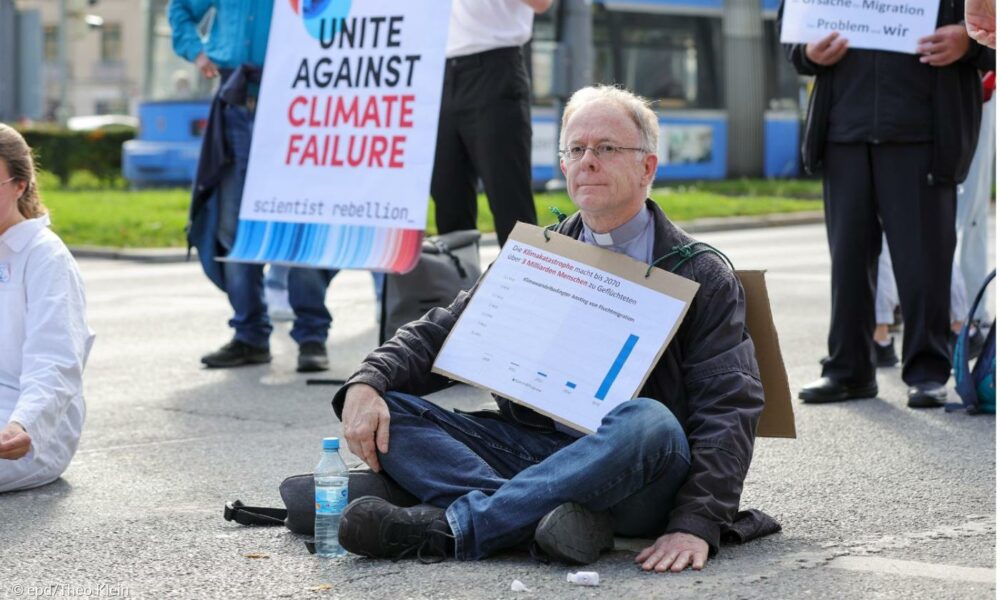
The German Jesuit Jörg Alt, known in recent years for his climate protests, blockades alongside the so-called Last Generation and his time in prison, has changed his setting. For several months now he has been serving as parish priest in St. Blasien, a small town in the German Black Forest, where he has encountered a reality quite different from the one that occupied much of his public activity: an aging community, practically without children, and with faithful who confess to finding Mass boring.
Read also. The Jesuit who wanted to be Greta Thunberg: penance with heating and wifi
In an interview given to Katholisch.de, Alt recounts that change of direction and also acknowledges the disillusionment his climate activism has left him with. After decades of books, petitions, campaigns and acts of civil disobedience, he admits that those strategies have barely achieved the results he expected.
“I really tried everything that could be tried,” the 65-year-old Jesuit assures. His conclusion is that it makes no sense to continue indefinitely with methods that, in his view, no longer work.
The prison as a turning point
The possibility of returning to parish life arose precisely during his stay in prison.
Alt recounts that his Jesuit provincial came to visit him and explained that in St. Blasien they needed to temporarily cover the parish priest’s absence. The religious already knew the town well, located in the German state of Baden-Württemberg, because he used to spend his summer vacations there, and he accepted the proposal.
What began as a temporary substitution ended up becoming a more stable assignment. He currently dedicates half a day to the parish and the other half to preparing a new book.
The change does not mean that Alt has abandoned his political and environmental convictions. He continues to defend his positions on climate and maintains a very critical view of governments and the economic system. What he does acknowledge is considerable exhaustion after years of activism.
A parish with only one child for First Communion
The Jesuit acknowledges that he was “horrified” to see the aging of the St. Blasien community. When he arrived, there was only one child preparing for First Communion, a single student in Religion class and barely two altar servers. Confirmation had not even managed to get any registrants.
“I thought: this can’t be true,” he recalls.
Since then, he claims to have increased the number of altar servers to eleven and has placed children’s and youth ministry among his main priorities.
The figure is especially significant in the context of his own trajectory. After forty years in which social and political issues occupied a central place in his activity, Alt finds himself once again facing one of the most basic problems of any parish: how to transmit the faith when there are practically no children left to receive it.
Explaining again what the Mass means
Another of the projects he has started in St. Blasien is a series of homilies dedicated to explaining the Holy Mass.
The Jesuit himself acknowledges that many parishioners consider the Catholic liturgy boring and ask to “do something different.” His response to those requests is that the Mass “belongs to our identity” and that it is necessary to explain how the celebration originated and what its different elements mean.
While preparing those catecheses, the priest admits he was surprised by the number of things he himself did not know. He cites as an example the second Eucharistic Prayer, which he says he rediscovered while studying its origin and elements. He acknowledges that it was a part of the celebration that could be recited quickly because he had heard it countless times, and that his preparation allowed him to access its meaning again.
“I can’t always preach about the climate”
The Jesuit has not completely abandoned his old agenda.
When asked about his series of homilies on the liturgy, he replies with a laugh: “I can’t always preach about the climate. I already do that enough.”
The phrase unintentionally sums up a large part of his journey.
Alt entered the Society of Jesus after discovering his vocation precisely in parish life, first as an altar server and later as a scout leader. He himself states that being a parish priest was always his “dream job.”
However, after becoming a Jesuit, “social and political issues” were incorporated into his trajectory, areas in which he has worked for approximately forty years.
From activism to the altar
Jörg Alt’s journey leaves a contrast that is hard to ignore. After years of climate activism, blockades and political campaigns that, he now admits, are strategies that “don’t work at all,” he returns to a parish where there are barely any children and many faithful do not understand the meaning of the Mass. After decades looking toward the world’s “great causes,” St. Blasien has brought him back to the center of priestly life.