


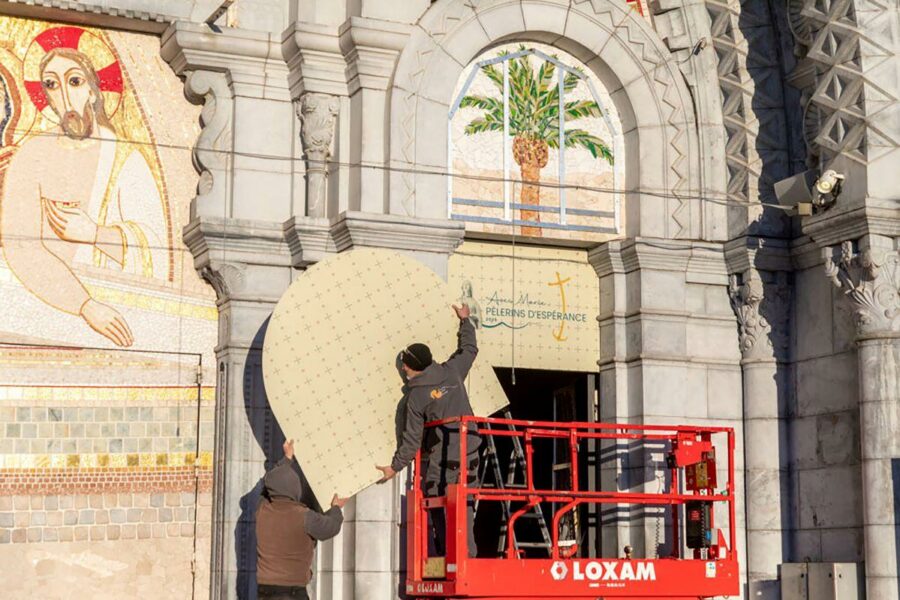
The mosaics by former Jesuit Marko Rupnik will remain covered during the visit that Pope Leo XIV will make to the Lourdes shrine next September. However, the bishop of Tarbes and Lourdes, Jean-Marc Micas, has made it clear that the decision is not due to the Pontiff’s presence, but to the desire that no victim of sexual abuse should feel prevented from coming to the Marian shrine in search of comfort and healing.
In an extensive interview given to OSV News at the end of July, the French prelate explained that covering part of Rupnik’s mosaics was a decision born from direct contact with abuse victims, who made him understand that the works had become, for many, an obstacle to approaching one of the world’s main Marian pilgrimage sites.
«My mission is that anyone can reach the grotto»
Micas recalled two moments that shaped his discernment. The first took place in February 2023, when an English volunteer who had suffered sexual abuse explained to him that many victims were no longer able to make a pilgrimage to Lourdes since the accusations against Rupnik became known.
Months later, the bishop received several women who reported having been victims of the Slovenian artist himself. According to his account, those conversations helped him understand the deep suffering caused by the fact that Rupnik’s works continued to preside over the entrance of the Basilica of Our Lady of the Rosary.
«My mission is to allow anyone to enter the shrine and reach the grotto to find comfort», the bishop stated.
«It was impossible for some people to have to pass in front of those mosaics to access the place where they sought to heal their wounds».
For that reason, in March 2025 he ordered part of the mosaics on the basilica’s façade to be covered, a measure that will now be extended throughout Pope Leo XIV’s visit.
A decision that does not depend on the trial against Rupnik
The bishop also addressed the canonical process the Vatican is following against Marko Rupnik for multiple accusations of spiritual, psychological, and sexual abuse.
In recent weeks, rumors circulated about a possible acquittal of the former Jesuit, which prompted a statement from the Holy See. Nevertheless, Micas assured that the outcome of the trial would not change the pastoral criterion that led him to cover the mosaics.
«The reason for my decision is the effect that the presence of these works has on the hearts and lives of people who have suffered abuse», he explained. Even if the judges did not find canonical criminal responsibility, he added, that would not mean that those who reported the facts had lied.
The prelate also stressed that Lourdes was one of the first major shrines in the world to adopt a measure of this kind, convinced that the Church must offer concrete gestures of closeness to victims.
Leo XIV will arrive as a pilgrim
The Pope will visit France from September 25 to 28. On the 27th he will preside over the Eucharistic celebration in the esplanade in front of the grotto of the apparitions, pray the Rosary of the Torches, and greet the sick and pilgrims.
Micas insisted that Leo XIV did not choose Lourdes because of the Rupnik controversy, but because «Lourdes is Lourdes»: a place of prayer, conversion, and hope to which hundreds of thousands of faithful come each year, especially the sick and those seeking comfort.
The bishop also confirmed that the Pontiff will probably meet with victims of sexual abuse during his trip to France, although the final program has not yet been published.
A message about life for a divided France
The papal visit will take place after France approved the law legalizing euthanasia and assisted suicide under certain conditions, a decision that has caused deep concern in the French Church.
For Micas, the Pope will not come to France to deliver a political speech, but to proclaim the Gospel. «The Gospel speaks of life», the bishop stated, convinced that Leo XIV will remind people that «the value of life does not depend on the decisions of parliaments or human conventions, but on God’s gaze upon each person».
In his view, that message will resonate with particular force precisely in Lourdes. While any reference to the defense of life made in Paris could be interpreted in a political key, in the Marian shrine it will be received, above all, as the word of a shepherd who comes to confirm in the faith a people who continue to see in the Virgin a refuge for the sick, those who suffer, and those who seek hope.