


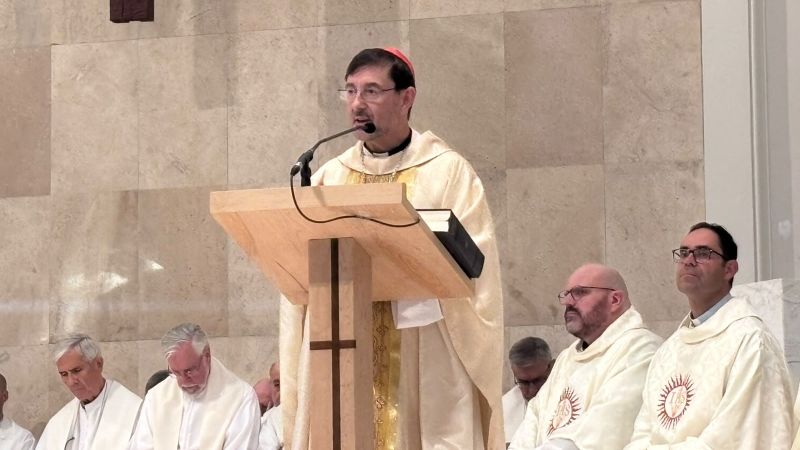
The other day, the Archdiocese of Madrid’s account carved for Cardinal Cobo his phrase for posterity, delivered among the Jesuits and concerning the founder:
«Ignatius teaches us that the decisions that change a life are not improvised».
I read it slowly, as one reads what comes from a prince of the Church, and found it to be one of those phrases with all the accidents of doctrine and no substance beneath, aristotelically speaking.
It sounded like a saint and smelled like a maxim, but it nourished what a packet of stock nourishes, and it could be preached of Ignatius, of Teresa, of a pension plan or of the signing of a centre-forward without anyone’s legal department raising an objection. The community manager posted it with his newspaper emoji, quite pleased with himself.
The serious thing was not the emptiness, for we are already used to emptiness. The serious thing was the damage the phrase did to the saint it invoked, because Ignatius wrote exactly the opposite, and not in a draft, but in the Spiritual Exercises, number 175, where he lists the times for making an election and places first, ahead of every method, the moment when God moves and draws the will so that the soul, «without doubting and unable to doubt», follows what is shown to it, «just as Saint Paul and Saint Matthew did».
The celebrated discernment, the rules, the motions, all that apparatus that has fed so many weekend courses, is left for the second and third times, that is, for when God speaks more softly. In Ignatius’s own school, the perfect case is the lightning decision.
The pedagogy of the saints
It is worth reviewing the examples the saint chose.
Saul set out for Damascus with the most planned decision of his life, letters from the high priest included, and the decision that changed his life was made for him halfway there, between a light and a fall (the horse was Caravaggio’s addition). Three days blind and without eating: that was his whole process.
Matthew’s conversion is dispatched by the Gospel in a verse and a half: he was sitting at the tax booth, heard «Follow me», rose and followed him, and the evangelist records no request for a weekend to think it over or consultation with his spiritual director.
Peter and Andrew left their nets at once, the text says, and the nets were their pension plan.
The Spirit, as Christ already warned Nicodemus, blows where it wills and does not make appointments.
Grace does not wait its turn
It will be said that the phrase, well groomed, merely recommends seriousness before decisions, and it will be said rightly, but a notary recommends that as well.
If it means anything more, it means a theology in which the protagonist of conversion is the convert, with his agenda, his process and his dashboard, and grace arrives at the end to sign what has been agreed.
That doctrine has had a name since ancient times. A council dispatched it at Orange in the year 529, defining that even the first stirrings of faith come from grace and not from the effort of the interested party. And Trent reinforced that God prevents us without any merit of ours preceding it.
Prevenient means that it arrives beforehand, without a prior meeting and without respecting the editorial calendar.
The lives of the saints are an archive of divine improvisations, of cannonballs, burning bushes and voices in a garden in Milan. And that archive we call the history of salvation.
What changes a life
There are, to be sure, decisions that are not improvised, and the proof was given by the tweet itself.
That phrase passed through a homily, a summary, a draft, an approval and an editorial calendar before going out into the world with its emoji, and along the whole route no one stopped it, which is what happens when method replaces content instead of serving it.
The cardinal is right without meaning to be: what changes no life is planned to the last detail. What does change a life is improvised by God, almost always without notifying the cabinet, and the only sure teaching of Saint Ignatius is that it is well to be at home when he calls. Saul was not, and they knocked him to the ground all the same.