


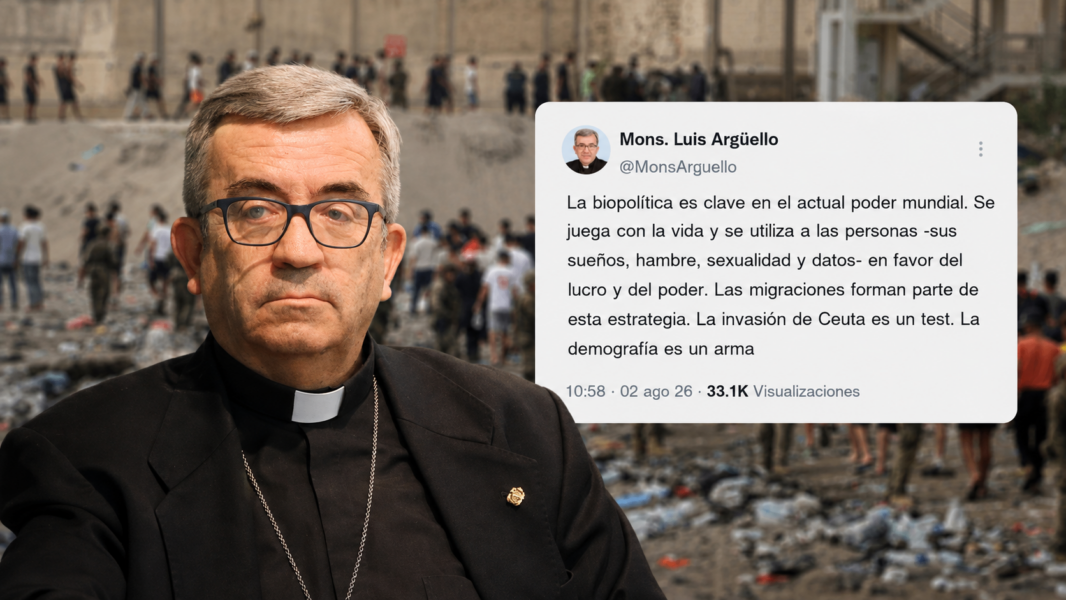
The president of the Spanish Episcopal Conference, Monsignor Luis Argüello, has reappeared on the social network X with a message that marks a change in tone in the discourse of the episcopal leadership regarding illegal immigration. Although he does not abandon the characteristic language of the hierarchy, the Archbishop of Valladolid interprets the events in Ceuta as an operation of power and states that «the invasion of Ceuta is a test» and that «demography is a weapon.»
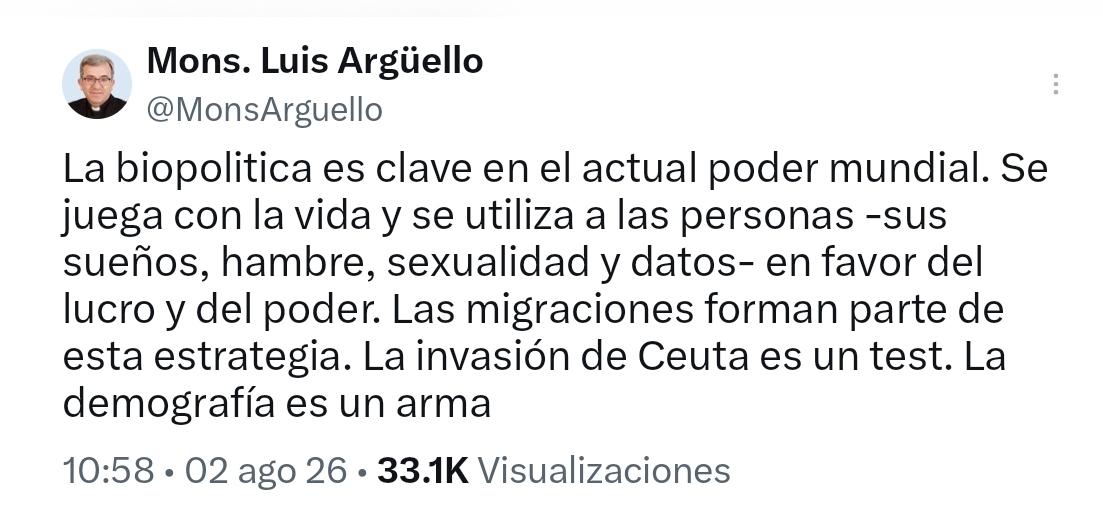
With these words, Argüello condenses an analysis that departs from the usual language used in the ecclesiastical sphere to explain the migratory phenomenon. In contrast to a reading focused almost exclusively on reception and assistance, the prelate places the focus on the use of human beings as a tool of power and pressure between States.
Read also: The Diocese of Cádiz and Ceuta reacts to the invasion by raising money for the invaders
A diagnosis that breaks the usual framework
This is not the first time that the Archbishop of Valladolid has used the term «biopolitics.» Until now, he had employed this concept in reflections on the political management of life and bioethical issues; now, «migrations are part of this strategy.»
However, what Argüello proposes is much simpler to express than the conceptual and academic garb in which he presents it. His reflection ultimately describes a reality that many perceive with less artifice: an invasion carried out through the use of thousands of people as genuine «cannon fodder» in the service of a strategy of political pressure, hence the conclusion: «demography is a weapon.»
The contrast with the words of Leo XIV
The publication of the tweet coincided with Leo XIV’s mention of the Ceuta episode. During the Angelus on this first Sunday of August, the Pontiff stated that he was following «with concern the alarming situation in Ceuta» and invoked Our Lady of Africa so that «solutions of peace, stability, and justice may be found,» without identifying those responsible for what happened.
Argüello’s words are situated in a different register. While the Pope described the events as a «situation» and called for solutions in diplomatic terms, the president of the Spanish Episcopal Conference named the mechanism that, in his view, explains what happened: the use of illegal immigration «in favor of profit and power.»
If for Leo XIV the subject of the action remained implicit, in Argüello’s message it appears, albeit wrapped in a more conceptual language. The focus is no longer solely on the consequences of the invasion but on those who make it possible, incentivize it, allow it, and use it as an instrument of power.