


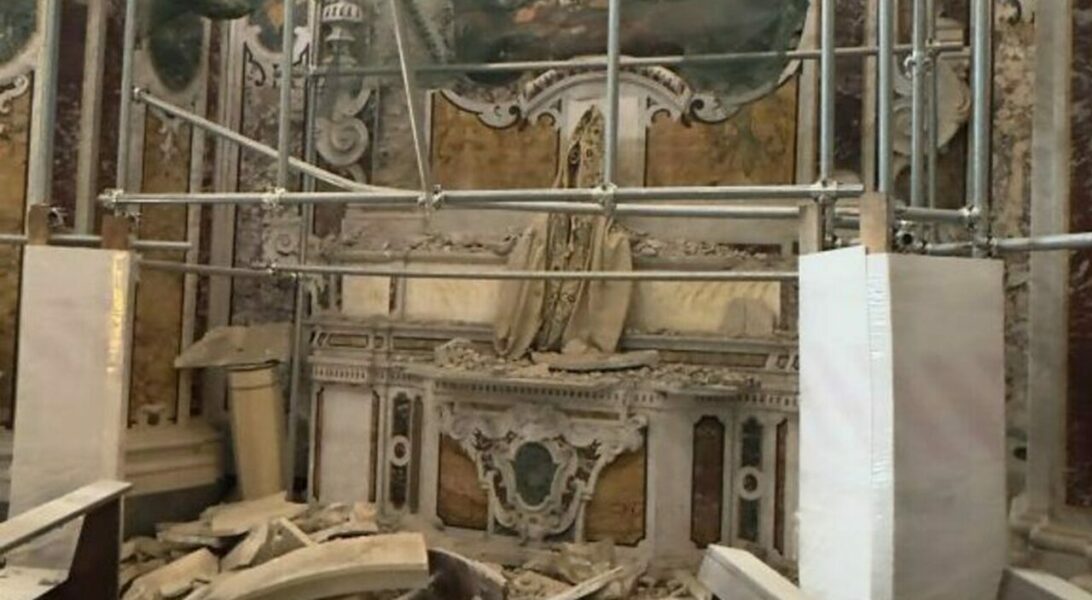
An earthquake of magnitude 4.7 recorded on Friday, July 31, caused significant damage to several churches in Pozzuoli, a city located near Naples in southern Italy. The quake, followed by aftershocks, also affected homes, commercial establishments, and infrastructure in the area.
The Diocese of Pozzuoli and Ischia reported on Saturday, August 1, that the first tremor occurred at 7:46 p.m. the previous day and that the successive shocks had left a “truly difficult” situation. According to the statement, the few churches in Pozzuoli that were still open for worship showed “significant damage.”
Bishop Carlo Villano noted that the Diocesan Office for Cultural Heritage had intensified inspections to assess the condition of the temples. At the time of reporting, the diocese had not released a complete list of the affected churches nor specified how many would have to suspend services.
Damage to the churches of Pozzuoli
One of the most visible damages occurred at the Church of St. Francis of Assisi and St. Anthony of Padua, located in the center of Pozzuoli, where one side of the bell tower partially collapsed. The collapse caused no injuries or damage to nearby buildings, according to Italian authorities.
The church was already closed for worship due to its state of preservation and was undergoing restoration and consolidation work. The façade had been secured in December 2025, and structural work began in March of this year.
The church was included in public plans for the rehabilitation and seismic protection of places of worship in the area. According to the Italian Ministry of Culture, the interventions carried out before the earthquake helped limit the damage. Technicians must now assess the reconstruction of the collapsed sections and the continuation of the works.
The diocese calls for attention to vulnerable people
“I express the Church’s closeness to the population, to law enforcement, and to all those involved in civil protection efforts,” Villano stated in the Saturday communiqué.
The bishop asked the community to remain united and to pay particular attention to “the most vulnerable, children, the elderly, and the sick.” The diocese indicated that its first concern was for the people and families affected, given the existence of numerous uninhabitable homes and damage to businesses and churches.
Navigation in the port of Pozzuoli was also suspended due to problems with the dock and access roads. Villano called for efforts to reopen it as soon as possible because of its importance for the economic and social activity of the Phlegraean Fields and the island of Ischia, especially during the summer.
Churches that had served as shelters
The statement recalled that, during previous seismic events, the bishop had offered the churches of the diocese as shelter spaces. In October 2023, Villano stated that the doors of the temples were open to show that “the Church is a home for all and for everyone” and so that each person could feel “welcomed, heard, and accompanied.”
The damage recorded on Friday now complicates that function, as several of the few churches that remained open were affected. The inspections initiated by the diocese will determine which ones can continue to be used safely.
The Italian Church expresses its closeness
Following the earthquake, the president of the Italian Episcopal Conference, Cardinal Matteo Maria Zuppi, contacted Villano to convey the closeness, solidarity, and prayers of the bishops and the Italian Church.
Also, the vice president of the Episcopal Conference, Bishop Francesco Savino, expressed his support and assured his prayers for the communities of Pozzuoli, the Phlegraean Fields, and Naples, called to face “once again moments of fear and great concern.”
The Italian Church entrusted the families, the most vulnerable people, and all the affected communities to God, and asked for them “serenity, strength, and hope.”