


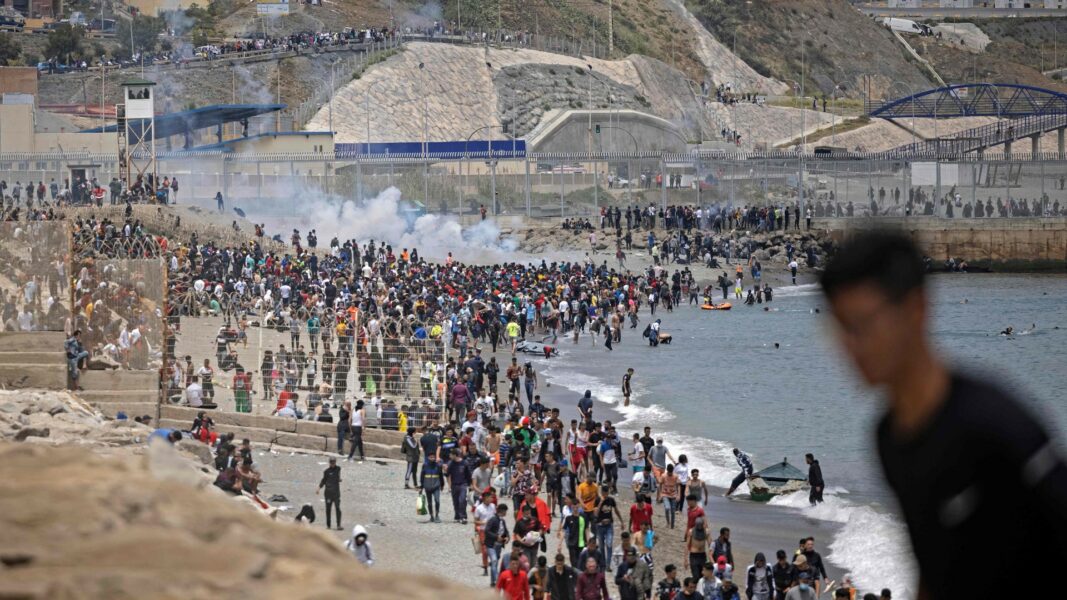
There are coincidences that seem written by a screenwriter with poor taste. These days I find myself on the coast of Cádiz, from which, on clear days, Morocco can be glimpsed, reading The Camp of the Saints by Jean Raspail. And while I underline its pages, the city of Ceuta—85,000 inhabitants, a Christian stronghold in North Africa for more than four centuries—suffers a massive, violent, and coordinated entry of tens of thousands of people through a broken border. Closed shops, residents confined to their homes, an entire city in a de facto state of emergency. And at that precise moment, the Diocese of Cádiz and Ceuta issues a statement announcing that the weekend collection will go to assist those who have just broken through the border. Raspail is no longer a novel: it is a chronicle.
Read also: The Diocese of Cádiz and Ceuta reacts to the invasion by raising money for the invaders
A statement to comfort its faithful barricaded in their homes? To denounce the use of human beings as a political battering ram by the Moroccan regime? To ask the public authorities to protect the population? No. To announce, literally, that “the collections taken this weekend in the parishes of Ceuta will be allocated entirely to the Diocesan Delegation for Migration”.
The collection. In the parishes of Ceuta. This weekend.
The delusion that the invaded should allocate the collection to their invaders is even surpassed by the material circumstances. What collection is there going to be, if the faithful cannot go out into the street? Who is going to fill the collection boxes of parishes whose parishioners have closed shops and lowered shutters? The statement is not only a pastoral absurdity; it is the perfect photograph of a hierarchy that lives with its back turned to its own flock. A noteworthy reaction for the history books when, in a few centuries, someone tries to understand what happened in this madhouse.
Raspail, an uncomfortable prophet
In 1973 Raspail wrote a novel that bien-pensant criticism has spent half a century trying to bury (Homo Legens has just released a providential reissue). In it, a million disinherited people from the Third World set sail for the coasts of France, and the civilization that should defend itself disintegrates before the first boat arrives. Raspail never makes a moral judgment about those who come: they are not the villains of the novel. The villains are others. The villains are those who should guard the house and instead open the doors and applaud.
Raspail’s literary genius consists in concentrating in a few weeks what in reality is a process of decades: the civilizational imbalance between two worlds, the demographic pressure of the South on the North, and—above all—the suicidal paralysis of Western elites who have made their own dissolution a theological virtue. And among those elites, with fierce irony, Raspail portrays clerics and bishops devoted to the cause: prelates who bless the landing, who celebrate the arrival of the tide as an event of grace, who encourage—this is the word—the suicide of their own people.
When I read it, it seemed a caricature to me. Today, the Diocese of Cádiz and Ceuta has taken it upon itself to prove to me that Raspail fell short.
What the statement leaves unsaid
The statement expresses “deep concern for the gravity of the events and for the special vulnerability of so many people affected by this reality”. An ambiguous formula, calculatedly ambiguous. But all the subsequent concreteness—the entire collection, the San Antonio Migrant Care Center, the Migration Delegation—goes in a single direction.
Not a word for the Ceutans locked up and invaded, in real physical danger. Not a word for the merchants. Not a word for the overwhelmed security forces. Not a single mention—and this is what is truly scandalous—of the responsibility of the Moroccan government, which uses human misery as a weapon of political pressure against Spain and against a Spanish city. The Church, which has no qualms about speaking out on any minor matter of national politics, takes up a collection for the invader in the face of a full-scale geopolitical aggression against the last Christian stronghold in North Africa.
It is worth recalling something elementary: in matters of regulating migratory flows there is no doctrine. The Church has not received from Christ the task of managing borders, but of proclaiming the Gospel and saving souls. A Catholic can legitimately defend strict border control without any bishop having the authority to reproach him for it. What a shepherd cannot do is abandon his sheep in the middle of the assault on the fold and devote the resources of those same sheep to the logistics of the assault.
The name of things
I know the word is harsh, but there comes a time when one must put one’s foot down and call things by their name. When a Spanish and Christian city is the object of a coordinated pressure operation from the other side of the Strait, and the response of the one who has the cure of souls of that territory is to organize the welfare logistics of the operation while ignoring his own faithful, that is not charity. Charity begins with those at home—maxime autem ad domesticos fidei, says Saint Paul—and never demands, has never demanded, blindness to reality or desertion of one’s own people.
In the plain language that the people of Ceuta understand perfectly, that is called betrayal. Betrayal of the faithful who sustain those parishes, betrayal of four centuries of Christian presence in the city, betrayal of the very mission of the Church, replaced by the role of a subsidized NGO of the prevailing do-goodism. The clerical characters in Raspail were a satire; those responsible for this statement are its confirmation.
The people of Ceuta have the right to demand accountability from those who govern their diocese. And Spanish Catholics have the right to say out loud that a hierarchy that only finds its voice to succor the illegal invader and never to defend those who live behind it has ceased to be a shepherd and has become an accomplice. Attending to the needy is a Christian duty; offering them your children’s house on a silver platter is not.