


Leo XIV has just confirmed that synodality remains in force and vigorous. He has done so through new notes addressed to bishops and synodal teams to prepare the diocesan assemblies of 2027. In case anyone doubted it, Rome continues to expand the synodal machinery.
But every expansion requires a space to occupy. And synodality needs a vacuum.
Like opportunistic infections that spread when a body’s defenses weaken, it only thrives where priestly authority has been undermined. A vigorous priesthood would be its worst enemy, because the assembly can only aspire to discern everything after the priest has been persuaded that he has hardly any say in decisions.
For what does the synodal operation consist of, if not in shifting the Church’s center of gravity? Behind all that listening and co-responsibility lies a transfer of authority from the priest to an organized community that ultimately determines the pastoral response. It is a new revolution (in reality the same one as always), and like all revolutions, it is sold from below while imposed from above.
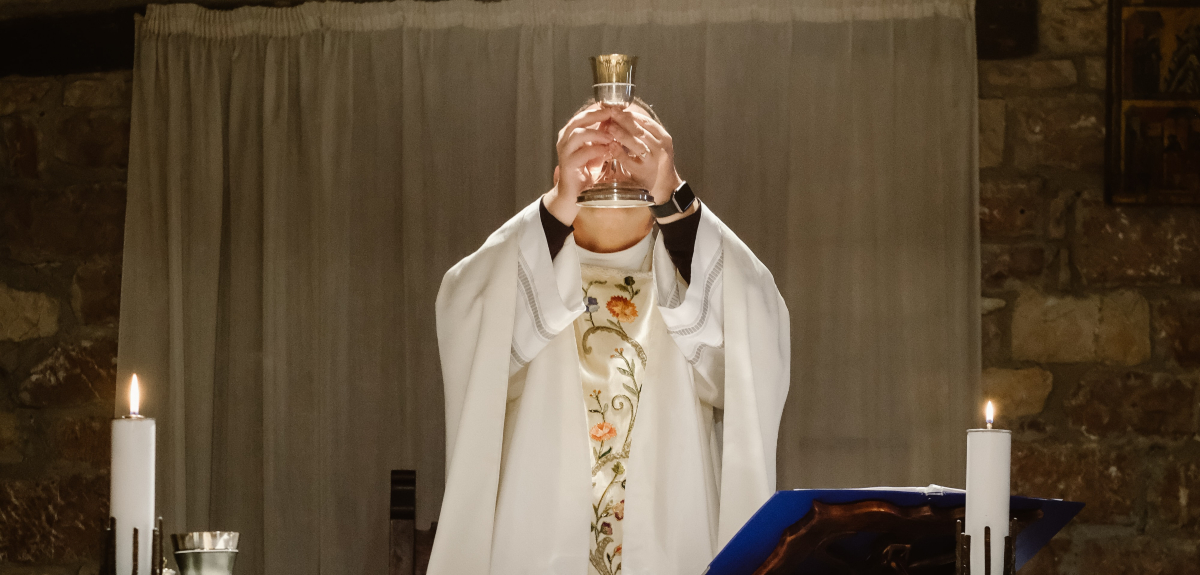
The priest is an obstacle to the triumph of synodality because his authority does not come from the community. He celebrates in persona Christi and leads the flock entrusted to him. Christ calls certain men, sets them apart, and confers on them an authority that the rest of the baptized do not possess. The priesthood can only be understood from the perspective of hierarchy, a key word that precisely means government of sacred origin.
If authority comes from Christ, the assembly cannot produce it; if that origin is forgotten, hierarchy degenerates into an organizational chart and the priest into a functionary.
To strengthen synodality, the priesthood must be weakened. The health of one and the other are inversely proportional. But however consecrated the Church may be to synodality, and however infiltrated it may be by Masons, Protestants, and charismatics, the goal of sacrificing the priesthood seems impossible today. Moreover, it is unnecessary: the synodal Church has sufficient tools to eliminate that obstacle without destroying it.
One of those strategies consists in discrediting the exercise of his authority. That is what the campaign against “clericalism” has served for, a word that once designated real abuses before becoming a general suspicion against any priest who dares to behave as such. The parish priest who decides may seem authoritarian, or rigid if he resists handing over governance to a team, and if he recalls the difference between the ministerial priesthood and the common priesthood, it is because he despises the laity.
Educated under that vigilance, intimidated, the priest abandons a space that can be occupied by an entire bureaucratic-charismatic and synodal flora.
The same perversion is found in certain ecclesial movements whose parallel structure ends up carrying more weight than the parish. The Neocatechumenal Way offers the most visible example: the priest joins as a sacramental guarantor of a work whose method and orientation have been set by others. Its founder, Kiko Argüello, once expressed his longing for Benedict XVI to die as the only salvation for the Way and enthusiastically celebrated the arrival of Bergoglio. The vehemence of his desire reveals how much the change of pontificate created a climate favorable to his lay organization.
Certainly, for synodality to reach its fullness, it suffices to blur the boundary that separates the priest from the layperson. The pattern is always the same: it brings lay ministries closer to the ordained, opens the possibility of female diaconate, presents married priesthood as a remedy for scarcity… The layperson advances toward priestly functions while the priest retreats until he seems like a layman licensed to consecrate.
If the Protestant revolution denied the sacrificial priesthood and left the Church, the synodal revolution preserves it within, progressively reduced to a sacramental provider for a community that claims to govern itself. Thus the Church can continue to ordain priests, fewer and fewer, while learning to live without them and advancing in its self-dissolution.
And what effect can such an operation have on vocations? The answer is obvious. Synodality discourages the priesthood. Abandoning the world is only comprehensible in the face of a mission proportionate to the sacrifice it demands. No one renounces forming a family to preside over meetings, nor accepts lifelong obedience with the purpose of managing parish consensuses. The vocational crisis did not fall from the sky. For decades the priestly identity has been blurred, and then the decline in vocations has been lamented. Synodality aggravates that crisis, but feeds on it: by reducing the priestly function, it diminishes the supernatural appeal of the vocation; that scarcity serves to expand the structures of the laity, and once these are consolidated, it achieves a Church less dependent on the priest. The vicious circle is perfect. The synodal organism widens the wound from which it feeds.
Here is an eloquent comparison: the Priestly Fraternity of St. Peter, dedicated to a full and traditional conception of the priesthood, ordained twenty-five priests this year, as many as the twenty-seven dioceses of modernist and synodal Germany ordained together in 2025. Could what each proposes to those who feel the call have something to do with it?
And another key question: what moves Leo XIV to persevere in an operation whose harmful effects on the priesthood are so visible?
The answer does not begin with his election to the pontificate, nor even with Bergoglio’s influence. Robert Prevost was formed at the modernist Catholic Theological Union in Chicago, within a post-conciliar environment that valued joint preparation for different ministries, and later exercised his pastoral work according to an ecclesial conception in which teamwork, territorial structures entrusted to the laity—with a very prominent presence of women in leadership roles—and communal listening already occupied a decisive place. Synodality did not reach him as a slogan learned in Rome.
But it was in Peru that Prevost earned his honors in synodality. The Augustinians themselves attribute to Prevost the promotion of “team ministry” and parishes divided into pastoral zones largely directed by laypeople, including women invested with broad pastoral responsibilities, within a structure they retrospectively describe as synodal. Chiclayo extended the model through pastoral animation networks and mixed listening teams, until one of his collaborators described it as a “synodal laboratory.” Bergoglio did not have to convert Prevost; perhaps he even learned from him. That is why he placed him at the head of the Dicastery for Bishops.
Now, with Prevost in Rome, the pastoral experiment of Peru is ready to become a program for the universal Church.
At this point, the old question cui prodest? becomes inevitable. Who benefits from disabling the priest, erasing the boundary that separates him from the layperson, and protestantizing the Church until it becomes unrecognizable? Certainly not Christ nor souls. But there is someone who knows better than anyone the value of consecrated hands.
Satan is the one who best knows the power of a priest aware of what he is. He can celebrate before a full cathedral or alone before God, because the efficacy of the Mass does not depend on attendance, and he can destroy years of patient infernal work with a single absolution. That is why the Enemy wants the ordained to stop fully believing in what they received. A persecuted clergy produces martyrs, but one ashamed of its authority disarms itself.
The priest who remembers Who called him and from Whom his authority proceeds is the katechon of dissolution and a living refutation of the synodal Church. There lies the ultimate reason for the satanic effort. Every priest aware of his vocation is an affront to the prince of this world. That there are still men willing to renounce the world for something the world cannot offer refutes the satisfied autonomy on which our age is built.
Every priest is part of that elite body of humanity that took up Christ’s challenge and accepted following him, leaving everything behind. His mere existence is a slap in the face to the Evil One, as well as a serious hindrance to the success of synodality.
Note: Articles published as Tribune express the opinion of their authors and do not necessarily represent the editorial line of Infovaticana, which offers this space as a forum for reflection and dialogue.