


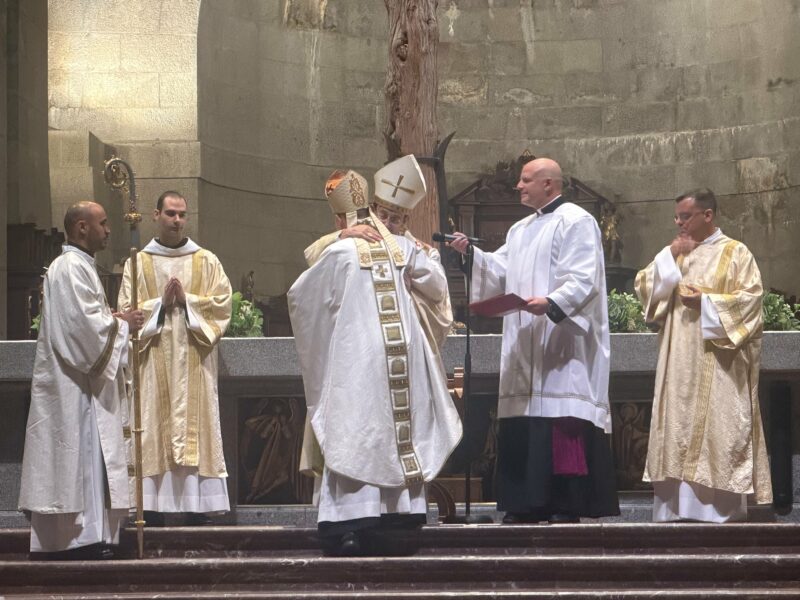
The Abbey of the Holy Cross of the Valley of the Fallen hosted this Wednesday the abbatial blessing of fray Alfredo Maroto Herranz, OSB, elected abbot by the Benedictine community last May 13. The ceremony, presided over by Cardinal José Cobo, took place while judicial proceedings remain open related to the actions promoted by the Government in the complex following the agreement signed between the Executive and the Archbishop of Madrid.
With the abbatial blessing, the process begun almost three months ago with the election of Maroto is completed, and the Valley once again has an abbot elected in accordance with the Benedictine constitutions after more than twelve years of governance by prior administrators.
The celebration brought together a broad representation of the Benedictine world, with the presence of the abbots of Solesmes, Fontgombault, Leyre, Quarr, Ganagobie, Donezan, Santo Domingo de Silos, Ligugé, Triors, Kergonan, Poblet, and Santa María de Huerta, in addition to the prior administrator of La Oliva and the abbot president of the Congregation of Santa Otilia. Representatives of various religious orders, priests, civil authorities, and family members of the new abbot also participated.
A new stage for the Benedictine community
The election of Alfredo Maroto ended last May a situation of exception that began in 2014, when the resignation of Dom Anselmo Álvarez for health reasons left the abbey without an abbot elected by the community.
During those years, the monastery was governed by prior administrators, first by Father Santiago Cantera and, since March 2025, by Alfredo Maroto himself, while the community faced some of the most complex episodes in its recent history.
«In the Church we still need fatherhood»
During the homily, Cobo insisted that the abbatial ministry «is not an honor or a dignity, but a fatherhood and a service».
«In a time when politicians, managers, and technicians abound, in the Church we still need fatherhood», affirmed the Archbishop of Madrid, who recalled that the abbot «takes the place of Christ in the monastery» and is called to govern «with prudence and mercy».
The cardinal added that whoever receives the abbatial blessing «also receives a cross», alluding to the responsibility of sustaining the unity of the community, maintaining hope in times of difficulty, and fostering reconciliation.
At another moment in the homily, he defined Benedictine monasteries as «artisans of peace in a fragmented, polarized, and wounded world» and exhorted the new abbot not to put «absolutely anything before the love of Christ».
Maroto recalls the spiritual mission of the abbey
After receiving the Rule of Saint Benedict, the ring, the mitre, and the pastoral crozier, fray Alfredo Maroto delivered words of gratitude in which he evoked the history of the abbey since its foundation in 1958.
The new abbot stated that the community has sought to be from its origins a place «where the cross of Christ is always contemplated in the light of the Paschal mystery», sustaining through liturgy, prayer, and fraternal life a constant service to the Church.
Likewise, he thanked the presence of the abbots, priests, and faithful in attendance, remembered his family and those who have accompanied the life of the monastery during these years, and entrusted his ministry and the future of the community to the protection of the Blessed Virgin Mary.
The Archdiocese avoids mentioning the Valley of the Fallen
The information released by the Archdiocese of Madrid regarding the abbatial blessing avoids at all times both the historical name of Valley of the Fallen and the official name of Valle de Cuelgamuros. The chronicle published by the Archdiocese identifies the place only as the «Abbey of the Holy Cross», without expressly mentioning the site where the ceremony took place.
This circumstance does not go unnoticed at a time when the future of the monumental complex continues to be the subject of political, ecclesial, and judicial controversy, and when the Benedictine community faces a new stage under the governance of an abbot elected by its own monks.