


Agustín and María Ángeles have been married for nearly twenty years, have five children, and come from Catholic families. Both went through a period of some distance from the faith during adolescence, but eventually rediscovered it and met each other precisely in a parish. Years later, the Pilgrimage of Our Lady of Christendom has become one of the central dates on the family calendar.
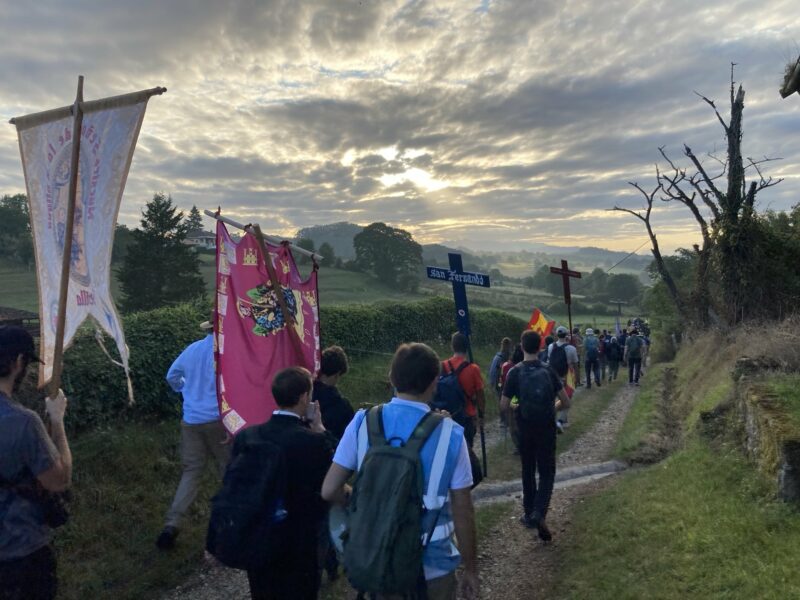
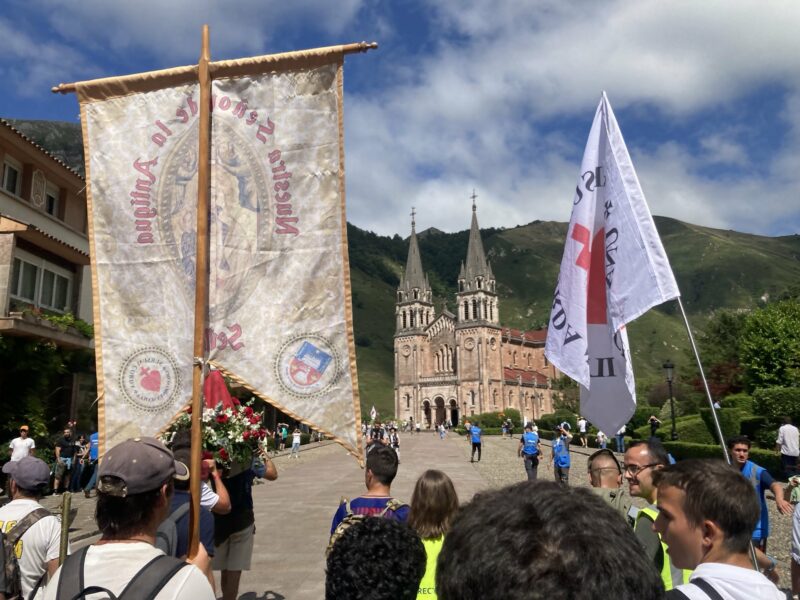
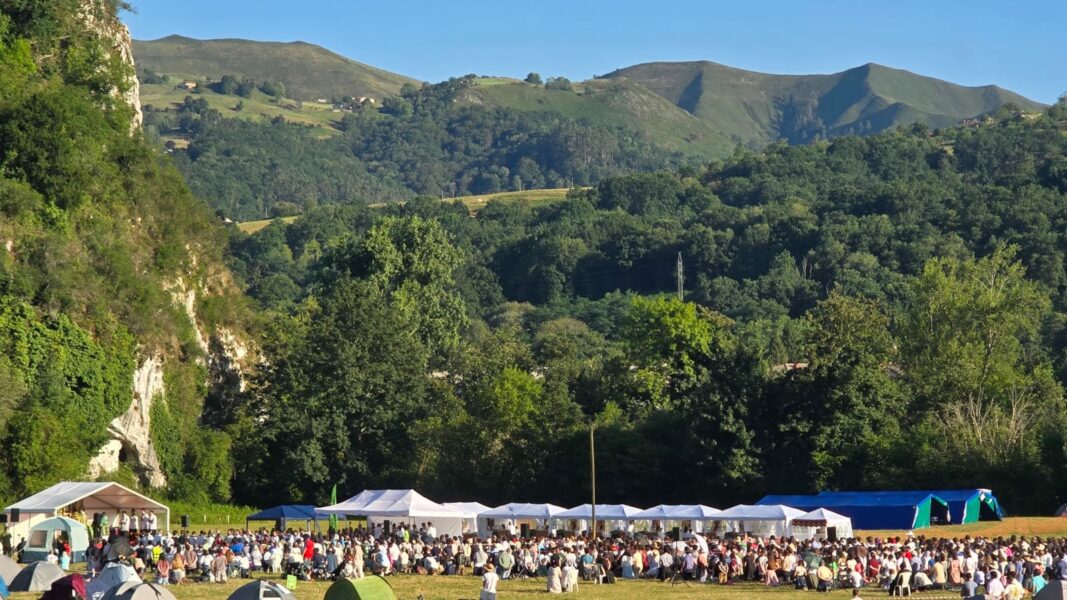
The sixth edition of this pilgrimage concluded on Monday, July 27, with the arrival of nearly 1,700 pilgrims at the Sanctuary of Our Lady of Covadonga, after walking almost one hundred kilometers on foot over three days from Oviedo, in a march marked by prayer, penance, and the celebration of the traditional liturgy.
“The first thing I do when I get a new planner in January is mark the days of the pilgrimage,” María Ángeles admits. It is not a passing hobby. For the couple, the three days of walking between Oviedo and Covadonga are an opportunity for prayer, sacrifice, formation, and family time that they look forward to all year long.
Their story with the pilgrimage began six years ago, when a cousin of María Ángeles and her husband took part in the first edition. Upon their return, they spoke with such enthusiasm about what they had experienced that they sparked their curiosity. “She came back radiant, with a glowing face, saying she had seen the greatness of the Church,” María Ángeles recalls. “Seeing her speak like that, I thought: ‘We’re not missing it next year.’”
At that time, the couple barely knew the traditional liturgy. They had attended some celebrations linked to family events, but they did not belong to that environment and did not particularly understand its appeal. The fact that a priest organized a chapter for families ultimately encouraged them to participate.
Since that first experience, they have not missed a single year.
Three days of pilgrimage to Covadonga
Inspired by the traditional Pentecost pilgrimage between Paris and Chartres, Our Lady of Christendom has become the main gathering linked to the usus antiquior in Spain.
The sixth edition was preceded on Friday, July 24, by a Holy Hour celebrated in the cathedral of Oviedo, which brought the faithful together on the eve of the start of the march.
The following day, the feast of Saint James the Apostle, the pilgrims set out from the Asturian capital toward Covadonga, divided into forty chapters. During the journey, they participated daily in the recitation of the rosary, listened to spiritual meditations, and attended Holy Mass according to the extraordinary form of the Roman rite.
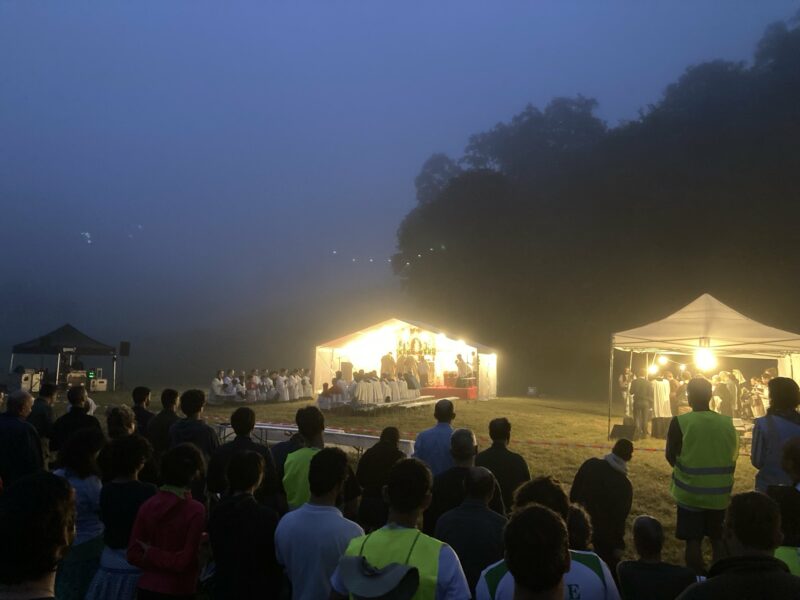
The first day concluded with a traditional Mass in El Remedio. On Sunday, a new solemn Mass was celebrated in Sebares, and on Monday morning, the pilgrims attended an outdoor Mass before walking the final kilometers to the Basilica of Our Lady of Covadonga.
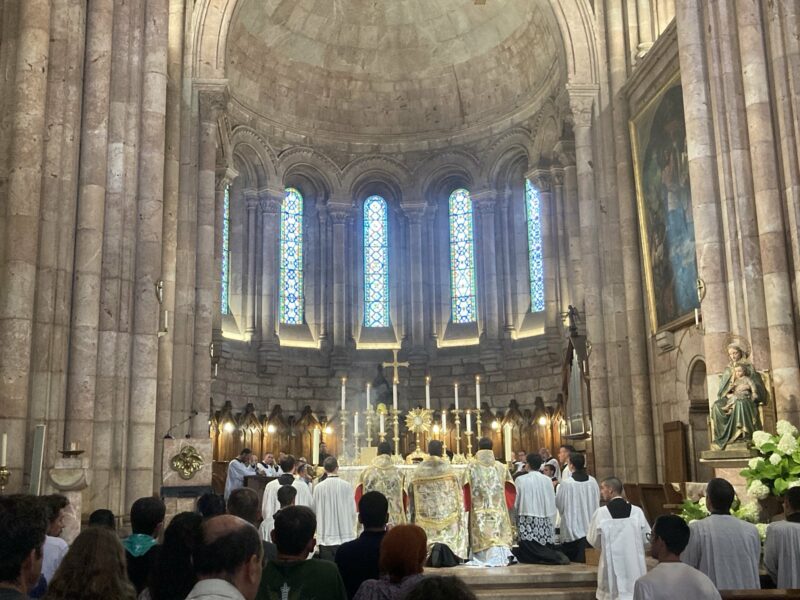
Once again, the pilgrimage took place without the possibility of celebrating the traditional Mass either in the cathedral of Oviedo, the starting point of the route, or at the sanctuary of Covadonga, the destination of the march. Although the organizers were able to celebrate the Holy Hour in the Oviedo cathedral, the Eucharistic celebrations had to be held in other locations along the way.
A gradual discovery of the traditional liturgy
The couple’s relationship with the traditional Mass was neither immediate nor the same for both. María Ángeles was captivated earlier by its beauty, while Agustín needed more time to understand it.
“I have already fallen in love with the traditional Mass,” she admits.
Agustín, on the other hand, recalls that at first he saw it as something “exotic,” belonging to people with a different sensibility from his own. During the first pilgrimages, he even considered going to a nearby parish to attend a Mass according to the ordinary rite. “I would tell María Ángeles that we should go find another Mass, but she would reply that we had come to this pilgrimage and that we should stay there,” he recounts.
Over the years, his perception changed. Beyond the liturgical form, he began to notice a way of living the faith that he considered more solid and complete. “In that environment, you breathe something that, in general, you don’t breathe elsewhere,” he explains. “The formation, the rigor, and the way of understanding the Catholic faith catch my attention because it is a more integral, more complete, and more fulfilling faith.”
Agustín also highlights the connection between personal faith and responsibility toward society, family, and country. In his view, these are dimensions that in other ecclesial environments have weakened, but which in the pilgrimage appear naturally united.
María Ángeles, for her part, emphasizes the beauty and depth of the liturgy: the care of the altars, the solemnity of the chants, the silence of the faithful, and the presence of numerous priests celebrating Mass.
“Every gesture is beautiful. Everything is very well cared for,” she notes. “But it is not only beauty. It is a faith based on reason, on formation, on centuries of doctrine, and on the lives of the saints. You see that we are rooted in a rich tradition.”
Agustín acknowledges that over the years he has also learned to experience the long chants of the solemn celebrations differently. “Before, they could bore me. Now I let myself be carried by recollection and interior prayer until I forget about time.”
Five children and five ways of making the pilgrimage
While pilgrims who complete the entire route walk nearly one hundred kilometers in three days, families with children can participate in adapted itineraries. Agustín and María Ángeles usually walk the two central stages of each day with their children, around fourteen kilometers daily.
The 2026 edition also included a “mini-route” designed for families with young children. The shortened route, accessible for strollers and connected by buses to the rest of the pilgrimage, allowed for even greater family participation.
In Agustín and María Ángeles’s household, the experience has not been the same for all their children.
The older ones initially attended motivated by the presence of other relatives their age. When these relatives stopped attending, they began to participate with more reluctance. Over the years, however, the youth environment has grown and their attitude has also changed.
The eldest daughter, 17 years old, who in recent editions has attended accompanied by her boyfriend, has already expressed her intention to make the complete pilgrimage next year. “They want to get up at six in the morning, start walking at dawn, and arrive in the afternoon with their feet worn out,” María Ángeles recounts. “It has come from them. The family pilgrimage is no longer enough for them.”
“The teenagers go a bit reluctantly, but, well, they’re already starting to meet people,” the mother explains, while assuring that spirits are rising. The younger children experience the journey differently. The boy especially enjoys serving as an altar server. With the energy typical of a 10-year-old boy, “he’s very active, doesn’t stop for a minute, always asking questions,” Agustín describes him. “But when you see him as an altar server, it’s like a miracle: he’s focused, calm, and recollected.” The youngest sibling, 6 years old, participates enthusiastically in the activities and catechesis prepared for the children.
For Agustín and María Ángeles, one of the great fruits of the pilgrimage is that their children meet other people and families who live the faith in a similar way. “They see that this way of living works in other families and that we are not the only odd ones.”
During the journey, the young people converse with couples, priests, religious, and pilgrims who share their experiences about marriage, parenthood, raising children, sacrifice, and the Christian life. That testimony, precisely because it does not come from their own parents, holds special value for them.
When there is no strength left
The pilgrimage is not a family outing or an entertainment activity. There is heat, rain, cold, lack of sleep, discomfort, difficult paths, and days when the children no longer want to move forward.
“What they often lack is not physical capacity, but motivation,” María Ángeles explains. “They can perfectly complete the stage, but suddenly they get discouraged and want to stop. Then a friend appears or they find something that interests them and they start walking happily again.”
On one of the last days, one of their children was so exhausted that he barely wanted to continue. Agustín knew he was already too old to carry him on his shoulders, so he had to improvise. “Since he really likes jokes, I said to him: ‘Come on, I’ll tell one and you tell another.’ We started telling jokes and that’s how he managed to cheer up.”
In another edition, when the child was younger, a pilgrim noticed his tiredness, started talking to him, and managed to get him to finish the stage. “She saved the day for us,” María Ángeles recalls. “It’s very beautiful to see how people help each other.”
The scene is repeated frequently: young people offering to carry children, strangers accompanying those who fall behind, and families sharing water, food, or a conversation.
“It’s not about having a good time, it’s enjoyed in a deeper sense”
Before leaving for the pilgrimage, a relative wished Agustín that they would have a good time. The phrase made him think. “I realized that the goal was not to have a good time,” he recalls. “To have a good time, you do something else. This is enjoyed in a deeper sense, but there are moments when it’s hard.”
Fatigue, sore feet, rain, mud, wet tents, or lack of comforts are part of a freely assumed sacrifice. “There are moments when you think: ‘What am I doing here, sweating like a pig? I can’t take it anymore, my feet hurt, it’s hot or now it’s cold. My son’s shoes got wet, he didn’t have others and I didn’t know what to do,’” the father admits. “But that’s the wonder: seeing that you can’t handle all of life. That’s a lesson.”
Agustín believes this experience is especially valuable for his children, who are growing up in a society marked by comfort and hedonism. “It’s a school of virtues. Life is not only about having a good time,” he states. “The sacrifice is made voluntarily, because no one forces you to come, but it has important value.”
The eldest daughter of the family agrees that effort occupies a central place. For her, the pilgrimage teaches one to surpass oneself and to do without usual comforts for a few days. “You go to bed at midnight, sleep as best you can, and get up early. But in the end it leaves you feeling good,” she explains.
She also recalls a meditation in which a priest compared the journey to Covadonga with the journey to heaven: a path with good and bad moments, difficulties and falls, but also with a goal that gives meaning to life.
Catechesis for the whole family
Prayer is part of the journey. The pilgrims pray the rosary, sing, and listen to the meditations. In the case of families with children, recollection requires additional effort, as parents must remain attentive to the pace and mood of the little ones.
The organization also offers catechesis adapted to different ages. In this edition, the youngest attended a performance about the conversion of the Visigoths to the Catholic faith. “A priest and two young people from the organization put on a little play for the children, with games and everything, about the conversion of King Reccared,” María Ángeles recalls. “This way, the children learn about history and the connection of Spain with Catholicism.”
The teenagers, for their part, received formation whose advice the family has continued to apply after returning home. “Besides returning with an enlarged heart, you return formed,” María Ángeles assures. “It increases your Catholic formation and your life of faith.”
The motto of this edition, “Through faith they conquered kingdoms,” was present in the meditations and catechesis. “To reconquer the world for Christendom, one must begin by reconquering oneself,” María Ángeles explains. “One must fight against one’s own passions and against comfort. For that, the pilgrimage is a school.” That was the teaching that most marked the family this year.
Marriages and vocations among the fruits of the pilgrimage
Agustín and María Ángeles affirm that the fruits of Our Lady of Christendom do not end with the arrival at Covadonga.
Over these years, they have met young people who met in the first editions, began a relationship, and now return married and accompanied by their children. Among them, they recall several couples who return to the pilgrimage each year with a larger family. They have also heard of religious vocations that have emerged around the pilgrimage.
In their view, these cases show that the pilgrimage is not only an intense and passing experience, but an environment in which friendships, courtships, and decisions capable of guiding an entire life can mature.
Discipline and freedom for families
Agustín and María Ángeles insist that no family should give up participating for fear of not being able to keep up with the pace.
The organization, they explain, combines very rigorous discipline with great flexibility. The chapters must maintain order during the march, but each family can complete the stages that their circumstances allow.
“No one asks you for explanations. If you’re tired, something hurts, or you can’t continue, there are buses and support cars that take you to the next stop,” María Ángeles clarifies.
The pilgrimage is for everyone. For those who want to do it entirely, for those who can only walk one stage, for those who go with young children, and for those who want to help.
The couple also highlights the work of the numerous volunteers. At the end of the stages, pilgrims find water, fruit, bread, shade, medical assistance, and spaces prepared for rest.
They are especially impressed by the order and cleanliness: when nearly two thousand people leave a clearing, they assure, there is hardly a single piece of paper on the ground.
Constant growth
The number of pilgrims has been progressively increasing each year. The sixth edition brought together forty chapters: twenty-nine from Spain and eleven from abroad. There is a large group of people who repeat every year, but also a constant renewal of families and young people. “It’s not something closed,” María Ángeles affirms. “There is a large core of people who always return, but also many new people. It keeps renewing itself and that’s very beautiful.”
To that renewal is added an increasingly visible international presence. In recent editions, they have coincided with pilgrims from France, Poland, Ireland, the Netherlands, and other places, in addition to participants from different parts of Spain.
María Ángeles especially recalls an occasion when she walked different sections of the chapters while the rosary was being prayed in Latin. As she advanced, she joined the prayer of groups of different nationalities. “You had prayed the rosary with people from all countries, each with their accent,” she explains.
For the family, that scene summarizes one of the most beautiful dimensions of the pilgrimage: people of different origins, ages, and circumstances, united by the same faith. A concrete image of the universality of the Church and of a spiritual communion that transcends borders during three days of walking between Oviedo and Covadonga.
Agustín and María Ángeles have seen the gathering grow, its participants renew themselves, and the presence of young people and foreign pilgrims increase. But their main measure of that growth is not in the numbers, but in their own children: those who at first were taken by their parents and now begin to ask for more of the journey.