


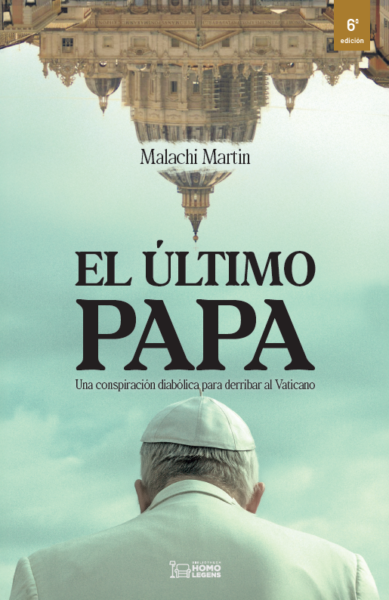
Malachi Martin, Jesuit, exorcist, and witness to the Council from within, left written in The Last Pope the novelized chronicle of an ecclesiastical betrayal that he claimed was 85 % real. A Vatican thriller of 774 pages to be read in one sitting under the August sun.
On 29 June 1972, in the homily for the solemnity of Saints Peter and Paul, Paul VI uttered a phrase that, sixty years later, still resonates like an open wound: he had the feeling that “through some crack the smoke of Satan had entered the temple of God.” He was not speaking in poetic metaphor. He was speaking of doctrinal confusion, of doubt, of a crisis that was devouring the Church from within. That pope who had closed the Council with hope now beheld, barely seven years later, a landscape he no longer recognized.
There is a book that turns that intuition into plot. It is titled The Last Pope, written by Malachi Martin —Irish Jesuit priest, doctor in Semitic languages from Louvain, archaeologist of the Dead Sea Scrolls, secretary to Cardinal Bea during Vatican II, and later an exorcist in New York— and Homo Legens has rescued it for the Spanish reader. It is a novel. Yet its author maintained until his death in 1999 that it was “85 % based on real events,” and that many of its characters had existed, even though he gave them fictional names.
The opening is unforgettable. The year 1963. In a chapel of the Vatican—and simultaneously in another in the United States, linked by telephone—a ceremony of Lucifer’s enthronement takes place, attended by cardinals and bishops. Martin recounts it with a liturgical coldness that chills: the inverted blessing, the pentagram, the litanies to the serpent. It is not gratuitous sensationalism. It is the gateway to a thesis: if the smoke of Satan entered the Church, someone opened the window.
From that point, the novel unfolds thirty years of conspiracy. A network of clerics, politicians, and financiers—united by Freemasonry, globalist delusion, and submission to evil—works to make the Catholic Church renounce its identity as the Bride of Christ and place itself at the service of a world government. Only one obstacle stands in the way: a Slavic pope, deeply spiritual, besieged within his own curia and pressured to sign his resignation. For the decisive move, that pope places his trust in a young American priest.
At the heart of the book, the fictional pontiff himself echoes Paul VI’s phrase and makes it his own:
“I recently mentioned to Father Angelo that I have long suspected my predecessor was right when he spoke of the smoke of Satan having penetrated the Church. Today I am convinced of it.”
It is not a cultured nod: it is the keystone of the entire work. Martin writes from the conviction that the crisis of the contemporary Church is not merely human—lukewarmness, lust for power, worldliness—but also supernatural. The battle is real and has two fronts. That is his narrative wager and, for many of his readers, also his diagnosis.
Martin was a controversial author, and not a few of his extra-literary claims have been questioned. Yet as fiction it works with devastating effectiveness. Those who seek enjoyment will find here a thriller of sustained pace, meticulously documented in its ecclesiastical setting, that is read with the same avidity as the best suspense novels.
It runs to 774 pages. Precisely for that reason it is summer reading: the book that only leisure allows one to tackle without haste, the one begun on a deckchair and not put down until evening falls. A summer offers much. It offers, for example, the chance to read in one sitting the most unsettling novel ever written about what is happening to the Church from within.
And, upon closing it, to return to the 1972 homily with a different gaze. Because the question Paul VI left hanging in the air—through what crack did the smoke enter?—still has no comfortable answer. Martin does not answer it. But he formulates it with a force that, more than twenty-five years after his death, has lost not an ounce of its relevance.
The Last Pope, by Malachi Martin. Bibliotheca Homo Legens. Translated by Enric Tremps. Available in bookstores and at homolegens.com.