


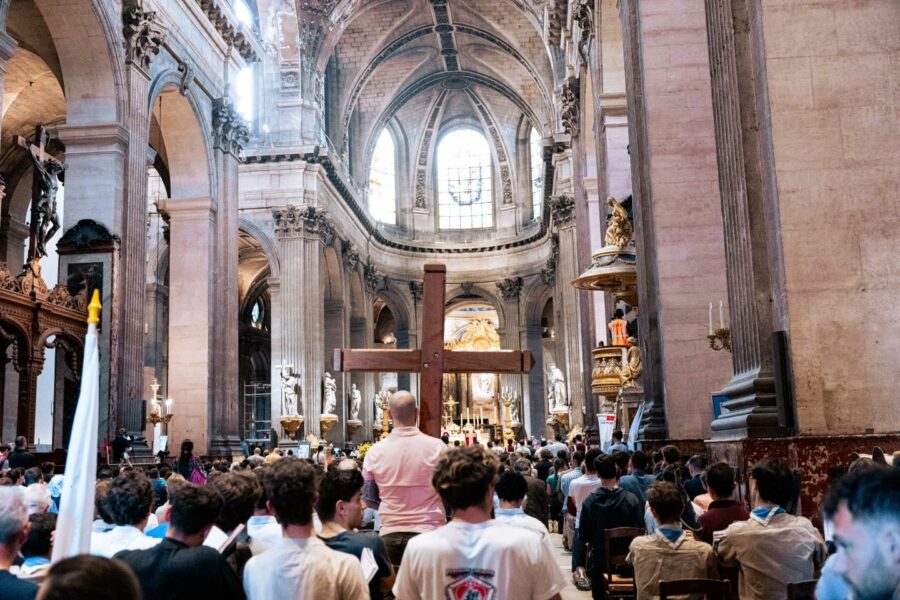
Four months after Pope Leo XIV asked the French bishops to seek “concrete solutions” to welcome more generously the faithful attached to the Vetus Ordo, the president of Notre-Dame de Chrétienté, Philippe Darantière, considers that this appeal has had hardly any practical consequences. In his view, the application of Traditionis Custodes continues without substantial changes, and many communities still face difficulties in developing their liturgical and pastoral life.
In an interview given to the French outlet Tribune Chrétienne, Darantière states that responsibility now lies mainly with the bishops. “We are no longer under Francis,” he maintains, before asking what prevents the French episcopate from adopting a more open attitude toward the faithful of the traditional liturgy while awaiting a possible decision from Rome.
Five years after Traditionis Custodes
The head of Notre-Dame de Chrétienté, the association that organizes the annual traditional pilgrimage from Paris to Chartres and is part of the Union Lex Orandi, asserts that the balance of the five years since the publication of Traditionis Custodes remains negative.
He explains that, in various French dioceses, priests of the Priestly Fraternity of St. Peter have been removed from their apostolates, and numerous communities have lost not only the daily celebration of Mass according to the 1962 Missal, but also other pastoral activities such as adult catechesis, conferences, or scout groups. Added to this, he says, are the restrictions imposed on several traditional pilgrimages and the ongoing difficulties faced by initiatives such as Nosto Fe in having their liturgical identity recognized.
Although he acknowledges that there are dioceses where these faithful are fully integrated, such as Bordeaux or Versailles, he considers these to be exceptional cases within the French landscape.
“We have seen no changes”
Asked about the letter sent on March 18 by Cardinal Pietro Parolin on behalf of Leo XIV, Darantière laments that, four months later, he perceives no change of attitude on the part of the French episcopate. He recalls that, after the last plenary assembly held in Lourdes, several bishops took for granted that the application of Traditionis Custodes would remain unchanged.
Nevertheless, he positively values the initiative of Bishop Philippe de Cagny, Bishop of Évreux and head of Liturgy at the French Episcopal Conference, to open a reflection on issues such as Tradition, the sense of the sacred, or Christendom. In his opinion, dialogue is necessary because there is a profound mutual ignorance between the episcopate and the communities attached to the Vetus Ordo.
The contradiction behind the Écône consecrations
Darantière also refers to the episcopal consecrations celebrated by the Society of St. Pius X in Écône on July 1 and to the subsequent appeal by the French bishops for their faithful to return to full communion with the Church.
In his view, that message loses force while many Catholics fully united with Rome who regularly participate in the traditional liturgy continue to encounter obstacles to integrating normally into some dioceses. “How can that invitation be understood if those who are already in full communion still have difficulties finding their place?” he asks.
In this context, he maintains that only an explicit gesture from Leo XIV will definitively close this chapter. As possible paths to a solution, he recalls the proposals recently put forward by various Church figures: the recovery of the Ecclesia Dei commission, advocated by Cardinal Gerhard Müller; the revision of Traditionis Custodes, requested by Cardinal Kurt Koch; or the creation of a specific ecclesiastical structure for the faithful attached to the traditional liturgy, proposed by Father Marie-Michel de Blignières.
“Come and see”
As a message directed to the French bishops, Darantière invites them to personally experience the reality of these communities. “Come and see,” he summarizes, explaining that he has already invited a bishop to preside over the adoration of the Blessed Sacrament that will conclude the Chartres pilgrimage at Pentecost 2027.
In his opinion, a large part of the prejudices toward the faithful of the Vetus Ordo stem from identifying the reception of the Second Vatican Council with acceptance of the subsequent liturgical reform. He argues that traditional communities receive the Council “in the light of the Church’s Tradition” and maintains that the real challenge is not the existence of dynamic groups attached to the traditional liturgy, but a certain interpretation of the so-called “spirit of the Council,” which, he claims, has contributed to the alienation of numerous generations from the faith.
Darantière concludes by reiterating the invitation issued by Leo XIV in his March 18 letter, in which the Pope asked both sides to look at each other “with a greater understanding of the other’s sensibility.” For the president of Notre-Dame de Chrétienté, this change of perspective is the first step toward living liturgical diversity within the unity of the Church and toward the French bishops giving an effective response to the Pontiff’s appeal.