


The cinematic adaptation of The Odyssey, directed by Christopher Nolan, has ended up becoming more than just one of the year’s major releases. The film has sparked an intense debate about adapting the classics in an industry that has grown accustomed to reinterpreting them through contemporary categories and ideological lenses.
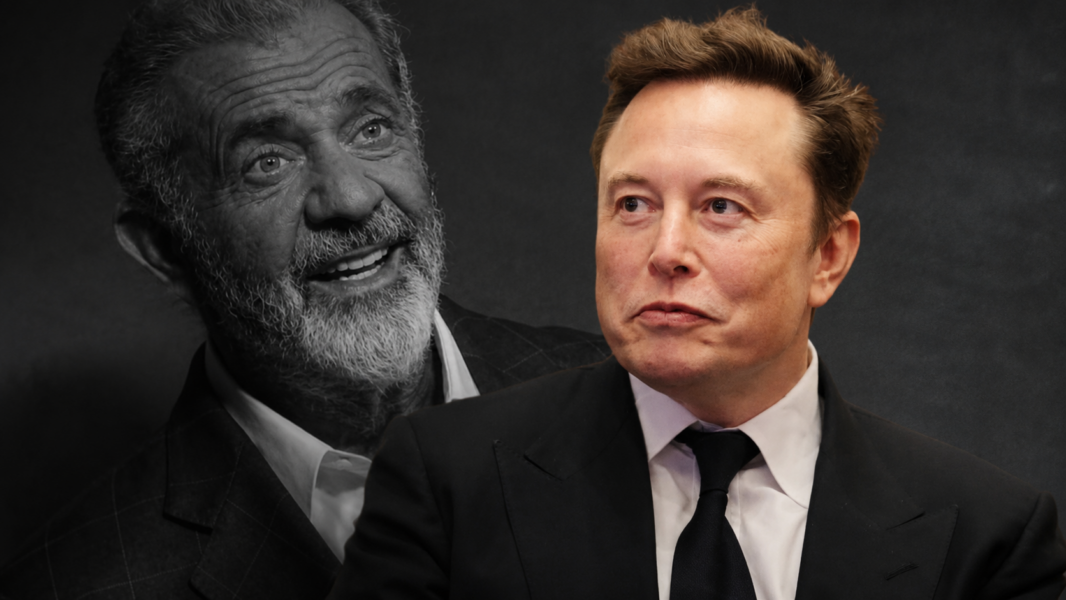
Amid this discussion, Elon Musk weighed in with a brief comment on his social media platform X, replying to a user who proposed that the entrepreneur fund with 100 million dollars a new version of The Odyssey directed by Mel Gibson, made with historically accurate ships, armor, weapons, and costumes, a cast consistent with the Homeric world, and dialogue taken directly from the poem and spoken in ancient Greek. Musk simply replied: «I’m down» («I’m in»).
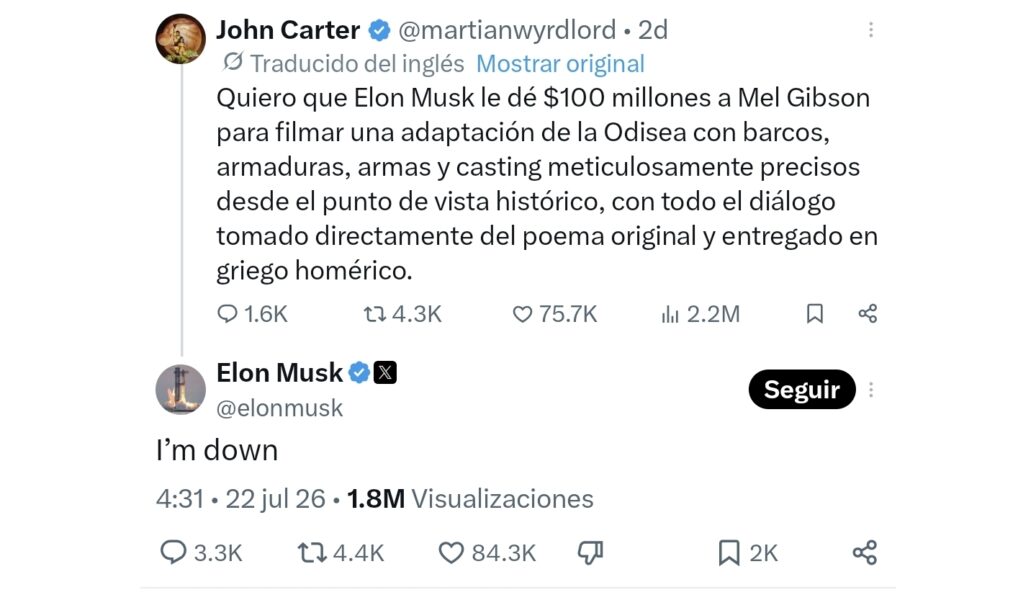
It is not an announced project or a funding commitment. But it is an explicit endorsement of an idea: that of adapting a classic once again while respecting the classic.
Adapting a classic beyond the cast
Every adaptation involves changes. Virgil reinterpreted Homer to place the epic at the service of Rome’s birth; Dante engaged with Antiquity from a Christian worldview; Shakespeare transformed chronicles and earlier tales to speak to the people of his time. Cinema, too, has produced great adaptations that alter characters, settings, or events without betraying the spirit of the original work.
Adapting has never meant copying literally.
The problem is not the existence of adaptations, but the way they are understood. In much of the cultural industry, the idea has taken hold that the classics must be corrected to fit contemporary ideological discourse. It is no longer enough to translate a story into a new artistic language; the vision of humanity contained in that story is now expected to be revised.
Various critics argue that The Odyssey adapts not so much the Homeric poem as a contemporary reading of it. The clever, ambiguous, adventure-loving Odysseus described by Homer appears transformed into a trauma-marked hero; Penelope acquires traits of modern psychological drama; and much of the religious universe that structures the epic—the intervention of the gods, sacred hospitality, or the heroic sense of existence—is relegated to the background.
It is not merely a matter of altering historical or aesthetic details. The impression shared by many of its detractors is that the story ceases to express the anthropology proper to the Homeric world and becomes a vehicle for categories belonging to the twenty-first century.
The fatigue of deconstruction
For years, this kind of reinterpretation was presented as a sign of creativity and modernity. The label «woke» ended up becoming the symbol of a way of understanding culture in which the great narratives of the past seemed to require permanent ideological updating.
Although that phenomenon has lost much of the momentum it had just a few years ago, the fatigue it has left behind remains evident. It is increasingly common to find viewers who do not demand «modernized» versions of Homer, Shakespeare, or Tolkien, but adaptations capable of respecting the internal logic of the original works.
The reception given to the proposal backed by Musk seems to respond precisely to that sensibility. Not so much because Mel Gibson is considered the only director capable of filming The Odyssey, but because he symbolizes a different way of approaching the classics: understanding the work first before attempting to reinterpret it.
Why Mel Gibson?
It is no coincidence that the Australian director’s name has emerged as a nominee.
In The Passion of the Christ, Gibson chose to shoot the dialogue in Aramaic and Latin, forgoing English to reinforce the historical authenticity of the story. In Apocalypto he again opted for a similar cultural immersion, using entirely the Mayan language and a cast made up mostly of indigenous actors.
That concern for the historical and cultural context of the stories he brings to the screen has made Gibson, for many viewers, the natural candidate to tackle an epic like The Odyssey without turning it into a mere pretext for telling another story.
A debate that goes beyond cinema
It is clear that the possibility of an Odyssey directed by Mel Gibson is no more than an idea that arose on social media. The director, moreover, has just finished shooting The Resurrection of Christ, the long-awaited sequel to The Passion of the Christ, whose release is planned in two parts during 2027 and 2028.
However, Elon Musk’s comment has served to highlight a sensibility that probably transcends this particular film.
The question does not affect only Homer. It is the same discussion running through art, architecture, music, and also the life of the Church today. When a tradition ceases to be seen as a heritage to be understood and transmitted and becomes instead a surface onto which the—distorted—categories of the present are projected.
Perhaps that is why Musk’s comment has found so much resonance. Not because people expect an archaeological reconstruction of Mycenaean Greece, but because it opens the way to a deeper intuition: that true creativity does not always consist in destroying tradition, but sometimes in having the humility to let tradition question us.