


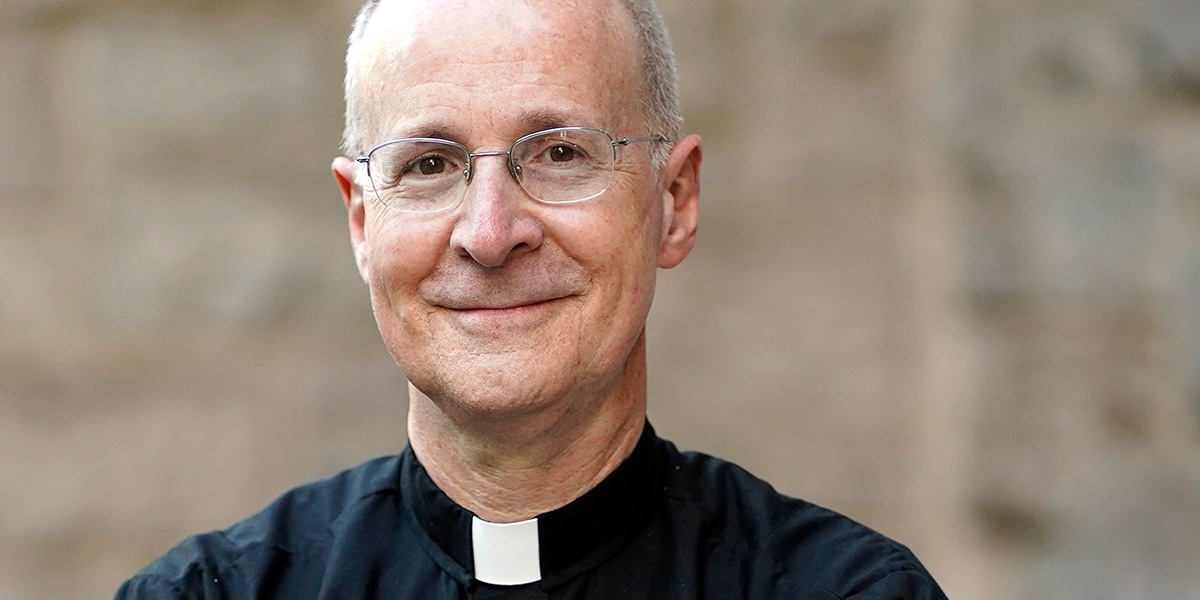
The controversial Jesuit James Martin has just published in Outreach an article regarding the recent document Do You Know Them to be Worthy?, by Fr. Thomas Berg and psychologist Timothy Lock, on the admission of candidates to the seminary. His argument fits into a single sentence: if a specific homosexual man can live celibacy faithfully—and Martin claims to know dozens who do—why close the doors of the priesthood to him?
Framed this way, the question seems unanswerable. Martin reduces to a problem of individual biographies what is, above all, a problem of institutional functioning. No one disputes that there are holy and celibate homosexual priests. What needs to be discussed is something else: what mechanism is set in motion in a male, celibate, and closed institution when a particular inclination progressively becomes its dominant tone. We will call that mechanism the vocational gear.
How a priest is recruited
To understand it, no theology is needed: basic sociology suffices. Two classic findings underpin the entire reasoning.
The first is the principle of homophily: people group together with those they perceive as similar. It is one of the best-documented regularities in the social sciences (McPherson, Smith-Lovin and Cook, Annual Review of Sociology, 2001). The second is the Attraction–Selection–Attrition model of organizational psychologist Benjamin Schneider («The People Make the Place», 1987): organizations attract those who resemble their internal culture, select those who fit into it, and expel through attrition those who do not. The result: every organization, if no one corrects it, homogenizes itself, in a loop. No one needs to intend it.
Now let us apply this to the priesthood, which brings together three conditions that turn that loop into a precision lathe:
First: vocation is born through personal contagion. No one becomes a priest by reading a job posting in the official gazette or a vacancy on InfoJobs. Vocation is almost always awakened by looking at a specific priest—the parish priest, the chaplain—and wondering, even wordlessly: «Can I see myself being like him?» The priest is, whether he wants to be or not, an existential recruiter. And a particular priestly register—in sensibility, in liturgy, in the way of inhabiting one’s own masculinity—will attract young men who feel comfortable in that register and will be illegible to everyone else.
Second: the seminary is almost a total institution, in the sense Erving Goffman gave the term: one lives, studies, prays, and rests within the same human perimeter for years. There the internal culture is not just one more factor: it is the air one breathes. Whoever does not breathe comfortably leaves. «Attrition» operates with maximum efficiency.
Third: celibacy removes the external counterweight. The lawyer or the doctor lives their affective life outside the office: wife, children, family. The celibate priest does not. His affective world is played out to a great extent within the presbytery. The internal subculture thus becomes the decisive filter of who enters, who perseveres, and who leaves.
The gear in motion
It is enough for a subculture to consolidate in a seminary for it to begin manufacturing, cohort by cohort, its own vocational offspring.
Put the three pieces together and the gear starts turning on its own. If a homosexual subculture or one of markedly kindred sensibility consolidates in a presbytery or seminary, that subculture operates as a vis attractiva: it attracts vocations comfortable in that register, makes the environment inhospitable for the others, and each new class reinforces the effect on the next. No intention, conspiracy, or proselytism by anyone need be assumed: it is pure institutional mechanics, the same that homogenizes faculties, newsrooms, or elite corps. With one aggravating factor: past a certain threshold, the process becomes almost irreversible by ordinary means, because those who should correct it—formators, rectors, bishops—come themselves from previous cohorts of the gear.
Evidence? Available studies on the U.S. clergy—from the Los Angeles Times survey of 2002 to the work of sociologist Paul Sullins (2018)—point to a homosexual presence in the priesthood far higher than in the general population, and moreover concentrated by classes and by seminaries. That clustered pattern is not what chance produces: it is exactly the trace left by a mechanism of local selection. And Martin himself provides, without realizing it, the most eloquent datum in his article: the seminarian in Rome who calculates that «half» of his classmates are homosexual. If the datum were true, it would not describe a sum of individual cases. It would describe a gear in an advanced phase.
Why Rome was right
This is where the theoretically valid (and practically ignored) discipline reveals its deep logic. The 2005 Instruction and the Ratio Fundamentalis of 2016 (nn. 199-201) do not admit to the seminary men with «deeply rooted homosexual tendencies» or those who «support the so-called gay culture.» Read through the lens of the vocational gear, that norm is not a judgment on anyone’s dignity or on their ascetic capacity. It is a norm of gear protection: it preserves the presbytery’s capacity to continue eliciting vocational identification in young people in general, and not only in one segment. In this framework, heterosexuality does not function as a moral merit of the candidate, but as a functional quality of the priestly body: the condition that keeps the door open to all vocations and brakes the endogamous drift. A sensu contrario: without that criterion, the gear turns without a brake.
Martin’s best cards, and why they do not win
Honesty requires taking the Jesuit’s arguments seriously; they are not bad.
«I know dozens of holy and celibate homosexual priests». Granted without reservation. But from achieved individual cases nothing follows about the dynamics of the whole, just as the existence of nonagenarian smokers does not lead to a health policy. Admission norms are judged at the institutional level, not the biographical. That leap of level is the fallacy that sustains Martin’s entire article.
«The Catechism (n. 2359) says that the homosexual person can approach Christian perfection». True, and no one denies it. But the universal call to holiness is not equivalent to suitability for a specific state. The Church also does not ordain those who lack other functional qualities, and no one sees in that a judgment on their possible holiness. The vocation to perfection and institutional fitness are distinct planes.
«Exclusion pushes people into clandestinity, and that is a recipe for disaster». This is his best card, and it describes a real problem: the double life, secrecy, vulnerability to blackmail. But note the reader: it is an argument about the costs of applying the norm, not against its foundation. And it admits the inverse reading: that massive clandestinity Martin describes is the symptom that the gear turned for decades without a corrective criterion. Not proof that the criterion is excessive, but that it arrived late.
The complete question
Martin asks: «Can this man model Christ by living celibacy faithfully?» It is a necessary question, but incomplete, because an ordination does not exhaust its effects in the ordained: each ordination modifies the ecosystem that will generate the following vocations. The complete question is twofold. His, and this other: What presbytery are we composing, and whom will that presbytery be capable of calling within a generation?
The discipline of 2005 and 2016 answers that second question. Its application may be debated; what cannot be done is to dismiss its logic without having understood it. And understanding it requires something the Outreach article never does: lift one’s gaze from individual biographies and look at the gear of a wounded institution that must rethink its structural foundations of survival.